
Jassper Shipping to Invest US$50M, Puts India at Center of Global Push
Source: PR Newswire
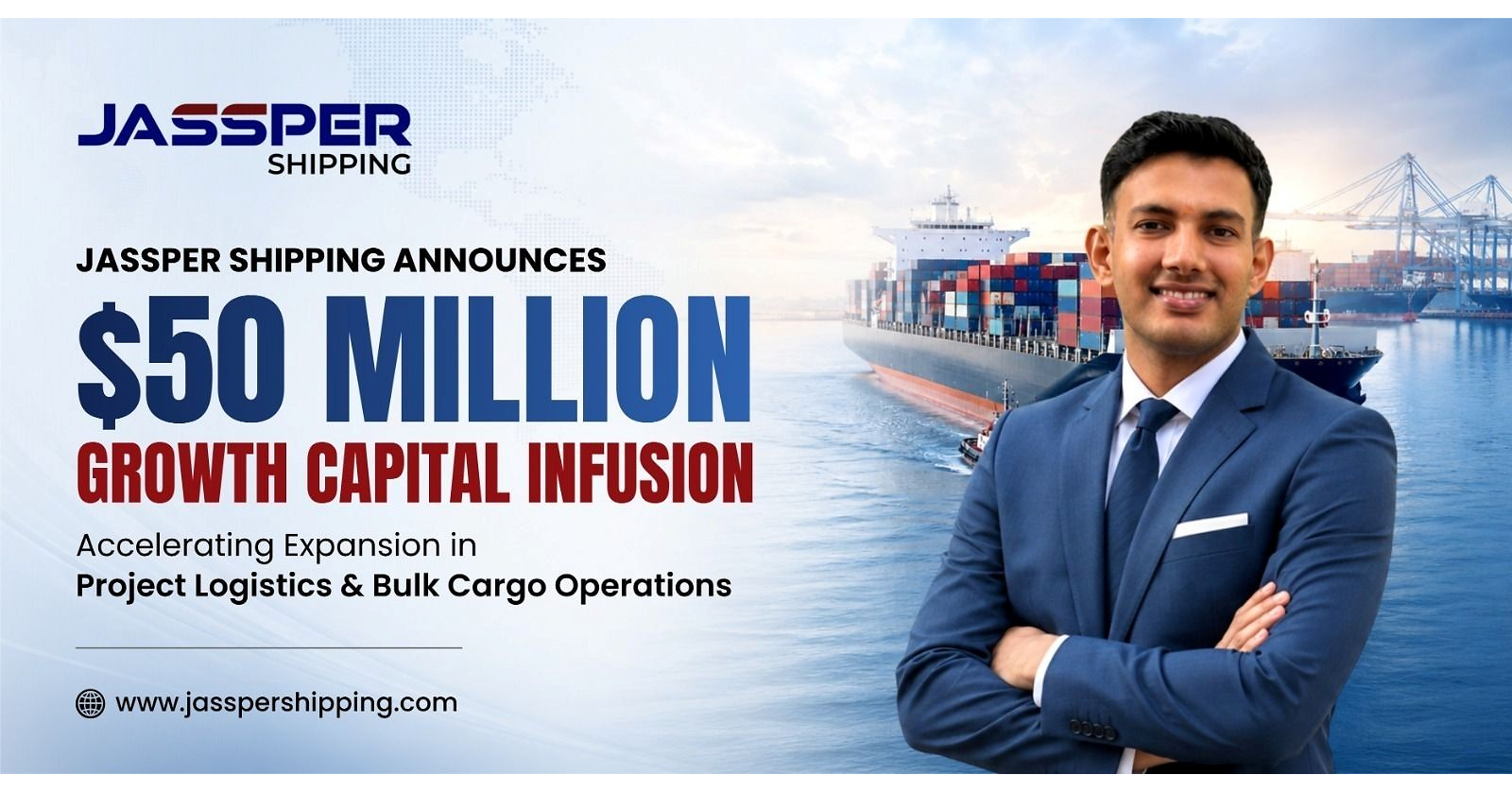
Jassper Shipping announced a growth-capital programme of up to $50 million over three years, subject to market conditions, regulatory approvals and internal authorizations, with an initial $10 million allocated to its B2B project-logistics business. The investment targets Indian infrastructure, manufacturing, power, steel, petrochemicals and heavy engineering, while expanding supply-chain links across the Gulf, Southeast Asia, Africa, the Red Sea and the Far East. India’s major ports handled 915.17 million tonnes in FY2025-26, up 7.06% year on year, supporting the company’s outlook for specialized cargo and industrial-logistics demand.
Analysis
This is not independently investable news: a privately held operator's proposed capital program is too small to alter capacity, pricing, or earnings for listed logistics incumbents. The useful signal is directional—specialized project-cargo demand is likely tightening ahead of conventional container logistics where cargo requires engineering, multimodal permits, heavy-lift equipment, and assured port-to-site execution. That favors asset-linked Indian incumbents such as Adani Ports (ADANIPORTS) and Container Corp. of India (CONCOR) only if volume growth translates into higher rail/terminal utilization rather than capacity-led competition.
Near term (days to 1-3 months), there is no reason to chase listed logistics equities from this announcement. The disclosed spending is conditional and execution-dependent, while project logistics is lumpy: a few delayed refinery, power, or EPC awards can materially defer demand. Monitor Indian EPC order intake, port throughput mix, and freight/charter rates; generalized cargo-volume growth without a rise in project-cargo yields would be a weak earnings catalyst.
Over 6-18 months, the more consequential second-order effect is corridor fragmentation. India-Gulf industrial supply chains can increase demand for multimodal and breakbulk capacity, but Red Sea disruption can also convert volume growth into working-capital stress and schedule penalties for smaller forwarders. Larger, balance-sheet-backed platforms can gain share if customers prioritize execution certainty; conversely, normalization of Red Sea transit or a slowdown in Indian private capex would compress the scarcity premium embedded in logistics valuations.
The contrarian view is that markets may over-attribute infrastructure spending to port operators. Much of incremental project cargo is low-frequency, contract-priced, and may bypass broad terminal economics through dedicated berths, direct chartering, or captive logistics. The better equity read-through is not headline capex announcements but sustained utilization, pricing, and return-on-capital improvement at listed operators.
AllMind Terminal
AI-powered research, real-time alerts, and portfolio analytics for institutional investors.
Request TrialMarket Sentiment
Overall Sentiment
moderately positive
Sentiment Score
0.48
Key Decisions for Investors
- No immediate position based solely on this release; treat it as a watch signal rather than a catalyst, given the private issuer, conditional funding, and immaterial scale versus listed transport platforms.
- Build a 1-3 month monitoring basket of ADANIPORTS, CONCOR, and DELHIVERY; upgrade only if quarterly volume growth is accompanied by pricing/yield expansion and management raises FY27 capex or EBITDA guidance.
- Prefer ADANIPORTS over DELHIVERY if Indian industrial/project-cargo indicators accelerate: port and integrated-logistics assets offer more direct exposure to heavy industry, while last-mile parcel economics have limited sensitivity to project logistics.
- Use a risk trigger for any India logistics long: reduce exposure if Indian EPC order awards weaken for two consecutive months, Red Sea routing normalizes sharply and freight yields fall, or company guidance indicates utilization gains are being offset by new capacity.
- For global portfolios, avoid extrapolating this into a broad freight-rate long such as ZIM or DAC; project-cargo demand and container-liner pricing are different markets, and an easing in Red Sea disruption would be a more important driver of those equities.
More News
- Are global oil reserves sufficient to withstand renewed US-Iran war?
- France is flashing euro crisis signals. This time, the fault lines are different
- EU entering winter with lowest gas reserves on record, IEA boss warns
- OpenAI Trims Target Value & Volvo Cars Cuts 2,500 Jobs
- Russia and Ukraine trade fresh strikes despite renewed push for U.S.-brokered peace talks
- U.S. oil holds above $100, Brent at five-month high as Iran says it’s prepared for warfare