
GAPVelocity AI Launches VELO for VB6 to Modernize Legacy Applications for Azure
Source: PR Newswire
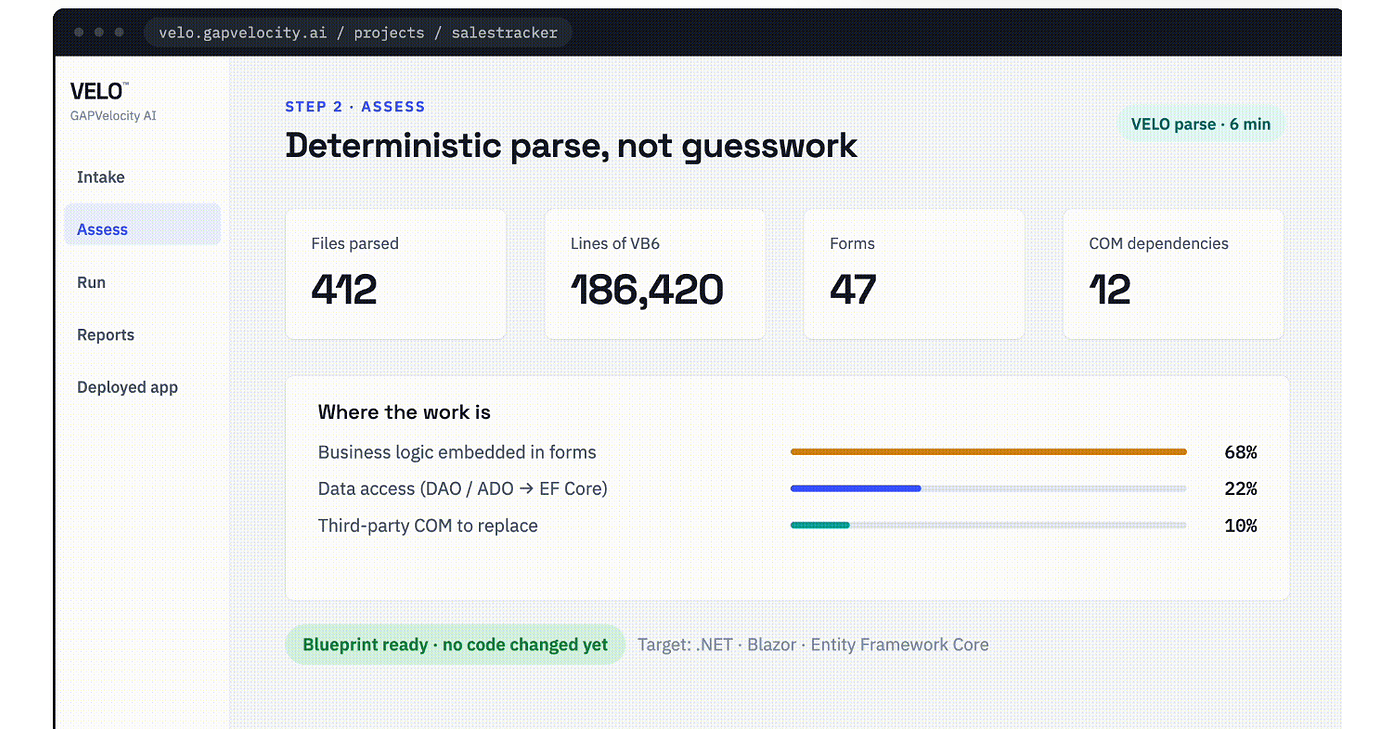
GAPVelocity AI launched VELO for VB6, an agentic AI managed service that converts Visual Basic 6 applications into Blazor and C# .NET applications for Microsoft Azure at a pre-agreed fixed price. Built on Microsoft Foundry, the platform uses specialized agents to inventory, architect, convert and validate legacy applications while preserving embedded business rules. Self-service access is planned for November, following the current managed-service launch.
Analysis
The investable read-through for MSFT is not direct revenue from a small partner launch, but incremental Azure/Fabric/Foundry workload capture once modernization projects move from code conversion into production hosting, identity, databases, observability and ongoing AI tooling. The economic value is therefore back-end loaded: migration assessments may create near-term pipeline, while meaningful cloud consumption would emerge over 6-18 months only if converted applications become production workloads rather than one-off rewrites. This is directionally supportive of Azure's legacy-estate conversion moat, but immaterial to consolidated MSFT estimates absent evidence of repeatable enterprise deployments.
The fixed-price model is a double-edged sword. It can lower procurement friction for CIOs with poorly documented applications, but it transfers dependency-mapping, ActiveX replacement, security remediation and post-conversion testing risk to the vendor; beta-ready code is not equivalent to production acceptance. The likely second-order pressure falls on labor-heavy modernization vendors such as ACN, EPAM, GLOB and CTSH if AI reduces billable conversion hours, although incumbent integrators can offset this through higher-value architecture, data migration, testing and change-management work.
Consensus may overstate the displacement effect from code-generation tools. The binding constraint in legacy modernization is usually undocumented workflows, integration testing and business-owner signoff, not raw code translation. A meaningful adoption signal would be disclosed conversion throughput, production acceptance rates, and Azure consumption per migrated application after the November self-service release; without those metrics, this is an ecosystem watch item rather than a catalyst for MSFT.
Near-term risk is that self-service availability exposes error rates or limits around proprietary controls and complex dependencies, reinforcing enterprise preference for services-led migrations. The thesis is falsified if customer references show migrations remaining on non-Azure infrastructure, if deployment cycles fail to shorten materially, or if MSFT's Azure growth commentary shows no incremental legacy-modernization contribution over the next two earnings cycles.
AllMind Terminal
AI-powered research, real-time alerts, and portfolio analytics for institutional investors.
Request TrialMarket Sentiment
Overall Sentiment
mildly positive
Sentiment Score
0.32
Ticker Sentiment
Key Decisions for Investors
- No standalone MSFT trade on this announcement; maintain existing Azure-driven positioning and treat the November self-service release as a diligence catalyst, not an earnings-estimate catalyst.
- Monitor MSFT earnings calls over the next 1-3 months for quantified Azure AI/modernization workload commentary. Upgrade the signal only if management or partners disclose production deployments and recurring Azure consumption rather than assessments or code-conversion volumes.
- For a services-industry basket, watch ACN, EPAM, GLOB and CTSH for margin commentary on AI-assisted application modernization over the next 2-4 quarters. Consider a selective short only if utilization or pricing weakens while conversion automation is explicitly cited; do not pre-position on this press release alone.
- Use a relative-value framework rather than directional AI exposure: long MSFT versus a basket of labor-intensive IT-services names becomes actionable if self-service modernization demonstrates materially shorter project cycles and reduced conversion labor. Exit if integrators retain pricing through expanded architecture, testing and managed-service scope.
More News
- Investors react to Fed hike and market sell-off: Brace for 'higher for longer' rates
- Snap tries to bring AR glasses to enterprise market, partnering with Nvidia, AWS and Salesforce
- Hyperscaler debt signals warning sign, Apollo cautions
- Vistra vs. Constellation vs. Talen Energy: Which Nuclear-Heavy Stock Is the Better AI-Power Bet?
- Arcee AI trained four models for $20 million. Now, it’s worth $1 billion.
- Tenable at Piper sandler growth frontiers: ai fuels growth