
94% of U.S. Adults Concerned About the Frequency of Food Recalls, New GS1 US Survey Shows
Source: PR Newswire
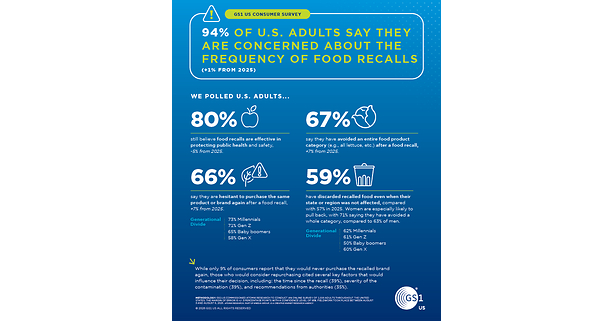
A GS1 US survey found 94% of U.S. adults are concerned about the frequency of food recalls (up from 93% in 2025), while fewer think recalls protect public health (80% vs. 85% in 2025). Consumer trust is weakening, with 67% avoiding an entire product category after a recall (vs. 60% in 2025) and 59% discarding recalled food even if unaffected locally (vs. 57%). The FDA’s FSMA Section 204 Food Traceability Rule requiring key data elements and 24-hour information upon request takes effect July 20, 2028, aiming to improve recall precision via better traceability and data sharing.
Analysis
This is not a broad consumer demand shock so much as a brand-trust and compliance-capex story. The near-term market impact is usually asymmetric: the company in the recall gets hit hard on mix, promo intensity, and shelf-space negotiations, while the broader category sees a slower but more persistent drag as shoppers substitute away from the whole aisle. That favors firms with cleaner traceability and stronger incident response; it hurts smaller food manufacturers and private-label-heavy suppliers that cannot rapidly isolate lots or afford the systems upgrade.
The second-order winner is the traceability stack rather than the headline consumer brands. 2D barcode adoption and item-level event capture create a multi-year upgrade cycle for packaging, labeling, scanning, and supply-chain software vendors; the spend is defensive, but it should be recurring once embedded. That points to names like ZBRA, AVY, and selected enterprise supply-chain software as beneficiaries into the 2028 compliance window, with the biggest upside if large CPGs move from pilot to enterprise rollout over the next 12-18 months.
For staples, the risk is not a single recall but a higher steady-state cost of doing business: more QA, more working capital in tighter lot control, and more promotional spend to rebuild trust after even minor incidents. That is a margin headwind for KHC, GIS, CPB, TSN, and similar brands, especially in categories with high consumer visibility and repeat purchase. The contrarian point is that the move may be underpriced in retailers with strong private label and data-enabled supply chains, because they can use transparency as a loyalty tool rather than just a compliance burden.
The catalyst path is slow: the article itself is not tradable, but every new recall between now and 2028 will reinforce the procurement case for traceability upgrades and increase pressure on laggards. What would falsify the thesis is a lack of spending conversion into actual vendor orders over the next 2-3 quarters, or evidence that regulators delay/soften enforcement; absent that, this is a structural rather than event-driven theme.
AllMind Terminal
AI-powered research, real-time alerts, and portfolio analytics for institutional investors.
Request TrialMarket Sentiment
Overall Sentiment
mildly negative
Sentiment Score
-0.18
Key Decisions for Investors
- Overweight ZBRA / AVY on weakness over the next 1-3 months as a multi-quarter compliance capex beneficiary; target 15-20% upside if 2D barcode and lot-level traceability rollouts broaden into enterprise purchasing cycles.
- Watchlist long MANH versus short a basket of vulnerable packaged-food names (KHC, CPB, GIS) into any sector-wide recall headline; the pair works only if brand-trust degradation persists beyond a single incident.
- Avoid chasing immediate moves in food manufacturers after recall news; wait 2-4 weeks for retailer scan data and management commentary to confirm whether category demand merely shifts or actually contracts.
- If a major retailer (WMT, KR, COST) publicly accelerates traceability adoption, consider it a signaling event for the whole supply-chain tech complex; that would be the cleanest catalyst to add to ZBRA/AVY.
- Set a thesis stop-loss on the traceability trade if 2027 budget cycles show no evidence of systems spending acceleration or if FDA implementation timing slips materially.
More News
- AI Capex, Gamble or Jackpot?: Market Snapshot
- Indonesia stocks suffer biggest daily slump since 1998 as MSCI weighs downgrade
- ‘I told you so’: China’s chip sector is making breakthroughs—and U.S. export controls are the reasons why
- UK's Healey Plans to Raise Bank Taxes
- One Singapore ship was sunk, but here's why others are still transiting the Strait of Hormuz
- Hybe shares jump 10% as K-pop sensation BTS' tour lifts earnings hopes