
One in Three U.S. Women Are Already Using AI for Skincare and Bodycare Advice, New Survey Finds
Source: PR Newswire
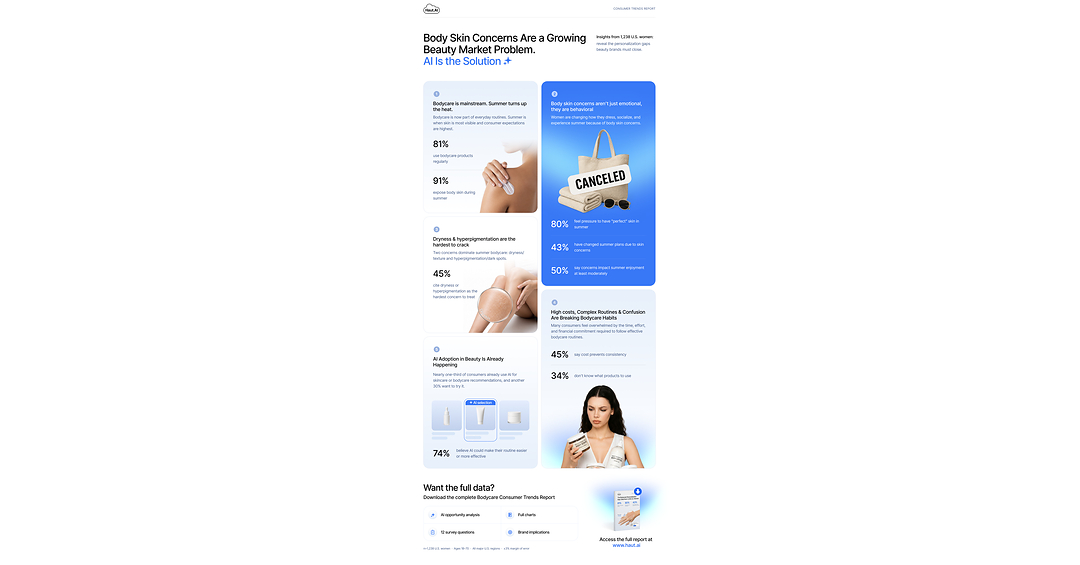
Haut.AI’s survey of 1,238 U.S. women finds 32% already use AI for skincare/bodycare advice, and 74% say AI could make routines easier or more effective. Trust drivers are strongest around product recommendations (50%) and personalized routines (34%), with 34% trusting AI to identify skin concerns from a photo. The article frames AI as moving from answering beauty questions to narrowing choices and guiding decisions, indicating growing consumer openness but no direct financial or market-moving catalyst.
Analysis
The actionable read-through is not that beauty demand is suddenly stronger, but that personalization is becoming a conversion layer. That favors retailers and brands with rich first-party data, large SKU breadth, and enough traffic to train recommendation engines; ULTA is better positioned than legacy wholesale-heavy brands because it can monetize guidance at the point of discovery and checkout, not just in marketing. The second-order winner is whoever can reduce choice overload into higher AOV and repeat rate; the losers are undifferentiated brands that rely on shelf presence rather than a measurable skin-concern solution.
Near term, this is mostly sentiment support, not an earnings catalyst. The survey suggests consumers want help making decisions, but there is a big gap between willingness to try AI and willingness to change spending behavior, especially when cost is already a barrier; that limits immediate revenue attribution. Over 1-3 quarters, the key metric is whether ULTA shows higher digital conversion, lower returns, or better loyalty engagement from personalization features; without that, the market should discount this as inexpensive PR.
The contrarian view is that AI could commoditize recommendation discovery and shift power toward the platform with the best data, not the most famous brand. That creates a mild structural headwind for branded product economics if algorithms steer shoppers toward fewer hero SKUs and away from trial-heavy innovation, which would favor retailers and private-label over fragmented premium brands. For BDRFY, any benefit is likely indirect and modest unless its branded portfolio becomes materially better at surfacing specific ingredient/concern claims inside retailer AI flows.
AllMind Terminal
AI-powered research, real-time alerts, and portfolio analytics for institutional investors.
Request TrialMarket Sentiment
Overall Sentiment
mildly positive
Sentiment Score
0.15
Ticker Sentiment
Key Decisions for Investors
- Maintain a modest long bias in ULTA for 1-3 months as an AI-personalization beneficiary, but size it as a sentiment/engagement trade, not a fundamental re-rate; upside is better digital conversion and basket, downside is limited if the company fails to monetize the feature.
- Do not chase BDRFY on this print; treat it as a watch item for distributor/retailer merchandising gains rather than a direct earnings driver. Reassess only if retailer data shows share gain in targeted skincare/bodycare subcategories.
- Watch for ULTA management commentary on personalization KPIs over the next two quarters; if conversion, repeat purchase, or loyalty activity does not improve, fade the thesis and expect the market to reprice this as non-monetized AI theater.
- If you want a cleaner trade, pair long ULTA against a basket of lower-data, wholesale-dependent beauty exposure rather than buying the broader consumer discretionary complex; the edge is in first-party data monetization, not beauty demand beta.
- No action in CPSS or GAP from this item alone; the signal is too indirect. Use them only if broader consumer spending data later confirms a shift from apparel spending toward beauty/wellness.
More News
- There's one retail name that made Josh Brown's Best Stocks list that caught him by surprise
- Gap sees executive exit as catalyst to rebuild struggling Athleta unit
- Why is T-Mobile stock tumbling today?
- Why is Verizon stock sliding today?
- SpaceX wants to become a 'major mobile carrier' with low-band spectrum acquisition
- OpenAI projected to bring in $20bn less in revenue than expected