
HillFaith Highlights Congressional Aides' Perspectives on Autonomous Rideshare Vehicles in the Nation's Capital
Source: PR Newswire
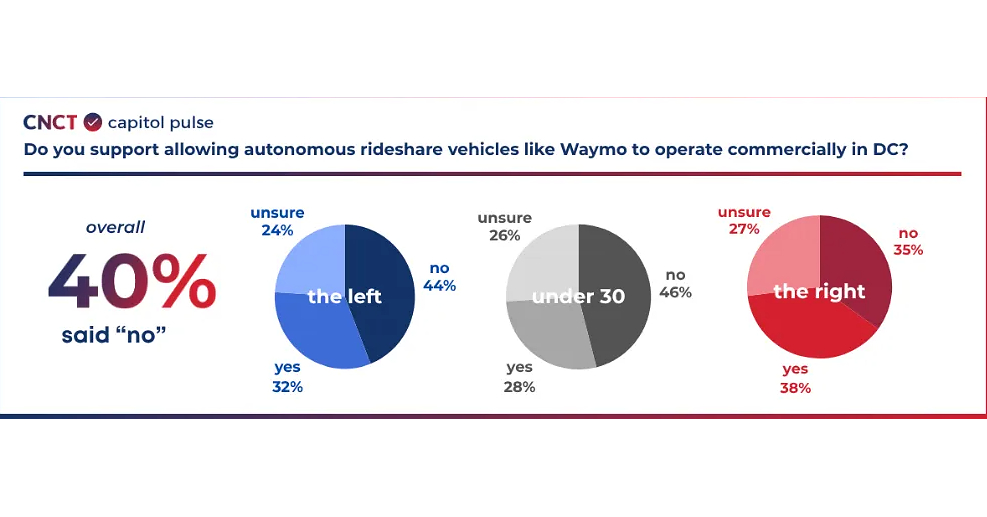
Survey results cited by HillFaith show 40% of congressional aides oppose (and 22% are explicitly unsure) driverless cab expansion in Washington, D.C., with only ~35% supportive of autonomous ridesharing operations. Opposition skews toward Democrats (44% of Democrats “no”) and Republicans are also divided (27% “unsure” within Republicans), reinforcing a cautious policy outlook. The news is likely to moderately affect sentiment around near-term municipal/state regulatory pathways for autonomous-vehicle deployments.
Analysis
This is less about Washington, D.C. itself and more about the signaling value of a politically sensitive micro-market. When staffers around the legislative process lean skeptical, the near-term effect is not lost rides in one city; it is slower permit velocity, more cautious public-safety language, and a higher bar for any operator seeking to argue that autonomy is ready for dense urban deployment. That raises the probability that federal attention becomes a friction point for commercialization, which matters most for the names whose valuation still embeds a fast robotaxi ramp.
The relative winners in the next 1-3 months are the incumbents that monetize human drivers and dispatch infrastructure today, especially UBER and, to a lesser extent, LYFT. The losers are the AV option-value names whose upside depends on regulators letting them scale before the market grows impatient; GOOGL’s Waymo exposure is structurally better funded, but the multiple can still compress if the path-to-scale narrative lengthens. The bigger second-order effect is that a slower rollout extends the life of the current ride-hailing oligopoly and delays any margin substitution from driver labor to software.
The contrarian read is that this survey is a sentiment snapshot, not a regulatory event. D.C. is high-visibility but economically small, so the market should not extrapolate a local thumbs-down into a national adoption stall unless it is followed by actual hearings, permit denials, or a safety incident. If there is no adverse headline in the next 1-3 months, the right trade is likely to fade the skepticism rather than press it.
AllMind Terminal
AI-powered research, real-time alerts, and portfolio analytics for institutional investors.
Request TrialMarket Sentiment
Overall Sentiment
mildly negative
Sentiment Score
-0.25
Key Decisions for Investors
- No immediate standalone trade on this survey alone; keep it as a watch item and wait for an actual D.C. permitting action or federal AV safety guidance before putting risk on. Falsifier: a formal pilot approval or a clean operating record in another dense city over the next 30-60 days.
- Tactical relative-value: long UBER / short TSLA into any spike in robotaxi skepticism. UBER benefits from a longer runway for human-driven supply and dispatch monetization, while TSLA’s AV option value is more sentiment-sensitive. Target 2:1 downside/upside over 1-3 months; trim if TSLA regains pre-headline levels on heavy volume.
- If the market sells off GOOGL on broad AV fears, use weakness to add selectively rather than chase the short. Waymo’s commercialization risk is regulatory timing, not demand, so a dip that is not accompanied by adverse permit news is likely an entry point for 6-18 month patience.
- Prefer UBER over LYFT on any 'slower AV adoption' thesis. Both get a longer human-driver window, but UBER has the scale and cross-selling power to convert delay into margin durability; LYFT remains more vulnerable if the market interprets slower autonomy as simply extending a weaker incumbent structure.
- Set an alert for any D.C. council hearing, DOT statement, or safety incident involving autonomous rides. That would be the real catalyst path; absent that, this is noise and should not drive sizing.
More News
- Indonesia stocks suffer biggest daily slump since 1998 as MSCI weighs downgrade
- One Singapore ship was sunk, but here's why others are still transiting the Strait of Hormuz
- Order to limit Starshield for Ukraine came from inside White House: Reuters reports
- CoreWeave credit default swaps hit distress levels as investors sour on AI debt
- Taiwan to curb AI chip sales to China for more U.S. alignment- Bloomberg
- Giant Taiwanese chipmaker TSMC confirms it’s in talks with Elon Musk to join ‘Terafab’ complex in Texas: ‘The AI market continues to be very strong’