
UpCodes' AI Reviews 1,300+ Plan Sets, Identifying More Than 180,000 Potential Issues
Source: PR Newswire
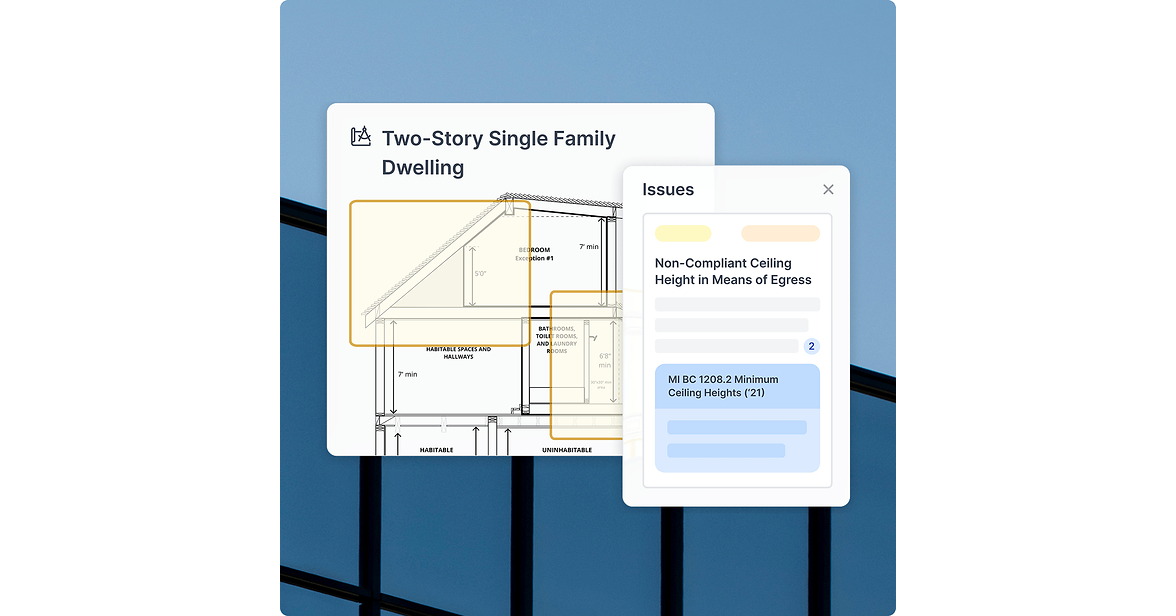
UpCodes said its AI Plan Review, launched in June, has reviewed more than 1,300 construction plan sets and identified more than 180,000 potential issues, surfacing an estimated average of over $1 million in potential construction-error costs per project. The reviewed sets spanned 73 jurisdictions and 14 code editions; plans averaged 21 critical issues, and 46% of critical issues involved life-safety systems. The company notes the tool provides first-pass analysis and does not replace licensed design-professional review or regulatory approval.
Analysis
The investable signal is not the vendor’s headline estimate of avoided costs; it is whether AI review becomes a repeatable, budgeted workflow rather than an optional QA layer. UpCodes’ estimate is company-generated and measures potential exposure, not realized savings, customer ROI, or revenue. First-pass review also leaves licensed professionals and permitting authorities accountable, limiting near-term labor substitution and making accuracy, auditability, and liability allocation adoption gates.
Over 1–3 months, this is a modest product-validation datapoint, not evidence of material earnings change for public software vendors. Over 6–18 months, successful integration into design and construction workflows could raise the value of connected project data and favor platforms such as Autodesk, Bentley Systems, and Procore if they can offer reliable review inside existing tools. Conversely, standalone code-checking features risk becoming bundled or copied; workflow distribution may matter more than model access. Earlier issue detection could reduce rework but may initially increase design-phase review and correction activity, so the economic benefit may accrue to owners and project budgets before it appears in design-firm margins.
The contrarian point: issue counts and estimated construction exposure are not proof that the system catches issues humans miss, avoids costly rework, or works consistently across jurisdictions. A false negative on life-safety review could slow adoption or create liability concerns; false positives could add labor and erode trust. No direct public-equity trade is justified on this announcement alone. Validate paid adoption, renewal rates, independently measured detection precision/recall, and realized project savings before underwriting a structural earnings effect.
AllMind Terminal
AI-powered research, real-time alerts, and portfolio analytics for institutional investors.
Request TrialMarket Sentiment
Overall Sentiment
mildly positive
Sentiment Score
0.35
Key Decisions for Investors
- No trade on the press release alone; UpCodes is not identified as a public issuer in the supplied data, and the announcement does not establish a material earnings catalyst for public peers.
- Put Autodesk, Bentley Systems, and Procore on a 1–3 month monitoring list. Look for evidence of embedded AI review, customer conversions, pricing, and measurable workflow usage—not feature announcements alone.
- For a 6–18 month thesis, require independent evidence of reduced rework or review time and acceptable false-positive/false-negative rates across jurisdictions. If those metrics emerge alongside paid adoption, reassess the workflow-platform beneficiaries; if not, treat this as a limited feature rather than a sector-wide productivity catalyst.
- Falsifiers: customer pilots fail to convert or renew, review errors trigger professional or permitting pushback, or adoption requires substantial human checking that offsets time savings.
More News
- South Korean carmaker Hyundai plans 'strategic' investment of $15.5 billion in India by 2032
- Applied Materials’ $5 billion AI lab aims to cut chip development time in half—and restore Silicon Valley’s edge
- Wells Fargo CFO on Earnings, Deals, Consumer Strength
- Bank of America hit with more than $1.2 billion in penalties over money-laundering violations
- China's exports likely grew by double-digits in September
- Meta’s Muse models reach the AI frontier—and kill any hopes to ‘pace’ it