
DB's 2028 Targets Gain Traction: What's Driving Growth Momentum?
Source: zacks.com
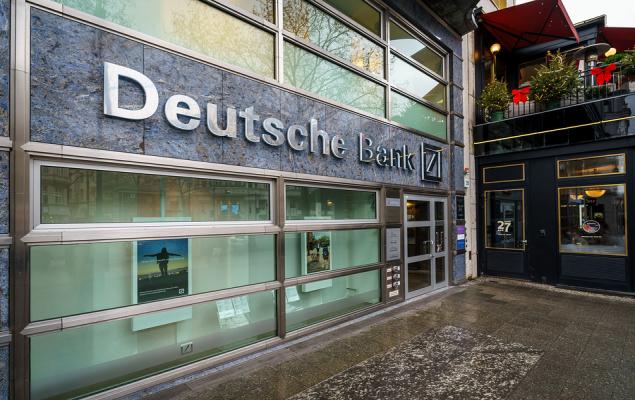
Deutsche Bank reaffirmed 2028 targets of more than 13% return on tangible equity, roughly €37 billion in revenue and a cost/income ratio below 60%, supported by at least €2 billion in planned operating efficiencies. Wealth Management revenue rose nearly 8% year over year in H1 2026 with approximately €60 billion of net new assets, while Corporate Bank loans increased €8 billion. Management expects 2026 net interest income to modestly exceed its €14 billion guidance, reinforcing the bank's improving earnings outlook.
Analysis
DB’s valuation rerating depends less on the headline 2028 target than on whether it can convert higher-quality fee and transaction revenues into a durable reduction in earnings volatility. The critical incremental signal over the next 1-3 quarters is operating leverage: positive jaws, stable credit costs and a rising fee-income mix would justify narrowing the persistent discount to European universal-bank peers. Conversely, the proposed efficiency gains are sufficiently long-dated that the market should not capitalize them fully until quarterly expense run-rate and restructuring cash costs are disclosed.
The structural-hedge benefit creates a non-obvious duration exposure: DB can retain NII momentum even if the ECB begins easing, but only while deposit pricing remains disciplined and the curve does not bear-steepen sharply. That makes deposit beta, German corporate loan-loss provisions and CET1 capital distribution capacity more decision-useful than reported revenue growth. A weaker German industrial cycle would pressure Corporate Bank credit quality and transaction volumes simultaneously, undermining the diversification narrative.
Relative to WFC, DB has greater sensitivity to European rates and capital-markets normalization; relative to C, it offers a cleaner execution story but less scope for an operational-surprise rerating. The consensus risk is that European banks have already priced much of the higher-for-longer benefit: a modest earnings beat without an upgrade to medium-term capital returns may produce limited upside after sector-level gains. Falsify a constructive DB thesis if the cost/income trajectory stalls, core NII guidance falls on ECB easing, or impaired-loan charges rise materially above management’s through-the-cycle assumptions.
AllMind Terminal
AI-powered research, real-time alerts, and portfolio analytics for institutional investors.
Request TrialMarket Sentiment
Overall Sentiment
moderately positive
Sentiment Score
0.58
Ticker Sentiment
Key Decisions for Investors
- Maintain DB as a 6-18 month European-bank overweight only on pullbacks; target a rerating catalyst around quarterly evidence of positive operating jaws and higher capital-return capacity. Use a 10-12% downside stop from entry or exit on a material NII-guide reduction.
- Express the idiosyncratic thesis as long DB / short C over 6-12 months: DB’s cleaner cost and revenue-mix execution should outperform if rates normalize gradually, while C remains more exposed to transformation slippage. Close the spread if DB’s expense run-rate fails to improve for two consecutive quarters.
- Do not chase the broader bank complex on this item. WFC’s profitability upside is principally regulatory-remediation and capital-return driven, not read-through from DB; wait for specific capital-rule or buyback catalysts before adding WFC.
- Set alerts for ECB easing expectations, German PMI deterioration, DB deposit beta and Corporate Bank impairment charges. A rapid easing-cycle repricing or credit-cost acceleration changes the setup from a rerating trade to a sector-risk reduction.
More News
- Microsoft gives Copilot a much-needed overhaul, and the stock deservedly soars
- Nike’s stock is one of the worst in the S&P 500 — and BofA says it’s not done sliding
- These two market gauges may signal a big risk-off event for the market, says BofA
- Costco just reported strong earnings. Goldman Sachs sees a sharp move higher for the stock
- One key part of the AI trade has decoupled from the rest. Why that is, and whether it can come back
- 1 Wall Street Analyst Just Called Netflix a Sell. Is It Time To Dump the Streaming Stock?