
Huawei presenta la nueva arquitectura de computación UnifiedBus para SuperPoDs y clústeres
Source: PR Newswire
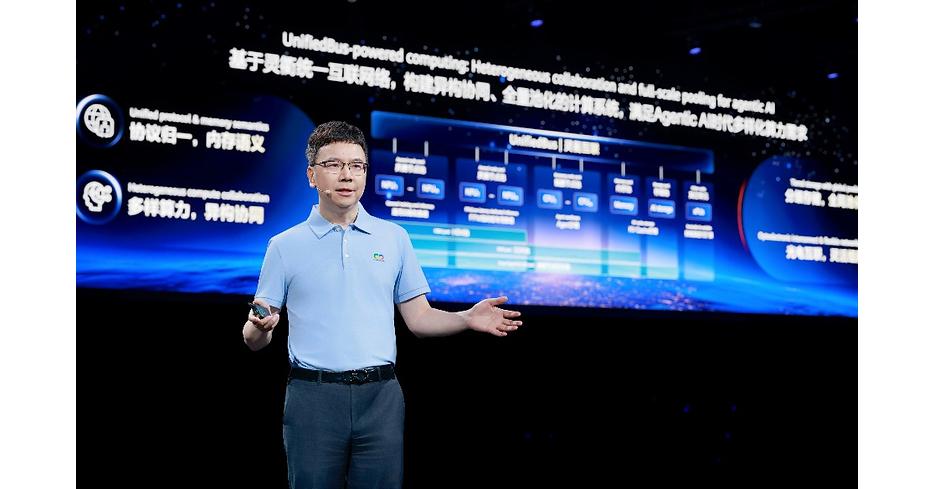
Huawei unveiled its UnifiedBus computing-interconnect architecture and related products to scale AI systems from single cabinets to clusters of up to 1 million NPUs. The company said UnifiedBus lifts interconnect bandwidth from roughly 100 GB/s to TB/s levels and cuts round-trip latency from 7 microseconds to 2 microseconds; its LinkDevice provides 280 Tbit/s of optical interconnect capacity across 176 ports. Huawei also introduced an agentic-AI SuperCluster built around TaiShan 950 and Atlas 960 systems and said new UnifiedBus devices will enable SMEs to run trillion-parameter models locally.
Analysis
The investable read-through is not Huawei revenue but a potential shift in China AI capex from standalone accelerators toward networking, optical interconnect and memory-pooling content. If the claimed utilization gains are reproducible in customer deployments, each incremental AI cluster should carry materially higher fabric value per accelerator, favoring China-exposed optical-component vendors such as Zhongji Innolight (300308 CH), Eoptolink (300502 CH) and Accelink (002281 CH) over commodity server assemblers. The second-order effect is ambiguous for domestic accelerator vendors: better cluster efficiency lowers NPU unit demand per workload, but lower total cost of training/inference could expand the addressable workload base and ultimately raise system demand.
Near term, this is primarily a sentiment and procurement-specification catalyst rather than an earnings catalyst. Huawei's performance claims are vendor-provided and lack independently comparable benchmarks on model throughput, power usage, fault tolerance, software portability and total cluster cost; without these, the market should not capitalize suppliers on the announcement alone. The key 1-3 month signal is whether Chinese cloud operators, telecoms or sovereign-compute projects specify high-speed optical fabrics and pooled-memory architectures in tenders; 6-18 month upside depends on repeatable deployments rather than flagship installations.
Contrarian view: investors may overstate the threat to NVIDIA (NVDA) from a proprietary Chinese interconnect. The more immediate constraint remains ecosystem maturity, developer tooling, yields and access to leading-edge memory/packaging, not raw switch bandwidth. Conversely, successful deployment would increase China's strategic incentive to localize optical networking and AI infrastructure, creating a broader substitution risk for NVIDIA and Arista (ANET) only if it translates into large commercial deployments outside captive Huawei-led projects.
The tradeable thesis is therefore a confirmation trade, not a launch-day chase. Optical suppliers offer the cleanest upside convexity if tender data validates architecture adoption, while the primary falsifier is evidence that customers retain conventional fabrics because software integration, reliability or power economics offset theoretical utilization gains.
AllMind Terminal
AI-powered research, real-time alerts, and portfolio analytics for institutional investors.
Request TrialMarket Sentiment
Overall Sentiment
strongly positive
Sentiment Score
0.55
Key Decisions for Investors
- Set a 1-3 month procurement alert on Chinese cloud, telecom and government AI tenders for 1.6T optical links, pooled-memory systems or Huawei SuperPoD specifications; initiate a basket long in 300308 CH / 300502 CH / 002281 CH only after at least two independent customer wins. Target 15-25% upside on order-book rerating; exit if tender language does not broaden beyond Huawei-led deployments.
- Avoid treating the announcement as a direct short catalyst for NVDA or ANET. Reassess a China-exposure hedge only if verified deployments demonstrate competitive cost-per-token and sustained software portability; absent that evidence, their non-China demand bases dominate the earnings setup.
- For a relative-value expression after confirmation, prefer long China optical interconnect suppliers versus short a broad China server-hardware proxy, sized modestly. The thesis is that fabric and optical content gains share of system BOM while commoditized compute integration faces pricing pressure; stop out if component lead times and supplier guidance fail to improve within two quarters.
- Monitor Huawei-compatible HBM/DDR, advanced packaging and optical-module availability before underwriting a 6-18 month thesis. Supply bottlenecks or export-control tightening would cap cluster shipments even if the architecture performs as claimed.
More News
- All Iranian airlines to be 'shut down' from Wednesday, Bessent tells CNBC
- Taiwan benchmark Taiex rises to record intraday high as tech stocks advance
- AMD joins the $1 trillion club as chip rally surges - our AI Strategy saw it early
- Jamie Dimon says hyperscaler AI spending could hit $1 trillion next year
- Factbox-Key issues for this week’s Trump-Xi summit in Washington
- Here's who we know is going to the Trump-Xi dinner so far
From AllMind Research
- Anthropic IPO Preview: Valuation, Timing, and What to Watch
- Shein After the IPO: Venue, Valuation, and What Must Be Proved
- What AI Research Tools Should a Small Hedge Fund Buy First?
- Alternative Data Due Diligence for Institutional Investors
- Introducing AllMind: A New Data & AI Workspace for Institutional Investors