
TELUS Mental Health Index: Cost of living is the top money worry for 58 percent of US workers as financial anxiety hits workplace productivity
Source: PR Newswire
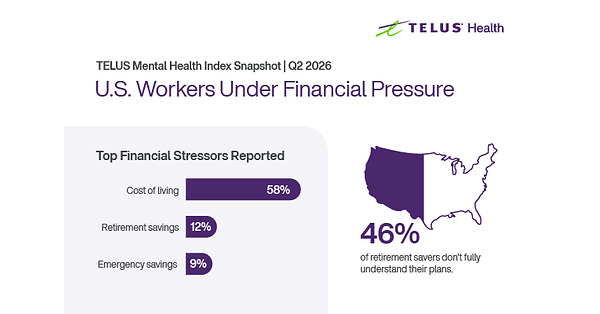
TELUS Health’s Q2 2026 Mental Health Index (US score: 70.1/100) finds cost of living is the dominant financial stressor for 58% of workers, while 46% lack strong understanding of their retirement benefits. The report links financial strain to lower productivity: 15% say stress directly impaired productivity and workers without emergency savings (23% of employees) are three times more likely to report productivity declines. Mental health disclosure barriers remain high, with only 49% comfortable telling managers about mental health issues; overall results suggest mounting wellbeing-driven operational costs for employers.
Analysis
The investable read is not that workers are stressed — that is already known — but that the monetization path for “wellbeing” vendors is weaker than the social narrative implies. A survey of strain does not automatically convert into budget growth; in most enterprises, money stress first shows up as absenteeism, overtime, and manager time, while the solution budget is more likely to come out of core HR/admin renewals than discretionary mental-health spend. That makes the near-term winner set narrower than headlines suggest: payroll/benefits platforms with embedded communications and nudges, not standalone point solutions.
The more interesting second-order effect is margin pressure at labor-intensive names: retail, food service, logistics, and healthcare operators absorb the productivity hit through lower throughput and higher scheduling inefficiency long before it becomes visible in top-line metrics. If the trend persists into 1-3 months, look for softer same-store productivity, higher temp labor usage, and worse turnover, which can compress operating margins even in a stable demand environment. Over 6-18 months, this is most bullish for integrated HCM/benefits vendors that can bundle financial-wellness tools into existing contracts.
Contrarian angle: the market may be overestimating near-term adoption of employer-sponsored financial wellness tools. HR teams often acknowledge the issue but defer spend until renewal season or until a hard labor market problem forces action; that means the earnings impact can lag the survey by quarters, not weeks. The thesis is falsified if upcoming enterprise commentary shows measurable attach-rate gains or if consumer spending improves enough to reduce productivity leakage without incremental vendor spend.
AllMind Terminal
AI-powered research, real-time alerts, and portfolio analytics for institutional investors.
Request TrialMarket Sentiment
Overall Sentiment
mildly negative
Sentiment Score
-0.25
Key Decisions for Investors
- No direct position in IUSDF/TOP/WWRL on this print; the signal is too indirect and likely not monetizable within the next 1-2 quarters.
- Conditional pair trade: long ADP or PAYX / short XRT on any broad consumer weakness confirmation over the next 4-8 weeks. Thesis is that labor-heavy retail absorbs productivity drag while HR platforms capture incremental benefits/communications budget; stop if consumer demand re-accelerates or payroll growth stays firm.
- Buy XRT downside only if the next labor-market or consumer-confidence releases confirm stress turning into lower discretionary spend. Use 1-3 month puts rather than outright short equity because the current evidence is survey-based, not earnings-based.
- Set an alert for 3Q/4Q earnings from ADP, PAYX, WDAY, and other HCM vendors: if management explicitly cites higher demand for financial-wellness, benefits education, or retention tools, the trade shifts from watchlist to actionable long.
More News
- Why did CoreWeave stock get crushed this week? Look to this corner of the debt market for clues
- Solar power booms in Philippines as war on Iran spikes energy costs
- Palantir patient data tech rejected by many NHS trusts in England
- Diageo's Toxic Spill Hits Pristine River in Scottish Whisky Country
- Stock fixing scandal could see Turkish companies frozen out of global indexes
- AI stock sell-off ramps up over debt-fueled data center spending fears: ‘Full-blown crisis of confidence'