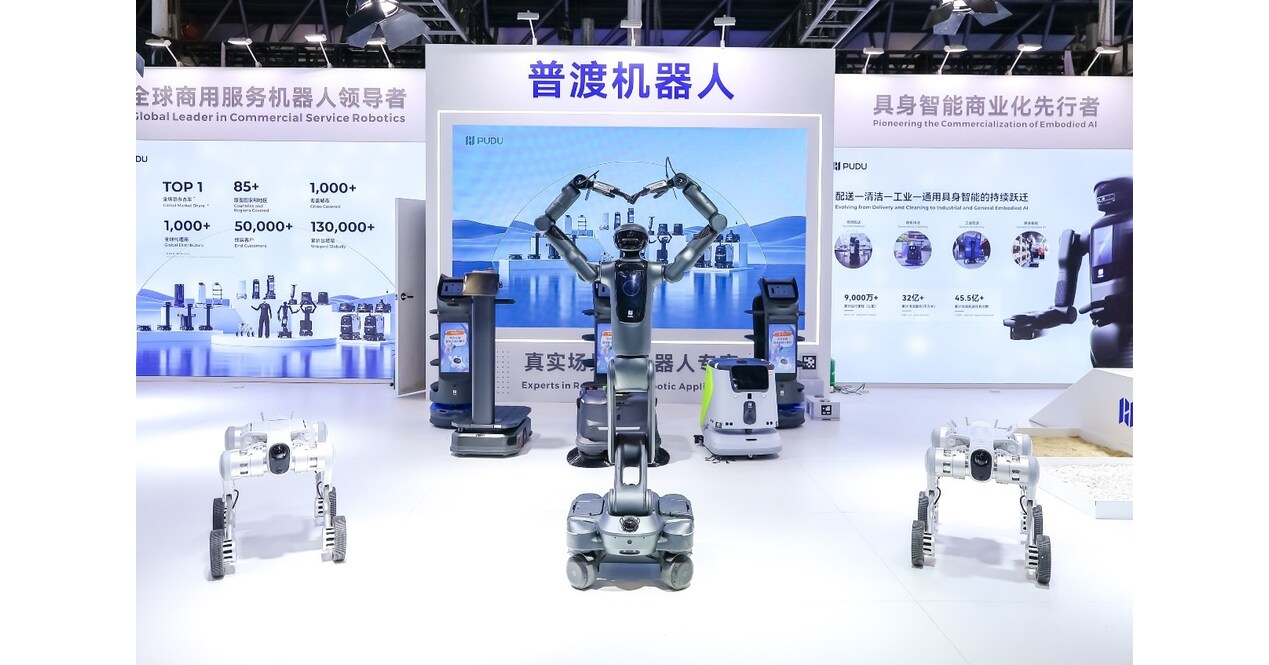
Pudu Robotics showcased the offline global debut of its next-generation semi-humanoid robot, the PUDU D7, at WAIC 2026 and won 36Kr’s “Most Investor-Attractive AI & Embodied Intelligence Enterprise” award. The company reported sustained capital traction, completing a financing round of nearly $150M in April 2026, lifting valuation to over $1.5B and cumulative funding to more than $300M. Frost & Sullivan research cited Pudu as #1 in the global commercial service robotics market by both revenue (25%) and shipments (23%), with >100% YoY revenue growth and international markets contributing >80% of revenue.
This is more a sentiment/multiple event than a direct earnings event for listed markets. The real signal is that embodied AI is moving from lab narrative to deployment narrative, which should help re-rate the small set of public robotics names with visible shipments and service revenue, while punishing pure-presentation names that still lack repeatable unit economics. In the near term, the biggest beneficiaries are likely suppliers of edge compute, motion control, sensors, and fleet software rather than the robot OEMs themselves, because the margin pool in early commercialization usually migrates to the picks-and-shovels layer.
The second-order effect is competitive pressure on labor-heavy service providers in hospitality, cleaning, and light inspection: once robots become demonstrably cheaper per shift, adoption can accelerate in 1-3 months through procurement pilots, then show up over 6-18 months in labor-cost line items. The risk is that this remains a showcase-led story; if deployment data, utilization, or gross margin do not improve by the next reporting cycle, the stock impact will fade quickly and the sector could de-rate on "AI theater" fatigue. Geopolitically, the high international mix also creates a hidden fragility: localization rules, tariff friction, and distributor concentration can interrupt growth even if product demand stays strong.
Contrarian view: the market may be overestimating how much of the value accrues to the robot brand and underestimating how much is captured by component vendors and integrators. If embodied AI is real, the cleaner trade is not chasing every robotics headline, but owning the enablers with recurring revenue and taking profits on the highest-multiple OEMs after conference-driven spikes. Falsifier: a deceleration in shipment growth, margin compression, or a failure to convert demos into contracted fleet deployments over the next 1-2 quarters.
AI-powered research, real-time alerts, and portfolio analytics for institutional investors.
Request TrialOverall Sentiment
moderately positive
Sentiment Score
0.55
