
Agentic AI Contracts Expose Organizations to Runaway Costs With Limited Recourse, Says Info-Tech Research Group
Source: PR Newswire
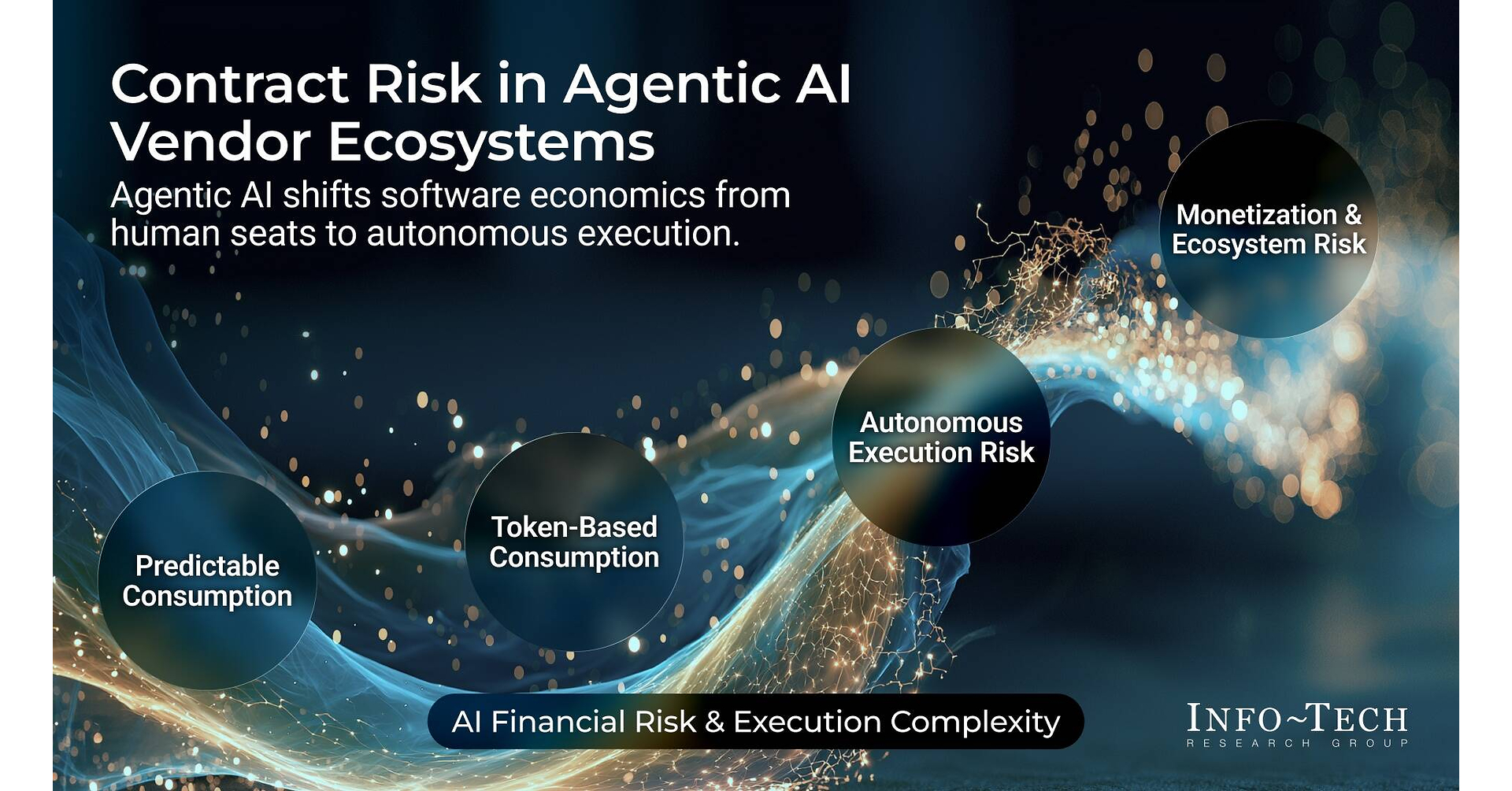
Info-Tech Research Group warns that agentic AI consumption-based software billing can create “bill shock,” with single prompts potentially triggering dozens of billable events (tool calls, retries, multi-agent orchestration, model-tier escalation) while billing definitions and pricing logic may sit outside the signed contract. The firm’s blueprint (“Negotiate Safe AI Contracts to Prevent Bill Shock”) recommends negotiating clear billing definitions, audit rights, dispute mechanisms, and financial guardrails such as thresholds, throttles, and kill switches before deployment. Overall impact is primarily risk-focused for enterprise buyers rather than a direct market-moving financial catalyst.
Analysis
The market takeaway is not that AI demand is impaired; it is that monetization is moving from a clean software budget line to a governance problem. That shifts bargaining power toward buyers who can force caps, audit rights, and committed-spend constructs, and away from vendors whose revenue depends on opaque usage meters or auto-scaling workflows that customers do not fully understand. The second-order winner is the advisory layer around procurement, FinOps, legal ops, and systems integration; the loser set is smaller AI software vendors that need to defend variable billing without enterprise-grade contract discipline.
Near term, this is more of a sales-cycle and pricing mix issue than a P&L event. Over the next 1-3 earnings cycles, watch for slower expansion revenue, longer procurement approvals, and more custom papering around AI add-ons; that tends to pressure high-multiple consumption names before it shows up in headline revenue. Over 6-18 months, the structural effect is a shift toward deterministic pricing, throttles, and workflow controls, which should favor incumbents with enterprise contracting muscle and punish startups trying to monetize every token, retry, and agent handoff.
The contrarian read is that the consensus may be overestimating how much this reduces adoption. Once an AI workflow is embedded and producing ROI, enterprises usually accept higher spend if the controls are clear; the real issue is pricing power, not usage collapse. The thesis is falsified if AI consumption metrics keep compounding through the next two quarters without a rise in disputes, discounting, or guidance language about contract friction.
There is no direct equity read-through for FCD.UN.TO or TCHC from this item; treat it as a process alert rather than a security-specific catalyst.
AllMind Terminal
AI-powered research, real-time alerts, and portfolio analytics for institutional investors.
Request TrialMarket Sentiment
Overall Sentiment
mildly negative
Sentiment Score
-0.15
Key Decisions for Investors
- No immediate position in FCD.UN.TO or TCHC; keep on watchlist only, because the article is about procurement discipline rather than identifiable revenue exposure.
- Relative-value idea over the next 1-3 months: long MSFT or ORCL vs short SNOW or DDOG into earnings, betting that enterprise incumbents with stronger contract control can preserve AI attach while metered-consumption names face pricing pushback; cover if the short leg prints accelerating net revenue retention or raises AI usage guidance.
- Consider a smaller tactical long in ACN or IBM over 3-6 months as companies outsource AI contract governance, FinOps, and implementation controls; invalidate if CIOs internalize this capability and advisory budgets get cut.
- If you want an event-driven hedge, buy put spreads on a basket of usage-heavy software names ahead of earnings rather than outright shorting the sector; the payoff is best if management commentary starts emphasizing guardrails, caps, or slower AI monetization.
More News
- Nvidia GPUs are everywhere. Here are the ways companies are accessing them
- As companies pour billions into Earth-based AI infrastructure, Google is taking the data center race off-planet
- AI's Supercharging a Scam Economy Bigger Than the Cocaine Trade
- European bank stocks slide 8% as bond yields spark investor caution
- Verizon stock heads for worst day since 2002 as SpaceX U.S. network plans whack telcos
- Big Tech is betting $700 billion on AI. Healthcare will decide whether the bet pays off