
AI Agents Must Be Governed as Persistent Digital Actors, Advises Info-Tech Research Group
Source: PR Newswire
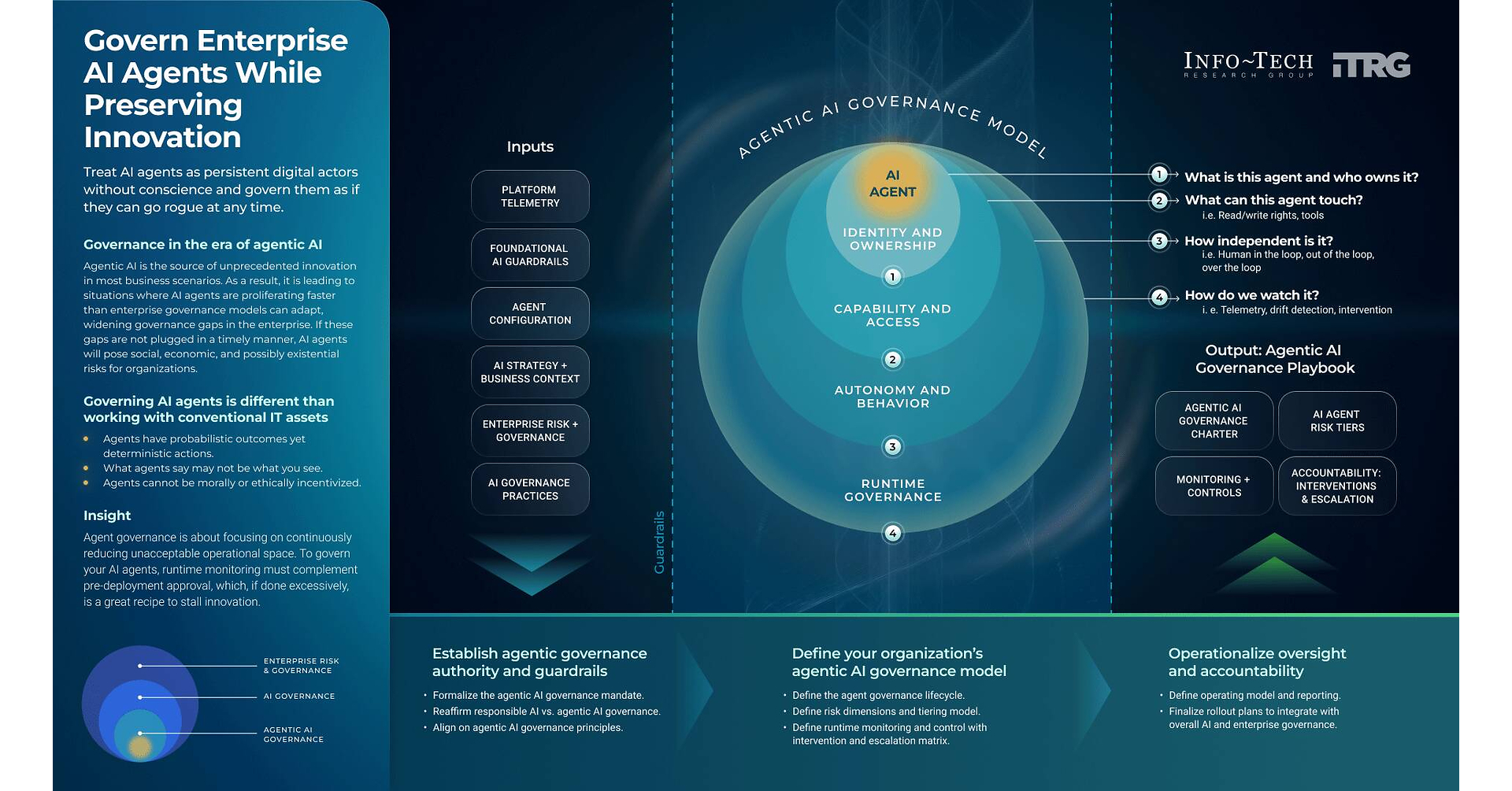
Info-Tech Research Group warns that rising adoption of enterprise AI agents is widening the gap between deployment and governance because agents can access systems, trigger workflows, and make decisions faster than organizations can detect—creating security, compliance, and reputational risks. The firm proposes a three-phase governance framework (authority/guardrails, agent lifecycle risk modeling, and operationalized oversight/accountability) to limit agent autonomy and access while preserving innovation. While the article is advisory rather than financial, it signals growing enterprise risk-management needs around agentic AI controls.
Analysis
This reads less like a single-company event and more like an early signal of budget reallocation inside enterprise tech. The first dollars around agentic AI are likely to go to identity, privileged access, auditability, and runtime monitoring rather than to the AI application layer, so the near-term winner set is cybersecurity and governance software with existing enterprise distribution. In practice, that favors incumbents that can bolt controls onto current stacks; point solutions without a compliance story may see slower deployment or get absorbed into larger platforms.
The second-order effect is that agentic AI adoption may actually widen the moat for vendors already embedded in security workflows, because the selling motion becomes “reduce blast radius” rather than “buy more AI.” That argues for relative outperformance in names tied to identity, PAM, SIEM/SOAR, and cloud security over the next 1-3 quarters, while pure-play workflow automation and AI app vendors face procurement drag. For FCD.UN.TO and TCHC specifically, I see no direct earnings sensitivity from this note; any impact is too diffuse to underwrite a standalone position.
Contrarian view: the market may be overestimating incremental spend. Most enterprises will likely reuse existing controls and vendor contracts, so this is more mix-shift than net-new demand. The thesis is falsified if major software budgets show no uplift in security/observability line items over the next 1-2 reporting cycles, or if agentic AI adoption remains confined to pilots without incident-driven governance spend.
AllMind Terminal
AI-powered research, real-time alerts, and portfolio analytics for institutional investors.
Request TrialMarket Sentiment
Overall Sentiment
mildly negative
Sentiment Score
-0.25
Key Decisions for Investors
- No direct trade in FCD.UN.TO or TCHC; keep as a watch item only, since this catalyst is not specific enough to drive estimates.
- Relative long PANW or CRWD versus a basket of high-beta AI application/software names over the next 1-3 months; target 8-12% relative upside if governance spend starts showing up in guidance.
- Pair long CYBR or OKTA against a broad software ETF (IGV) for a cleaner expression of security/identity budget reallocation; stop out if AI governance commentary does not translate into bookings by next earnings cycle.
- Use 3-6 month call spreads in PANW or CRWD into earnings only if channel checks confirm incremental demand for AI governance modules; otherwise avoid chasing the theme.
- Set an alert for any major incident involving autonomous agents or a regulatory proposal on AI accountability; that would convert this from a slow-burn budget shift into an immediate catalyst.
More News
- Why is SK Hynix stock sliding today?
- Senior Iranian official threatens to attack cables, data centers, and AI facilities in the region if the war escalates sharply again
- TSMC expected to report sixth straight quarter of record profit thanks to AI boom
- CXMT: How big is its market threat to Samsung, SK Hynix and Micron?
- Why is Foxconn Industrial Internet stock sliding today?
- Samsung, SK Hynix shares drop as China’s CXMT flags progress in memory development
From AllMind Research
- Anthropic IPO Preview: Valuation, Timing, and What to Watch
- Shein After the IPO: Venue, Valuation, and What Must Be Proved
- What AI Research Tools Should a Small Hedge Fund Buy First?
- AI Vendor Landscape for Institutional Investment Teams
- AllMind Fixed Income Compass for October 2025: Navigating Policy Divergence and Political Risk