
AI Selloff Deepens in Asia as Funding Fears Mount
Source: Bloomberg
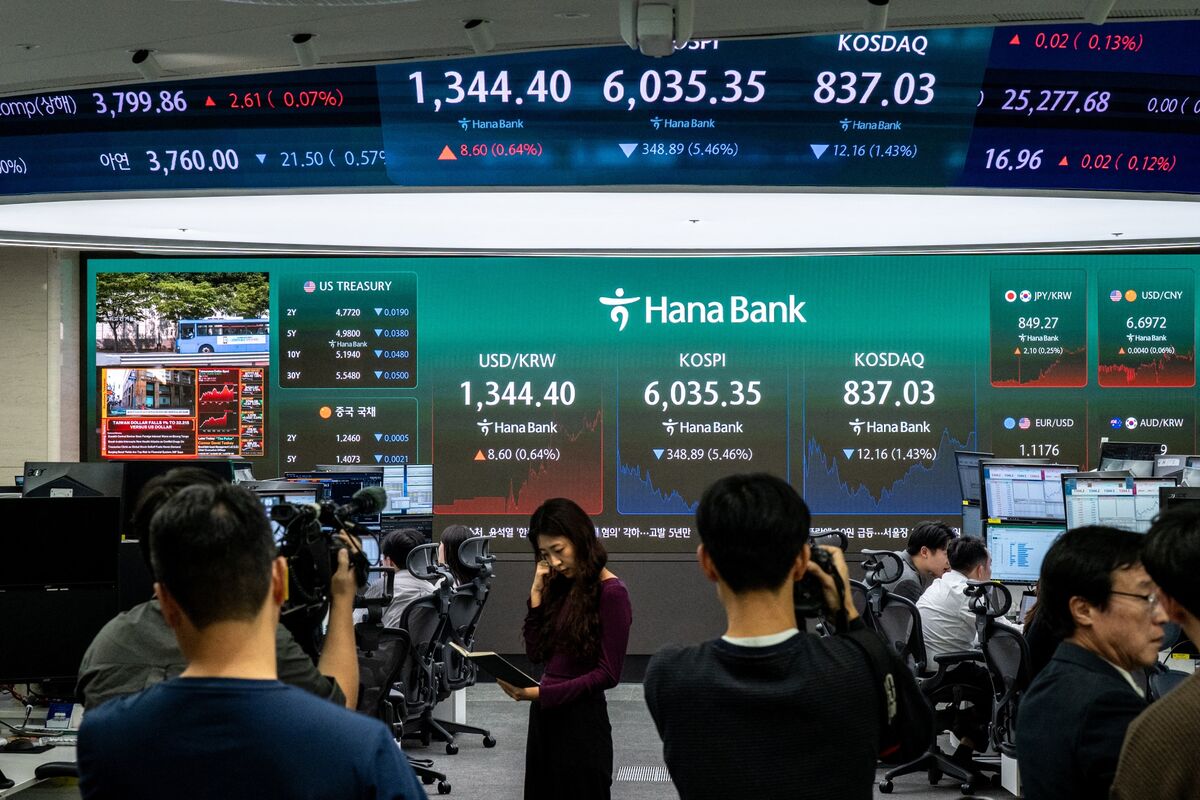
South Korea’s Kospi fell 8%, bringing its decline from the June peak to nearly 40%; SK Hynix and Samsung each dropped more than 9%, and foreign investors sold over $10 billion of Korean shares this month. Japan’s Nikkei 225 fell almost 5% as hotter US inflation revived Fed-tightening concerns and CoreWeave debt distress heightened worries about AI-buildout financing. The IMF raised its 2026 Asia growth forecast to 4.8% but sees growth slowing to 4.4% next year, warning that an AI investment or valuation correction could hit technology-supply-chain economies; oil-importing economies also face higher energy costs.
Analysis
The key transmission is not simply weaker chip sentiment: higher discount rates and doubts about AI customers’ ability to finance infrastructure can pressure both the valuation of expected AI growth and the durability of future orders. That creates a second-order risk for Asian suppliers: even if current demand remains strong, customers may stretch deployment schedules or prioritize utilization over incremental capacity. SK hynix is exposed to that repricing; Samsung may face broader electronics and memory sentiment spillovers, but the article does not establish equal earnings exposure. The regional growth upgrade is therefore a cushion, not a hedge, if investment concentration is high.
Near term (days), crowded positioning and foreign outflows can amplify moves beyond changes in fundamentals; after a near-40% Korea market drawdown, however, chasing shorts risks a sharp squeeze. Over 1–3 months, monitor CoreWeave financing conditions, hyperscaler capex guidance, memory pricing and supplier order commentary. Over 6–18 months, a sustained AI capex retrenchment would expose the region’s dependence on the buildout, while persistent oil strength would add a separate terms-of-trade headwind for energy-importing Asian economies.
Contrarian point: the selloff may be pricing a funding shock as an immediate collapse in end demand. If large customers continue funding projects and memory prices/orders hold, current weakness could reverse quickly. The thesis is falsified by stabilization in AI financing alongside maintained capex guidance and firm memory indicators; it strengthens with capex cuts, weaker memory pricing or further deterioration in credit conditions.
AllMind Terminal
AI-powered research, real-time alerts, and portfolio analytics for institutional investors.
Request TrialMarket Sentiment
Overall Sentiment
moderately negative
Sentiment Score
-0.45
Ticker Sentiment
Key Decisions for Investors
- Do not add to broad Korea or SK hynix shorts solely after the sharp drawdown. Prefer waiting for a rebound that fails on weak financing or capex news; that offers a cleaner risk/reward than selling into forced flows.
- Use SK hynix as a higher-beta watch position, not an unconditional short: consider a defined-risk bearish options structure only if near-term memory pricing/order data weaken or major AI customers cut capex. Exit the bearish thesis if supplier indicators stabilize and financing stress eases.
- Track CoreWeave’s access to financing and credit-market terms as an early warning signal, but do not treat one borrower’s distress as proof of a sector-wide funding freeze. A recovery in financing conditions would be a catalyst to cover AI-supply-chain shorts.
- Monitor oil prices and Asian currency/energy-import data for a separate relative-value opportunity: sustained energy cost pressure could favor underweighting exposed import-dependent economies versus AI-export beneficiaries, but verify country-level exposure and market pricing before implementation.
More News
- Suddenly, Wall Street is worried that the U.S. economy is more ‘vulnerable’ than it looks
- Can TSMC earnings help settle AI jitters?
- South Korea’s KOSPI triggers circuit breaker in tech-led selloff
- SK Hynix plunges 8% amid Asia tech rout as Fed rate hike fears, AI funding worries mount
- Is the AI rout making bonds safe again?
- KOSPI hits near 3-month low as 8% plunge triggers circuit breaker
From AllMind Research
- Anthropic IPO Preview: Valuation, Timing, and What to Watch
- Shein After the IPO: Venue, Valuation, and What Must Be Proved
- What AI Research Tools Should a Small Hedge Fund Buy First?
- Automating Financial Model Updates: A Source-Controlled Workflow
- Weekly Update: Live Event Center, In-App Documents, and Faster Transcripts