
La tecnología LONGWELL EC FanWall reduce el consumo energético de los ventiladores CRAH en un 38 %
Source: PR Newswire
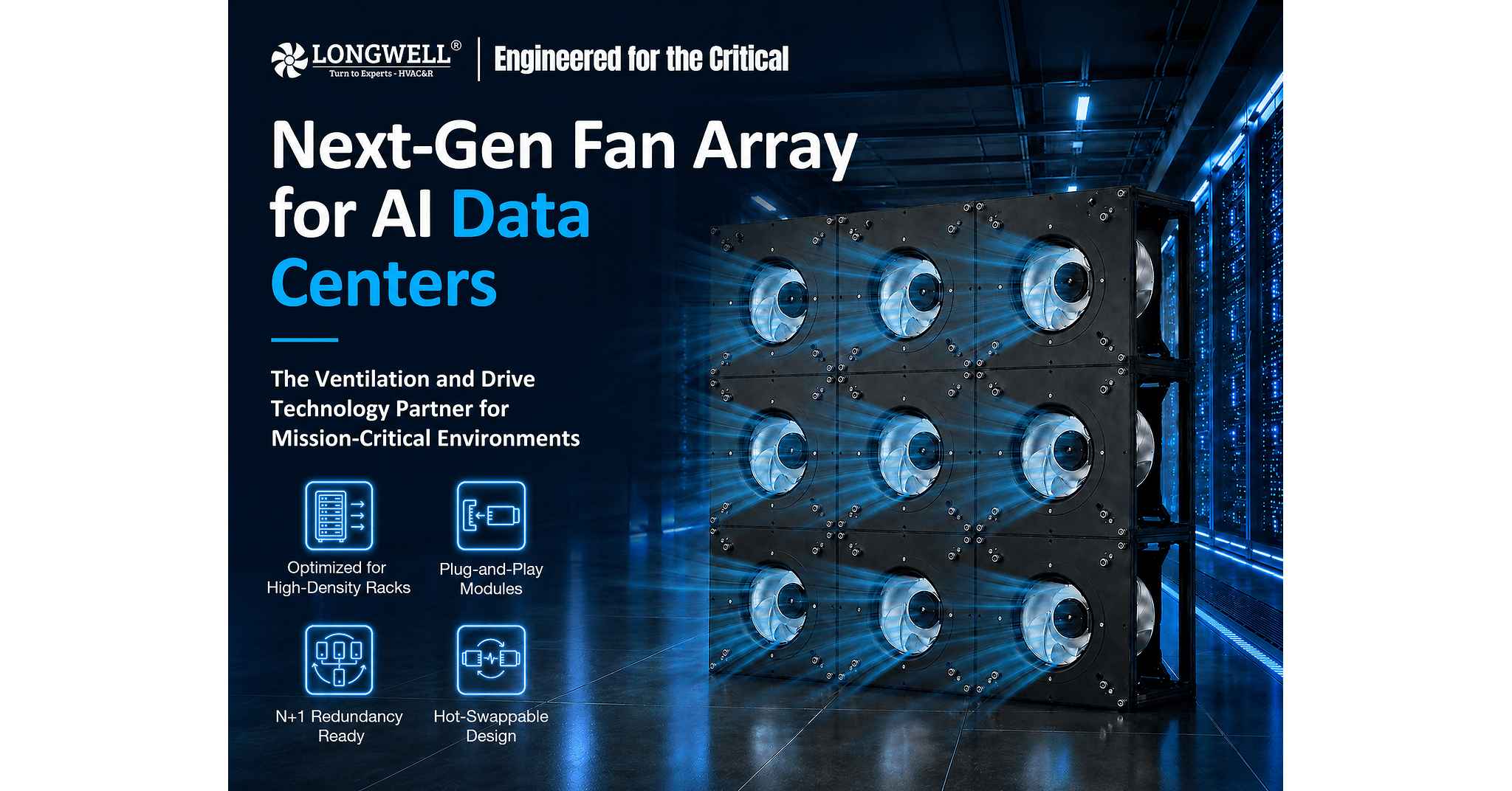
LONGWELL claims its LONGWELL EC FanWall platform cuts CRAH fan energy use by 38% and improves the system CRAH PUE contribution from 1.42 to 1.28, alongside 6.5 dB(A) less noise and zero field failures. The firm says it moved from specification definition to mass production in 90 days (vs. a stated 14+6 months by a prior European supplier) and secured an initial order of 1,500 units, with deliveries in 2025 exceeding 80,000 under a 2025–2027 framework (min 60,000/year). For the market, the news is more product/efficiency-focused than macro, but it signals competitive upgrades for high-density AI data-center cooling (>60 kW/rack, up to 100+ kW).
Analysis
The market signal here is not the claimed efficiency delta; it is the compression of qualification and ramp time. In AI infrastructure, speed-to-production often matters more than the last 5-10% of unit efficiency because buyers are racing to secure usable megawatts, not optimize specs in a lab. That favors suppliers that can co-engineer, validate, and ship quickly, and it raises the bar for slower incumbents with long design cycles and fragmented support.
Second-order, the real beneficiary is likely the data-center capex stack, not the fan vendor alone. If cooling losses fall at the rack level, operators can push higher density without blowing through PUE targets, which usually gets recycled into more GPU installs rather than lower power spend. That is constructive for critical infrastructure names tied to thermal management and power distribution, while legacy air-cooling/component vendors with longer lead times risk share loss if this becomes a repeatable procurement model.
The key risk is that this is a project-specific vendor claim, not a broad industry conversion. If the savings do not generalize across voltage, mounting, controls, and load profiles, the market should ignore it; if direct-to-chip/liquid cooling adoption accelerates faster than fan-wall retrofits, the addressable market also shrinks. The contrarian view is that consensus may be underestimating procurement velocity as a moat in AI buildouts, but overestimating how much system-level economics change from a component-level win.
AllMind Terminal
AI-powered research, real-time alerts, and portfolio analytics for institutional investors.
Request TrialMarket Sentiment
Overall Sentiment
mildly positive
Sentiment Score
0.15
Key Decisions for Investors
- No immediate standalone trade on the press release; treat as a signal to watch for confirmation in public earnings from Vertiv (VRT), Carrier (CARR), and Trane (TT) over the next 1-2 quarters.
- Accumulate VRT on weakness as the cleanest public proxy for AI thermal infrastructure adoption; thesis improves if data-center backlog/order growth stays >20% y/y, and is falsified if management flags slower conversion or margin pressure.
- Relative-value idea: long VRT / short CARR over 3-6 months if the market starts rewarding faster AI-specific execution over broader HVAC exposure; stop if CARR’s data-center bookings reaccelerate materially.
- Add ETN as a 6-12 month second-order beneficiary of higher rack density and electrical distribution intensity; the thesis breaks if AI capex shifts toward lower-power compute or hyperscaler build plans are cut.
- Do not short power/utility exposure on this headline alone; if anything, efficiency gains are more likely to increase total compute deployment than reduce aggregate load. Reassess only if industry PUE improvements become broad-based and confirmed by multiple OEMs.
More News
- AI Capex, Gamble or Jackpot?: Market Snapshot
- ‘I told you so’: China’s chip sector is making breakthroughs—and U.S. export controls are the reasons why
- One Singapore ship was sunk, but here's why others are still transiting the Strait of Hormuz
- CoreWeave credit default swaps hit distress levels as investors sour on AI debt
- The IPO drought is driving private equity-owned companies to the debt market to pay investors
- Hybe shares jump 10% as K-pop sensation BTS' tour lifts earnings hopes