
Korea University Study Uses Artificial Intelligence to Design Potential Antiviral Compounds
Source: PR Newswire
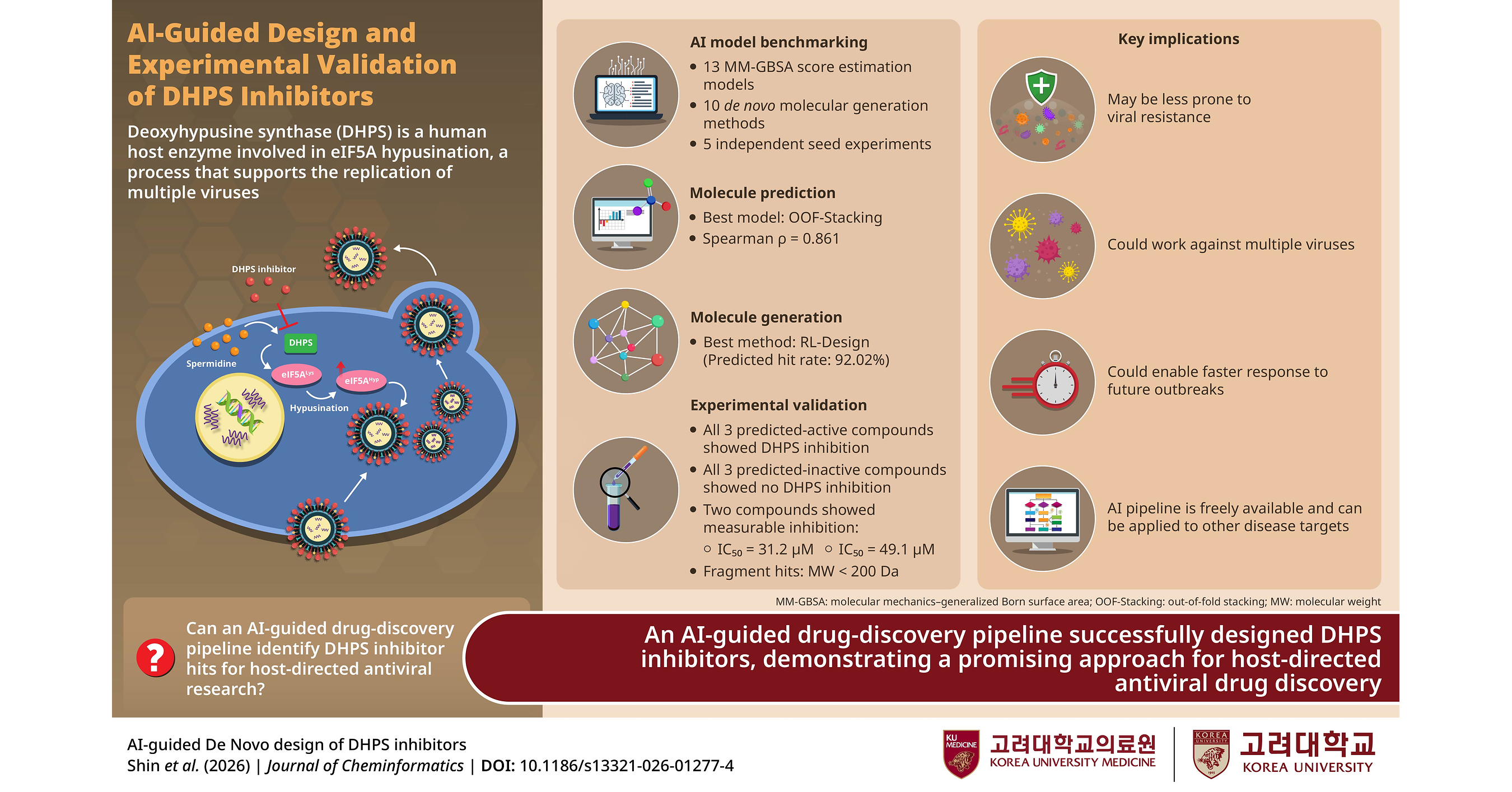
Korea University researchers used AI-guided molecular design to identify early-stage fragments that inhibit DHPS, a host enzyme involved in replication of viruses including HIV-1 and SARS-CoV-2. All three predicted-active fragments inhibited DHPS, while none of three predicted-inactive fragments did; two active fragments had IC50 values of 31.2 and 49.1 μM. The results are an early proof of concept, not drug candidates, and further work is needed to assess potency, selectivity, cellular activity, toxicity and animal performance.
Analysis
This is a platform-validation signal, not a near-term drug or earnings catalyst. The investable distinction is that AI-generated molecules reached an experimental binding readout, but the result does not establish a usable medicine: the reported fragments are weak starting points, and DHPS is a human target, making selectivity and a tolerable therapeutic window central hurdles. Broad antiviral potential could be valuable if host targeting reduces viral resistance, but inhibiting a pathway used by host cells may also create toxicity that limits dosing or narrows eligible patients.
The apparent prediction success should not be read as a general hit-rate estimate: only six selected fragments were tested. The harder value-creation work is medicinal chemistry, selectivity, cellular activity, and in-vivo validation. Meanwhile, an openly available, modest-compute workflow may diffuse quickly, making the method less likely to confer a durable moat; any benefit to drug-discovery tools or CROs is diffuse and not yet tied to identifiable revenue.
Time horizon: little basis for a trade on the announcement alone. Over 1–3 months, watch for independent replication, follow-on potency/selectivity data, and evidence of a licensing or development partner. Over 6–18 months, cellular and animal efficacy plus tolerability would be the meaningful de-risking steps. The contrarian read is that the study is more informative about a reproducible research workflow than about antiviral commercial prospects.
AllMind Terminal
AI-powered research, real-time alerts, and portfolio analytics for institutional investors.
Request TrialMarket Sentiment
Overall Sentiment
mildly positive
Sentiment Score
0.30
Key Decisions for Investors
- No directional position based on this study alone; the supplied data identify no public-company beneficiary, and the findings do not establish a clinical candidate or commercial timeline.
- Treat any broad AI-drug-discovery or host-directed-antiviral rally as vulnerable to reversal unless follow-up demonstrates cellular efficacy, selectivity over relevant host biology, and a credible safety margin.
- Set a catalyst alert for follow-on data or a development partnership. Reassess only if potency improves materially and activity is reproduced in cells and animal models without prohibitive toxicity.
- Falsification of the constructive research signal: independent teams fail to reproduce binding, or optimized compounds cannot separate antiviral activity from host-cell toxicity.
More News
- BlackRock, GIC among investors chasing Indian telecom major Jio's IPO as anchor bids top $26 billion
- Nscale, Anthropic Eye $45 Billion Cloud Deal as AI Trade Rebounds
- Gartner analyst behind tech rout: AI returns are not yet large enough to justify neocloud build-out
- Alibaba Backs Chinese Robovan Maker in $400 Million Fundraising
- Credit stress is threatening to unwind the AI bull. All eyes are on Oracle to hold the line
- X-Energy CEO on Amazon, AEP Nuclear Data Center Deal
From AllMind Research
- Anthropic IPO Preview: Valuation, Timing, and What to Watch
- Shein After the IPO: Venue, Valuation, and What Must Be Proved
- What AI Research Tools Should a Small Hedge Fund Buy First?
- How to Analyze SEC Filings With AI: A Verification-First Guide
- AI for IR Street Intelligence: Notes, Estimates, and Peers