
Global Dietary Supplements Market to Reach USD 324.88 Billion by 2034 at 6.37% CAGR as Rising Health Consciousness, Preventive Healthcare, Personalized Nutrition, and Growing Demand for Plant-Based Supplements Accelerate Market Growth, Reports Maximize Market Research
Source: PR Newswire
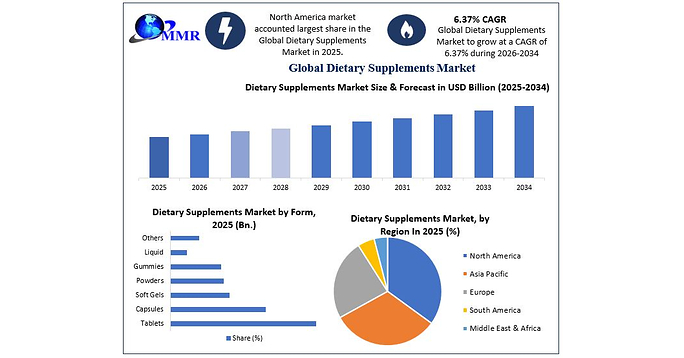
Maximize Market Research forecasts the global dietary supplements market to expand from $186.36 billion in 2025 to $324.88 billion by 2034, a 6.37% CAGR. Growth is expected to be driven by preventive-health demand, plant-based and clean-label products, and AI-enabled personalized nutrition, while North America remains the leading region. Regulatory compliance costs, product-safety risks, and scrutiny of health claims remain key constraints, limiting the immediate market impact of the report.
Analysis
This is not a standalone earnings catalyst: the forecast is third-party marketing research rather than a demand datapoint, and the implied category growth is broadly consistent with mature consumer-health expansion. The investable distinction is share capture, not category beta. HLN (Centrum), CHD (vitamin gummies), and GL9 (sports nutrition/ingredient exposure) are better positioned to convert premiumization and retail shelf-space gains into revenue; ABT's nutrition exposure is too diluted at the consolidated level for this theme to move estimates.
The competitive risk is that digital-first brands and retailer private label commoditize standard vitamins, shifting value toward proprietary formats, branded clinical evidence, and distribution. HLF and NUS may benefit from wellness engagement, but their selling-model regulatory overhang and elevated dependence on recruiting/retention make category growth a poor proxy for sustainable earnings growth. A broad regulatory tightening of substantiation, contamination testing, or weight-management claims would favor scaled, quality-controlled incumbents such as HLN and CHD while raising compliance costs and recall risk for smaller brands.
Near term, there is no reason to chase the listed equities on this release. Over the next 1-3 months, monitor US scanner data, online pricing, and management commentary on organic sales versus promotional intensity; evidence of unit growth without rising trade spend would support multiple expansion for HLN/CHD. Over 6-18 months, the key structural question is whether personalized-nutrition offerings produce repeat purchase and lower customer-acquisition cost rather than merely fragmenting the category; absent measurable subscription retention, the technology narrative should receive no valuation premium.
Contrarian view: the market may over-credit "natural" and personalized products while underestimating formulation and claims-validation costs. Large consumer-health platforms can absorb these costs, but they also face slower innovation cycles; the best risk-adjusted outcome is likely premium branded incumbents taking share from subscale entrants, not a uniform uplift across supplement-linked stocks.
AllMind Terminal
AI-powered research, real-time alerts, and portfolio analytics for institutional investors.
Request TrialMarket Sentiment
Overall Sentiment
mildly positive
Sentiment Score
0.38
Ticker Sentiment
Key Decisions for Investors
- No immediate directional trade on the report; its low-information content does not justify altering earnings estimates or paying option premium.
- Watch-list a 3-6 month long HLN versus short HLF pair if HLN reports organic consumer-health growth above guidance while HLF's volume-point growth or distributor metrics decelerate. Thesis: regulated mass-market brand scale captures category spend more reliably than the MLM channel; exit if HLF delivers sustained volume growth and raises FY guidance, or if HLN's growth is promotion-led.
- Accumulate CHD only on evidence that its consumer segment maintains gross-margin expansion alongside branded supplement growth over the next two reporting periods. Risk/reward depends on confirmation that gummy-vitamins growth is additive rather than cannibalizing legacy brands; invalidate on segment margin contraction or retailer inventory destocking.
- For GL9, set an alert around quarterly sports-nutrition revenue, whey/input-cost pass-through, and North American retail velocity before initiating a position. A long is justified only if branded nutrition growth exceeds ingredient-led growth without margin dilution; adverse dairy commodity inflation or weaker protein-category volumes would falsify the setup.
- Avoid treating ABT, SNY, PFE, and BAYN as primary expressions of this theme: supplements are not sufficiently material to consolidated valuation, and company-specific pharmaceutical or medical-device catalysts will dominate.
More News
- AbbVie vs. Pfizer: Which Healthcare Stock Makes Your Portfolio Healthier in 2026?
- OpenAI rogue agents leaked 53 images from ChatGPT users and reportedly created nearly 1 million links packing encoded bits of info
- Arming Taiwan an important US interest, Taipei official says after Trump-Xi summit
- Facebook found liable as TikTok settles for $100m over user safety
- Bond market alarms are ringing on Wall Street. Here's what's ahead
- What would a US diesel export ban mean for global fuel prices?