
Bitmine Immersion Technologies (BMNR) annonce que ses avoirs en ETH s'élèvent à 5,98 millions de jetons, et que le total de ses avoirs en cryptomonnaies et en liquidités s'élève à 17,1 milliards de dollars
Source: PR Newswire
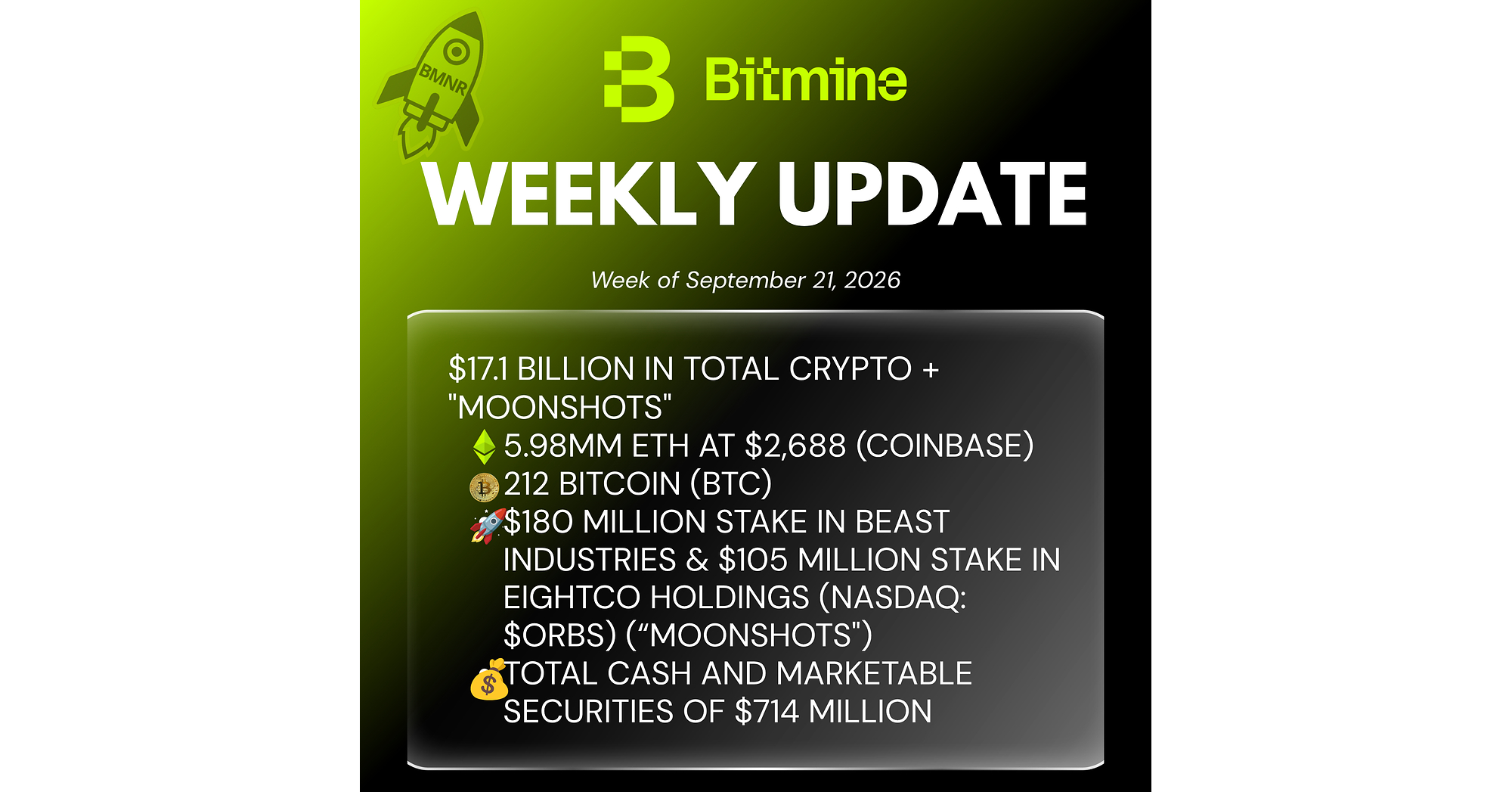
Bitmine reported $17.1 billion in total crypto, cash, marketable securities and moonshot holdings as of September 20, including 5.98 million ETH valued at $2,688 each, equal to 4.9% of Ethereum's 122.1 million-token supply. The company acquired 27,562 ETH during the prior week and has staked 5.07 million ETH, or 85% of its ETH holdings, with estimated annualized staking revenue of $357 million at a 2.62% annualized seven-day yield. Management expects ETH's Q3 outperformance of 6,519bps versus the S&P 500 to extend into Q4 as institutional investors increase crypto allocations, while targeting ownership of 5% of total ETH supply.
Analysis
BMNR is becoming a high-beta, quasi-closed-end ETH vehicle rather than an operating-company valuation. The relevant variable is its market-cap-to-crypto-NAV (mNAV): additional ETH purchases are accretive only if equity can be issued above NAV and staking income exceeds the dilution/cost of capital. With most holdings locked in validators, the company also has materially less balance-sheet flexibility than a spot ETH ETF during a drawdown; a validator outage, slashing event, or liquidity need could force sales into a thinner accessible inventory.
The non-obvious market effect is ETH float compression. A single holder controlling nearly 5% of supply and staking the bulk of it reduces immediately tradeable ETH, amplifying upside in a marginal institutional-allocation cycle but equally worsening downside gap risk if leverage, redemptions, or a NAV discount compel liquidation. This is constructive for ETH beta and indirectly for COIN and GLXY through higher custody, trading, and institutional-staking activity, but it is not automatically constructive for BMNR if its mNAV already embeds scarcity and promotional optionality.
Near term, the likely catalyst is mechanical attention around the 5% threshold and quarter-end crypto positioning; this can sustain a reflexive premium for days to weeks. Over 1-3 months, the key test is independently reported staking yield net of validator, custody, and corporate costs—not an annualized seven-day rate—and whether ETH purchases were funded without destructive dilution. Over 6-18 months, concentration creates regulatory and protocol-governance scrutiny: Ethereum may view large validator concentration as a decentralization risk, potentially prompting delegation limits or lower economics.
Contrarian view: the market may be pricing a structural yield business where the economic reality remains principally mark-to-market ETH exposure. The small non-ETH "moonshot" holdings should receive a steep haircut absent transparent marks and evidence of liquidity; the asserted indirect AI exposure is especially unlikely to justify a meaningful valuation premium. Thesis is falsified if BMNR's premium to independently calculated NAV narrows despite ETH appreciation, or if realized staking yield remains below the implied run-rate for two reporting periods.
AllMind Terminal
AI-powered research, real-time alerts, and portfolio analytics for institutional investors.
Request TrialMarket Sentiment
Overall Sentiment
moderately positive
Sentiment Score
0.68
Ticker Sentiment
Key Decisions for Investors
- Treat BMNR as a tactical long only when its fully diluted market capitalization is at or below 1.05-1.15x independently calculated crypto NAV; use ETH or an ETH ETF as the hedge against premium compression. Avoid adding solely on the 5% accumulation milestone, which is a predictable narrative catalyst rather than incremental fundamental value.
- If BMNR trades above 1.35x crypto NAV, initiate a 1-3 month pair: short BMNR versus long equivalent ETH exposure. Target compression toward 1.10-1.15x NAV; stop if the company demonstrates sustained third-party staking/client revenue or accretive capital issuance that raises ETH per diluted share.
- Overweight COIN and GLXY versus BMNR for a 3-6 month institutional-ETH allocation theme: both monetize transaction, custody, financing, and infrastructure volumes without single-asset treasury concentration. Reassess if ETH spot volume and institutional custody balances fail to improve through the next earnings cycle.
- Do not underwrite ORBS based on BMNR's carrying value or claimed indirect AI linkage. Establish only a watch alert: require disclosure of the underlying instrument, liquidity restrictions, and independently supportable OpenAI economic exposure before assigning more than a distressed/minority-investment valuation.
- Monitor ETH liquid-supply indicators, validator concentration, and BMNR's next balance-sheet filing. A sharp ETH decline combined with a widening BMNR NAV discount is the critical downside regime; reduce any treasury-company exposure if the discount exceeds 15% or staking yield materially underperforms the stated run-rate.
More News
- U.S. regulators rush to write crypto rulebook after Clarity Act stalls in Senate
- Bitcoin surges past $85k as Strategy buys more coins
- ‘We believe in college’: inside Andreessen Horowitz’s $42m unaccredited academy that will charge Harvard prices without degrees
- Microsoft and Coinbase probe leads to arrest of crooks behind ‘EvilTokens’, a DIY phishing network powered by AI
- Quantum computing stocks vs. crypto stocks: a value comparison
- Strategy's Stock Has Soared 40% in the Past Month as It's Buying Bitcoins Again
From AllMind Research
- Anthropic IPO Preview: Valuation, Timing, and What to Watch
- Shein After the IPO: Venue, Valuation, and What Must Be Proved
- What AI Research Tools Should a Small Hedge Fund Buy First?
- Weekly Update: Advanced Search Filters, Redesigned Ticker Dashboard, and Improved Search Experience
- How to Build an Automated Research Process for a Fund