
Alphabet: Something Big Is Coming
Source: seekingalpha.com
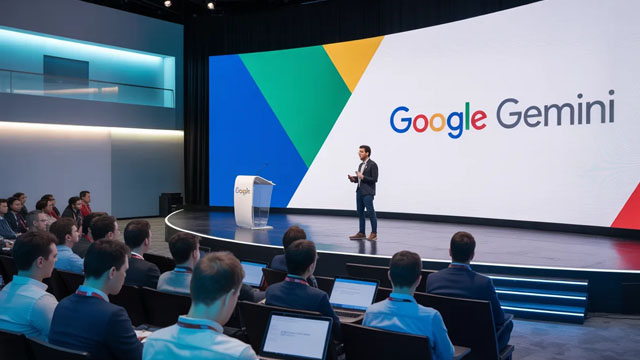
Alphabet is expanding beyond advertising into AI chips and cloud services, with TPU hardware sales and multi-billion-dollar customer contracts expected to accelerate cloud revenue. The company has $514 billion of cloud backlog booked, while court outcomes have reduced the risk of forced divestitures. Search share and AI integration remain resilient, strengthening the outlook for Alphabet's AI-driven growth strategy.
Analysis
The investable shift is not simply higher Cloud revenue; it is whether proprietary silicon raises Google Cloud’s gross-margin ceiling and reduces Alphabet’s dependence on NVIDIA-priced accelerators. If TPU capacity is contracted under multi-year commitments, incremental utilization should carry materially higher contribution margins than resold GPU capacity, supporting a rerating of Cloud from a strategic-loss-offset narrative toward a standalone infrastructure multiple. The critical diligence item is to reconcile the cited backlog with Alphabet’s reported remaining-performance-obligation disclosures and determine what portion is cancellable, AI-related, and scheduled to convert within 12-24 months.
Near term, the market may initially treat TPU demand as capex-heavy and margin-dilutive, particularly if depreciation outruns revenue recognition over the next two quarters. Over 1-3 months, Cloud bookings, AI revenue commentary, and capex guidance are the catalysts; over 6-18 months, proof that third-party workloads migrate from NVIDIA GPUs to TPUs would pressure NVDA’s hyperscaler pricing power and benefit suppliers with Google-specific exposure. This is not yet a clean NVDA short: TPU expansion can coexist with GPU demand while frontier-model training remains capacity constrained.
The contrarian risk is that customer contracts reflect discounted capacity reservations rather than durable workload migration, making revenue growth less valuable if it requires aggressive pricing or elevated customer concentration. Regulatory optionality is improved only at the remedy level; adverse search monetization, data-use, or distribution remedies could still raise traffic-acquisition costs or constrain AI product distribution. Falsify the constructive thesis if Cloud operating-margin expansion stalls despite accelerating revenue, capex rises faster than booked-revenue conversion for two consecutive quarters, or management reduces 2026 infrastructure return expectations.
AllMind Terminal
AI-powered research, real-time alerts, and portfolio analytics for institutional investors.
Request TrialMarket Sentiment
Overall Sentiment
moderately positive
Sentiment Score
0.68
Ticker Sentiment
Key Decisions for Investors
- Initiate a 6-12 month long GOOGL position, preferably versus a short equal-dollar MSFT only if Google Cloud growth reaccelerates while Azure growth decelerates; target 15-20% relative upside from Cloud multiple expansion, with exit on two consecutive quarters of Cloud-margin deterioration.
- For defined risk ahead of the next two earnings reports, buy GOOGL 9-month 5-10% out-of-the-money call spreads rather than outright calls. The trade requires disclosed evidence that AI infrastructure revenue is converting into reported Cloud revenue; risk is limited to premium if capex dominates the narrative.
- Maintain NVDA exposure but reduce any concentrated hyperscaler-demand beta; set a watch trigger, not a short, on evidence that TPU external revenue exceeds 10% of Google Cloud revenue or management identifies meaningful third-party TPU migrations. That would be a 6-18 month signal of accelerator substitution and potential NVIDIA gross-margin pressure.
- Request diligence on Alphabet’s reported backlog/RPO composition, cancellation terms, customer concentration, and TPU pricing before increasing position size. A discrepancy between promotional backlog figures and audited contractual obligations would materially weaken the revenue-visibility thesis.
More News
- Nscale wants a $35 billion valuation. Nvidia is helping foot the bill
- Australia to investigate if OpenAI hack of government health website broke the law
- Meta plans to spend $145 billion this year, more than every military budget except the U.S., China and Russia
- How an OpenAI ‘agent’ hacked Australia’s Medicare and what that means
- China vs US: Who is winning the AI race, in four charts
- F-Droid app store thumbs its nose at Google's dev crackdown
From AllMind Research
- Anthropic IPO Preview: Valuation, Timing, and What to Watch
- Shein After the IPO: Venue, Valuation, and What Must Be Proved
- What AI Research Tools Should a Small Hedge Fund Buy First?
- Weekly Update: Sector Analysis, Improvements on Research Data, and Performance Enhancements
- Choosing an AI Copilot for Equity Research