
Georgia State University Expands Partnership with Studiosity Following Highly Successful AI Writing Support Pilot
Source: PR Newswire
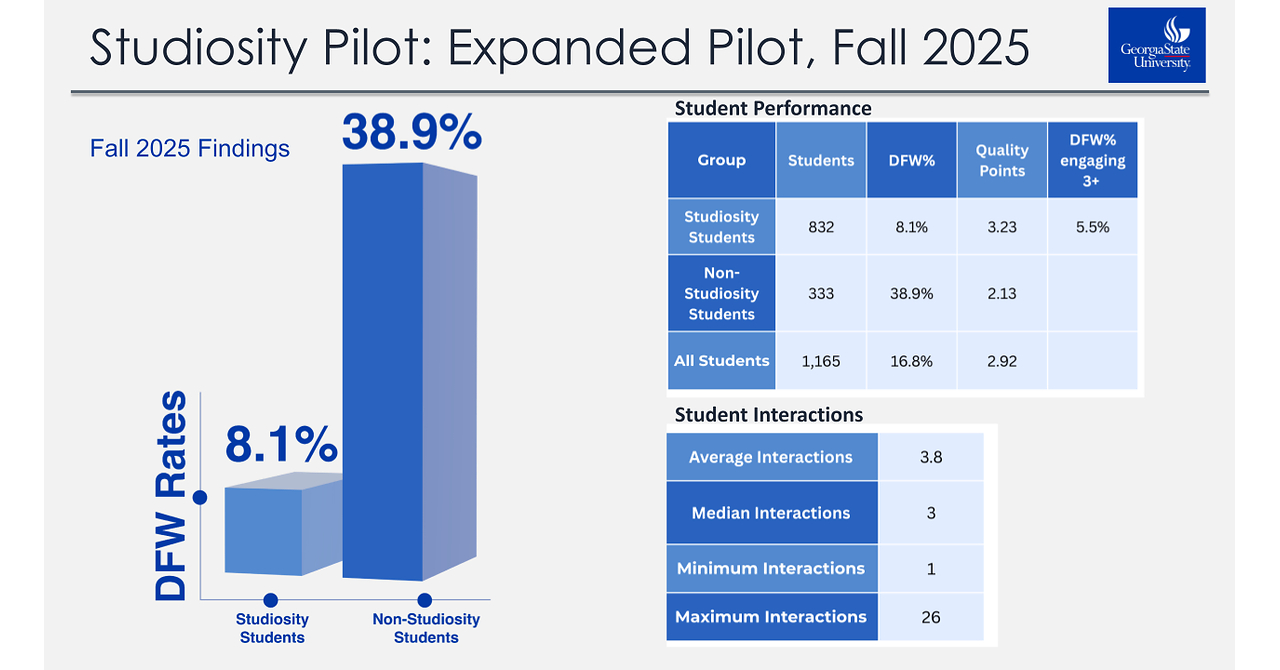
Georgia State University expanded its Studiosity AI-writing-feedback partnership from a 1,000-student pilot to 7,000 students after users posted an 8.0% DFW rate versus 38.9% for non-users in the same courses. Students using the tool averaged a 3.23 grade point average, while multiple-draft users improved grades by an average of 5 points; more than 80% of engagement occurred outside business hours. The expansion supports GSU's strategy to scale equitable, 24/7 academic assistance, though the announcement is primarily operational and unlikely to materially affect broad financial markets.
Analysis
This is not directly investable: Studiosity is private, the announcement discloses neither contract value nor retention economics, and pilot selection bias likely explains part of the outcome gap. The signal is nevertheless constructive for education-software vendors selling institutionally governed AI rather than consumer-facing generative-AI tools. The economically relevant feature is workflow integration and auditability: universities can justify recurring spend when AI lowers demand for scarce tutoring capacity, improves retention, and keeps faculty in control of assessment standards.
Over the next 1-3 months, this is a modest read-through for Instructure (INST) and PowerSchool (PWSC) only if procurement activity shows LMS-embedded AI tools are winning incremental budget rather than displacing core-platform spending. The larger 6-18 month effect is likely margin pressure on human tutoring and legacy academic-support providers, while vendors with distribution through LMS, student-information systems, and compliance workflows gain an advantage over standalone AI applications. Microsoft (MSFT) and Alphabet (GOOGL) remain indirect beneficiaries through education-cloud and model consumption, but this single deployment is immaterial to consolidated earnings.
The contrarian risk is that universities increasingly standardize on native AI functionality from LMS providers or hyperscalers, compressing standalone feedback-tool pricing once contracts renew. A stronger counter-risk is regulatory: privacy, accessibility, academic-integrity, and model-bias reviews can lengthen higher-ed sales cycles materially. The thesis is falsified if institutions report no measurable retention or staffing-cost benefit after broad deployment, or if LMS vendors bundle comparable writing-feedback features at negligible incremental price.
AllMind Terminal
AI-powered research, real-time alerts, and portfolio analytics for institutional investors.
Request TrialMarket Sentiment
Overall Sentiment
moderately positive
Sentiment Score
0.62
Key Decisions for Investors
- No standalone trade on this release; Studiosity is private and disclosed economics are insufficient to underwrite a public-equity read-through.
- Place INST on a 1-3 month procurement watch: become constructive only if management cites attach-rate or net-retention acceleration from governed AI modules. Falsifier: AI demand is described as a bundled feature with no ARPU uplift.
- Monitor PWSC quarterly bookings and higher-education product commentary for evidence that AI support tools expand wallet share rather than divert IT budgets; avoid initiating solely on this theme given limited direct exposure.
- For a broader 6-18 month expression, prefer MSFT over pure-play education-AI vendors: Azure distribution and enterprise compliance positioning capture adoption with lower single-product pricing risk. Treat this as a thematic tilt, not an event trade; reassess if education AI regulation constrains cloud/model usage.
More News
- Here’s the ‘core economic flaw’ in the AI bull case as stock and bond trades unravel, according to a top economist
- Biotech stocks are surging. How investors can play the new drug innovation boom
- AI funding fears rattle Wall Street. Here's how we're adjusting our portfolio
- Nvidia's role as AI financier faces first big test as neoclouds take market hit
- Ukraine says Starlink and Starshield high speed restrictions have been lifted
- Goldman says these top tech stocks have plenty of upside ahead of earnings