
Ozelle destacará O-Cyte 1 en MEDICA 2026: análisis hematológico asistido por IA con capacidad escalable
Source: PR Newswire
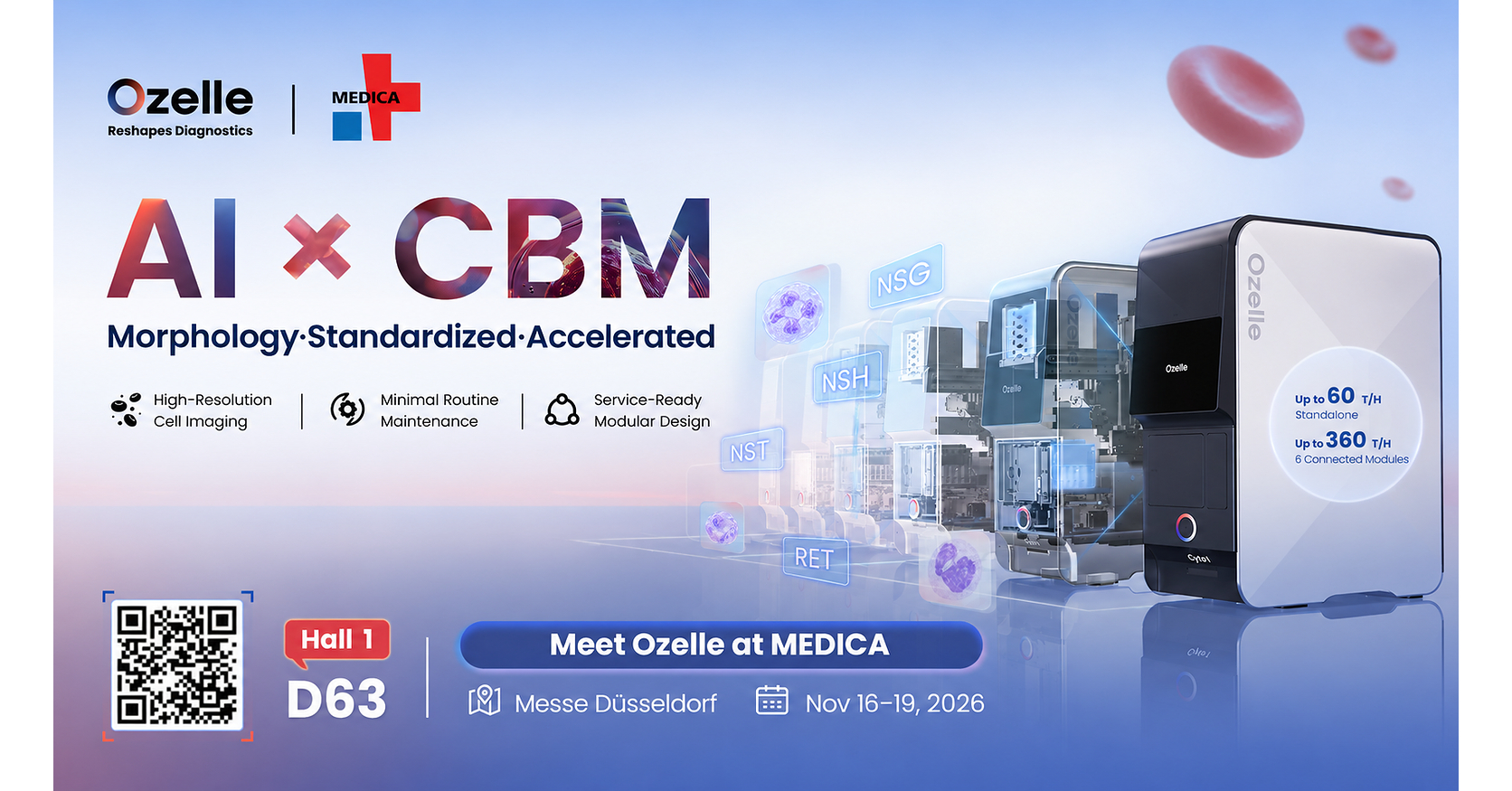
Ozelle presentará el analizador hematológico O-Cyte 1 en MEDICA 2026, con capacidad de hasta 60 pruebas por hora en una unidad y 360 pruebas por hora en una configuración de seis unidades. El equipo combina hemogramas con diferenciación de glóbulos blancos en 7 subpoblaciones, imágenes celulares de alta resolución y clasificación asistida por IA, con funciones diseñadas para facilitar el mantenimiento. La compañía también exhibirá los sistemas EHBT-75 y EHBT-50 y su plataforma Open Dx; el artículo no informa ventas, resultados clínicos ni impacto financiero.
Analysis
Ozelle’s launch is not yet an investable earnings signal: the release supplies no independent accuracy data, regulatory clearances, installed-base figures, pricing, or orders. The investable question is whether image-linked AI morphology can lower total lab workflow costs without sacrificing reproducibility. A six-unit configuration’s stated throughput is not equivalent to demonstrated uptime or lower cost per reportable result; verify validation performance, service response, reagent economics, and LIS integration before assigning share gains.
If adoption develops, the nearer-term pressure point is not necessarily analyzer sales but incumbent vendors’ service and consumables economics. Sysmex, Beckman Coulter (Danaher), Abbott, and Siemens Healthineers have established lab relationships and support infrastructure that may blunt a hardware feature advantage. Conversely, a consumables-integrated design could create recurring revenue for Ozelle while raising customer switching costs—or trigger procurement resistance if lifecycle costs are unattractive. The proposed ICSH standardization work is directionally supportive of digital morphology, but formal reproducibility requirements could raise validation costs and advantage vendors with stronger evidence.
Catalysts are limited before MEDICA (November 16–19); the release itself is promotional. Over 1–3 months, look for independently verifiable evaluations, regulatory status by market, distributor agreements, and customer deployments. Over 6–18 months, sustained adoption would require reliable service and compelling cost per test, not just scalable capacity. No public-equity trade is justified on this announcement alone. The contrarian risk is treating AI-enabled morphology as a near-term displacement event when workflow validation and service coverage may matter more than model capability.
AllMind Terminal
AI-powered research, real-time alerts, and portfolio analytics for institutional investors.
Request TrialMarket Sentiment
Overall Sentiment
mildly positive
Sentiment Score
0.25
Key Decisions for Investors
- No trade on the press release alone; Ozelle has no supplied ticker or verified public-company exposure, and the announcement contains no confirmed commercial orders.
- Add Sysmex, Danaher/Beckman Coulter, Abbott, and Siemens Healthineers to a competitive watchlist rather than shorting them: seek evidence of lost tenders, pricing pressure, or reduced hematology placement activity before expressing a negative view.
- Use MEDICA and the following 1–3 months as diligence catalysts. Request independent performance comparisons, jurisdiction-specific clearances, installed-base and distributor data, and total cost per reportable result, including reagent and service costs.
- Falsify the adoption thesis if independent studies show weaker reproducibility or no workflow-cost benefit, or if distributor interest fails to convert into deployments; strengthen it only with validated performance and repeat customer orders.
More News
- What investors need to know about Alphabet's stock-busting earnings report
- Our next steps for Alphabet stock after earnings disappoint at nearly every turn
- Budget 2026 speech
- SK Hynix says the memory-chip shortage will last until 2030—and more than half its production is booked for the next two years
- China’s tech darlings are losing their shine. Here’s what’s behind the sell-off
- Asian shares fall as Alphabet earnings miss drags Wall St futures lower