
HillFaith Highlights Recent CNCT Capitol Pulse Survey on Congressional Aides' Views Regarding Federal AI Equity Stakes
Source: PR Newswire
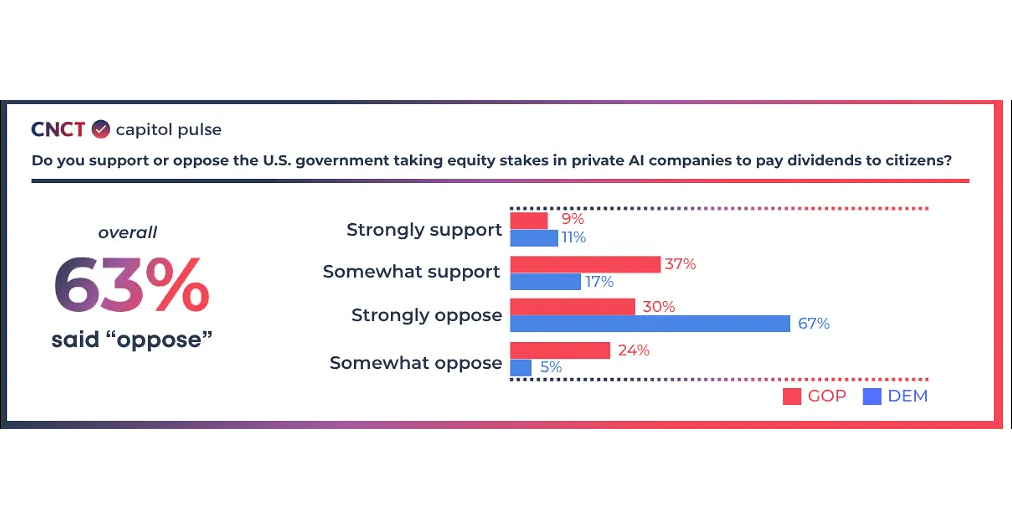
A CNCT Capitol Pulse survey found that 63% of congressional staffers oppose the U.S. government taking equity stakes in private AI companies. Strong opposition was reported by 67% of Democratic aides and 58% of Republican aides, while only 11% of Democrats and 9% of Republicans strongly supported such stakes. The findings indicate legislative-staff resistance to direct federal ownership in AI, though they do not represent enacted policy or an immediate market catalyst.
Analysis
This is not a policy catalyst by itself: staff-attitude surveys from a non-market participant have low predictive power absent committee text, appropriations language, agency rulemaking, or executive action. The more relevant signal is that direct federal equity participation appears politically difficult across both parties, reducing near-term odds of a sovereign-ownership framework that would dilute private AI economics or attach governance constraints to leading platforms.
For megacap AI beneficiaries, the investable implication is marginally favorable for private-sector value capture rather than a change to demand, capex, or earnings. MSFT, NVDA, GOOGL, AMZN, META, and private-market AI suppliers remain far more exposed to export controls, power-grid permitting, antitrust remedies, procurement rules, copyright liability, and potential model-safety regulation than to federal ownership. Over the next 1-3 months, this should not alter estimates or positioning; a material re-rating would require legislative movement toward subsidized public compute infrastructure or mandatory government rights in federally funded AI IP.
The contrarian risk is that rejection of equity stakes does not imply a deregulatory outcome. If policymakers conclude they cannot participate economically in AI upside, they may instead favor tougher access, safety, competition, and labor restrictions—particularly if automation becomes an election issue. That would be more negative for platform monetizers and hyperscaler capex returns than for diversified defense primes such as LMT, NOC, and RTX, which can monetize AI through contracted procurement under more established compliance regimes.
No standalone trade is warranted. Treat this as a watch item: policy risk is currently being overstated only if AI multiples embed a near-term nationalization scenario, which public-market pricing does not appear to do. Falsify the benign interpretation if draft legislation introduces government warrants, march-in rights, compulsory licensing, federal compute ownership, or restrictions tied to semiconductor/cloud procurement.
AllMind Terminal
AI-powered research, real-time alerts, and portfolio analytics for institutional investors.
Request TrialMarket Sentiment
Overall Sentiment
neutral
Sentiment Score
-0.05
Key Decisions for Investors
- No position change on this release; do not use it as a catalyst to add exposure to NVDA, MSFT, GOOGL, AMZN, or META. Reassess only upon committee markups, appropriations language, or executive-order detail.
- Maintain a 1-3 month policy monitor for federal AI-compute procurement and federally funded IP provisions; an explicit government-warrant or march-in-right proposal would be a negative catalyst for AI infrastructure valuation multiples.
- For portfolios seeking policy-resilient AI exposure, prefer a modest relative overweight in LMT/NOC/RTX versus high-multiple software AI proxies over 6-18 months, contingent on evidence that defense AI procurement is accelerating; invalidate if defense budget negotiations cut R&D or procurement growth.
- Use any AI-policy-driven selloff in hyperscalers as a screening opportunity rather than an automatic buy: require confirmation that cloud backlog, AI revenue disclosure, and data-center capex guidance remain intact before adding.
More News
- What next for France as riots rattle markets? Three questions facing investors ahead of more protests
- Next week brings major risks for the stock market, just as the AI trade keeps faltering
- AI Doubts Spread Cracks in Equities, Credit Markets: Evening Briefing Americas
- Looters hit 3,000 French businesses. Within hours, the haul was trending on Vinted under the riot’s date
- Kinder Morgan, Energy Transfer and Williams could benefit from cheap natural gas
- CrowdStrike CEO's alarming prediction — plus, the sell-off spreads beyond tech
From AllMind Research
- Anthropic IPO Preview: Valuation, Timing, and What to Watch
- Shein After the IPO: Venue, Valuation, and What Must Be Proved
- What AI Research Tools Should a Small Hedge Fund Buy First?
- Augmented Intelligence: AllMind, Elevate Human Judgement With an Accessible, Powerful, Data-Driven Financial AI Toolkit
- AI Research Systems for Hedge Funds: A Pilot Design