
YFORE presenta un sistema de detección por radar UWB multiescenario para vehículos de próxima generación
Source: PR Newswire
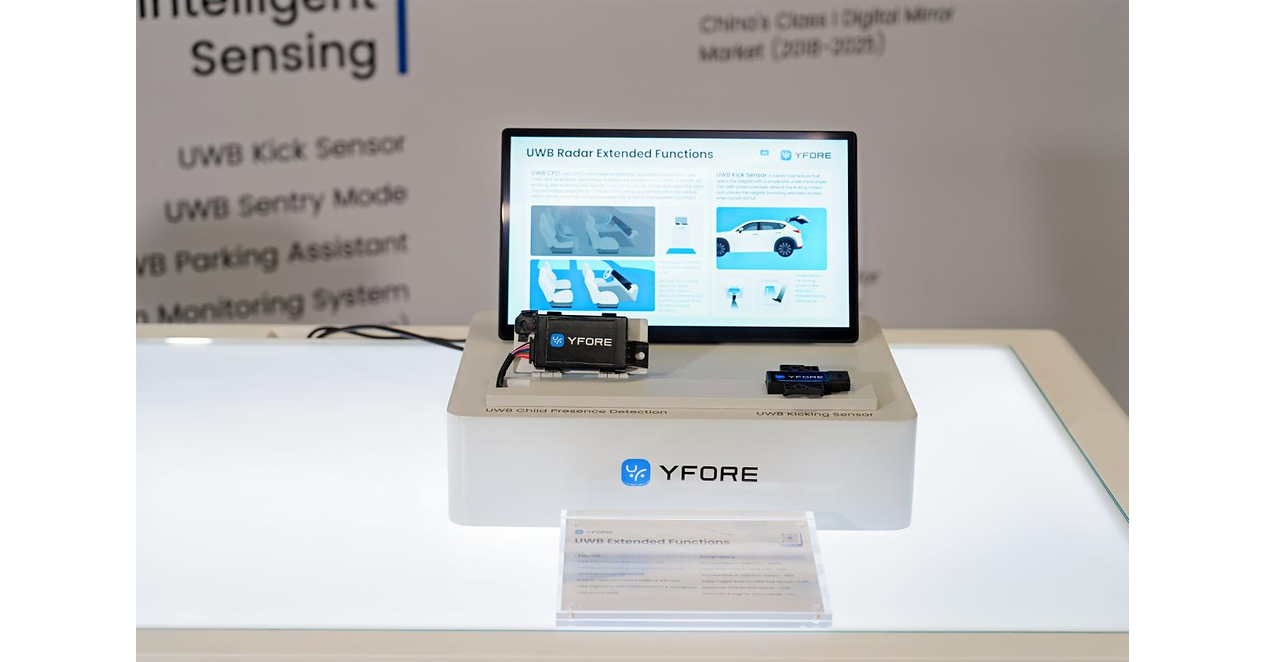
YFORE presentó una cartera de sensores de radar UWB multiescenario para vehículos, destacando una monitorización en cabina con >99% de detección de vida (fuga de señal <20 cm) y tiempos de respuesta <13 s alineados con Euro NCAP. En el exterior, reporta acceso manos libres al portón trasero con >98% de activación y <0,5% de falsas alarmas incluso con lluvia/animales, y un modo centinela que ahorra hasta 2 kWh por noche. El impacto potencial es principalmente tecnológico para futuras plataformas, con señal de mejora en seguridad y eficiencia, pero sin evidencia directa de resultados financieros.
Analysis
This reads more like capability signaling than a revenue event. The economic lever is content-per-vehicle: if UWB can replace multiple discrete sensors, the near-term winner is the supplier that owns the stack and can bundle sensing, access, and parking into one platform, while legacy ultrasonic/low-end parking content faces gradual share loss. The bigger second-order beneficiary may be automotive UWB silicon vendors and radar ASIC providers, because once OEMs validate the architecture, the dollar content migrates upstream from hardware assemblies to chips and software.
The competitive risk is that this compresses the moat of point-solution suppliers. Tier-1s with broader cockpit/ADAS integration, plus smart-mirror players and integrated electronics suppliers, are better positioned than standalone sensor vendors if OEMs push for fewer modules, lower wiring complexity, and lower false-alarm liability. But until there is a named SOP, platform award, or design-win cadence, this is still pre-commercial marketing; the market should not extrapolate meaningful P&L impact from a demo.
Catalyst path is longer-dated: 1-3 months for OEM validation chatter or NCAP language that rewards in-cabin detection and CPD compliance; 6-18 months for platform awards if the tech proves cheaper than camera-plus-ultrasonic stacks. Falsifiers are simple: if OEMs keep specifying mixed-sensor architectures, if false positives remain high in real-world weather/dirty-road conditions, or if the bill of materials comes in above current sensor bundles, adoption stalls and this remains a press-release story.
Contrarian view: consensus may be underestimating how much of the value pools into semiconductor content rather than the tier-1 assembler. If UWB parking and occupant sensing scales, the trade is not necessarily long the visible sensor brands; it is long the chip content and integrated electronics beneficiaries, and short the commoditized sonar/ultrasonic content that gets designed out first.
AllMind Terminal
AI-powered research, real-time alerts, and portfolio analytics for institutional investors.
Request TrialMarket Sentiment
Overall Sentiment
mildly positive
Sentiment Score
0.18
Key Decisions for Investors
- No immediate directional trade on YFORE itself; treat as watchlist-only until a named OEM design win or SOP date appears. Probability of near-term fundamental impact is low, so avoid chasing the press-release pop.
- Watch NXP (NXPI) and Qorvo (QRVO) for incremental UWB content pull-through over the next 6-18 months; bias is modestly positive if automotive UWB shifts from niche access use-cases to multi-function cabin/parking stacks.
- Relative-value idea: long integrated automotive electronics suppliers with software/content leverage, short legacy sensor/content names tied to ultrasonic parking modules. Use a 3-6 month horizon and only initiate if a second OEM validation headline confirms adoption.
- Alert on Euro NCAP / regulatory language around child-presence detection and occupant monitoring. A formal scoring uplift would be the cleanest catalyst for a re-rating across the in-cabin sensing chain.
- If building a basket, prefer component enablers over tier-1 marketing claims; look for 10-15% upside to UWB-enabled content assumptions, but require proof before paying for it.
More News
- CoreWeave credit default swaps hit distress levels as investors sour on AI debt
- Penske Automotive agrees to be taken private by Penske, Mitsui
- Faraday Copper completes acquisition of BHP’s San Manuel project
- Supermicro promised a new CFO in December 2024. A $2.5 billion smuggling case and a co-founder’s arrest later, it has one
- Blackstone President Jon Gray Bets Big on AI Boom
- Ukraine to resume strikes on Russian refineries, shattering hopes of an 'energy ceasefire'
From AllMind Research
- Anthropic IPO Preview: Valuation, Timing, and What to Watch
- Shein After the IPO: Venue, Valuation, and What Must Be Proved
- What AI Research Tools Should a Small Hedge Fund Buy First?
- AI Research Tools for Pension Funds and Allocators
- AllMind's Data Standardization Methodology: Our Approach to Fundamentals