
AMD's Case For The Underdog
Source: seekingalpha.com
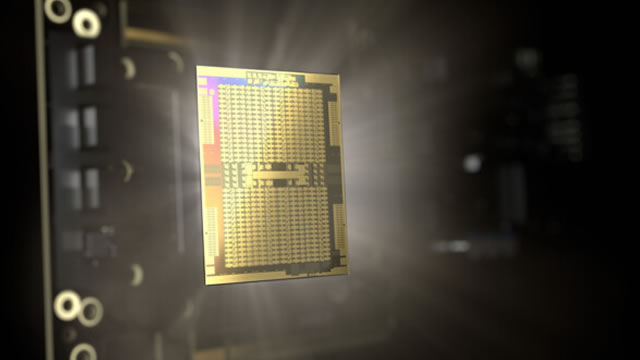
AMD is characterized as a credible AI-chip alternative to Nvidia, ranking No. 74 of 5,234 stocks in the author's Best Stocks Now database. The article cites a 141% year-to-date gain and projects 84% five-year upside to a $947.76 target price from $516.13 currently, while flagging meaningful share-price volatility as the principal risk.
Analysis
The investable question is not whether AMD can participate in AI demand, but whether it can sustain accelerator share gains fast enough to offset the valuation premium already embedded in a high-momentum narrative. AMD's upside is most sensitive to MI-series GPU availability, hyperscaler deployment disclosures, and software-stack adoption; hardware benchmark wins alone do not translate into durable gross-margin expansion without repeatable enterprise inference demand. NVDA retains the ecosystem advantage through CUDA, networking, and customer switching costs, so AMD's share gains are more likely to emerge first in price-sensitive cloud capacity and sovereign AI deployments than in the highest-value training workloads.
Near term, momentum can persist through the next earnings cycle if management raises AI-GPU revenue expectations and demonstrates supply conversion into shipped systems rather than design-win announcements. Over 1-3 months, the primary risk is that sell-side estimates extrapolate accelerator revenue before customers validate utilization and margins; a guide that implies weaker mix, elevated inventory, or delayed rack-scale qualification could compress AMD's multiple sharply despite strong revenue growth. Monitor AMD's data-center gross margin, AI revenue backlog-to-revenue conversion, and hyperscaler capex commentary as the key falsifiers.
The less obvious beneficiary of AMD share gains is not necessarily AMD equity alone: server OEMs and memory suppliers can gain from a second qualified accelerator platform, while NVDA's pricing power faces greater risk only if AMD can bundle competitive compute with a credible software and networking solution. Consensus may be overestimating the value of a five-year price target: semiconductor AI demand is cyclical, and a premium multiple requires evidence that AMD's AI business can remain structurally accretive through the next digestion phase rather than merely capture a supply-constrained window.
AllMind Terminal
AI-powered research, real-time alerts, and portfolio analytics for institutional investors.
Request TrialMarket Sentiment
Overall Sentiment
moderately positive
Sentiment Score
0.62
Ticker Sentiment
Key Decisions for Investors
- Do not chase AMD solely on the cited valuation target; establish a 1-3 month watch position only after management provides verifiable accelerator revenue, gross-margin, and supply-conversion guidance. Add on a post-earnings raise in AI revenue expectations accompanied by stable or improving gross margin; exit if data-center margin deteriorates or AI guidance is deferred.
- Express relative AI-share-gain exposure through long AMD / short NVDA in equal beta-adjusted notional only if AMD demonstrates two consecutive quarters of accelerator revenue execution. Target a 10-15% relative move over 3-6 months; stop if NVDA's data-center guidance accelerates materially while AMD fails to raise its AI outlook.
- For a bullish tactical position, prefer defined-risk AMD call spreads dated 4-6 months beyond the next earnings report rather than outright calls, because implied upside appears dependent on execution evidence rather than a single catalyst. Size for a full premium loss; take profits if the stock rerates before revenue guidance confirms the thesis.
- Track hyperscaler capital-expenditure guidance and GPU utilization commentary as a sector-level risk trigger. Broad cloud capex moderation or evidence of underutilized AI capacity would pressure both AMD and NVDA, but AMD should underperform because its multiple depends more heavily on incremental share capture.
More News
- China's AI leaders keep quiet despite U.S. 'publicity' on tech risks
- AWS says it can't restore service to Bahrain, UAE facilities 6 months after Iran strikes
- Is Amazon Stock a Buy After Its Best Quarter in Years?
- Two camps have emerged in the debate over AI safety and regulation
- Push for AI regulation mounts as talk of AI’s ‘existential’ risks go mainstream. But Trump resists calls for a slowdown
- Urgent calls from OpenAI, Anthropic for an AI slowdown fall on deaf ears with Trump, Xi ahead of next week’s meeting