
Pusan National University Study Rethinks How Household Income Needs Are Assessed for Welfare Support
Source: PR Newswire
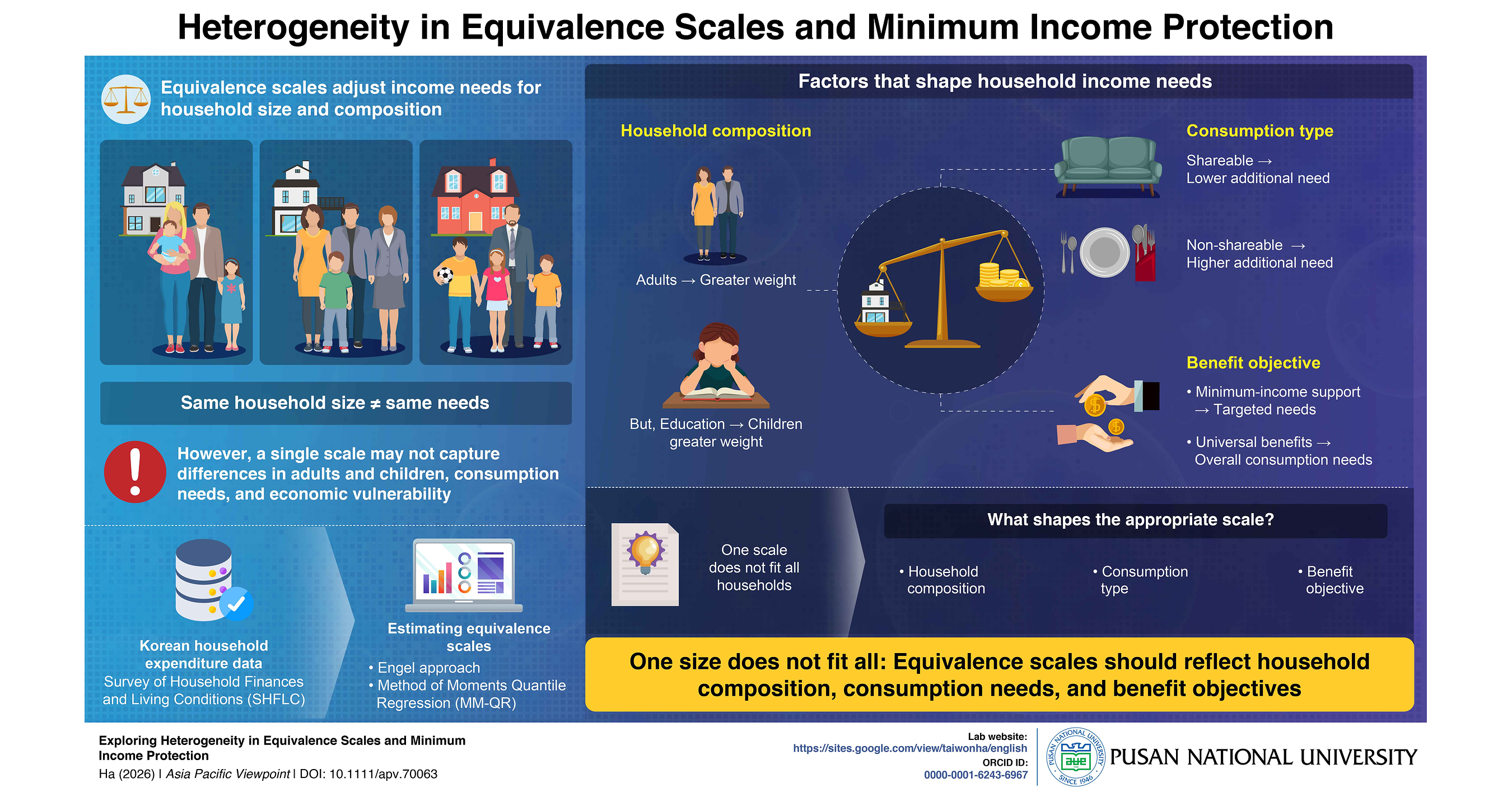
A Pusan National University study using Korean household data found empirical income equivalence scales were generally below the old OECD benchmark, indicating that benefit adjustments should vary by household composition and spending category. Additional adults typically require greater income weights than children, except for education spending, where children create relatively higher needs. The findings could inform more targeted eligibility thresholds and payments under Korea's National Basic Livelihood Security system, potentially improving welfare-program fiscal efficiency.
Analysis
This is not an investable catalyst absent evidence that Korean ministries will translate academic findings into a budget proposal or eligibility-rule change. The most plausible near-term implication is administrative: a more granular means-testing framework could increase implementation costs and delay benefit adjudication before any aggregate fiscal effect emerges. Treat this as a policy-monitoring signal rather than a macro demand signal.
Over 6-18 months, adoption of differentiated household weights would redistribute transfers rather than necessarily expand the welfare envelope. Households with more adults could gain relative to current formulas, while child-heavy households may benefit only where education support is separately recalibrated; the net consumption effect depends on whether reforms are budget-neutral. Korea's fiscal constraint and aging population make offsetting reductions elsewhere more likely than a broad stimulus, limiting implications for KOSPI consumer, retail, or housing exposures.
The non-obvious read-through is political: if policymakers use more precise targeting to contain welfare costs, it could modestly reduce pressure for universal cash-transfer programs, which would be less supportive for domestic-demand proxies than consensus narratives around social-spending expansion. Conversely, a reform framed around child education costs could become part of a broader fertility-policy package, creating a more durable—though still small—tailwind for education, childcare, and child-focused consumption. No listed-company trade is justified until a legislative proposal identifies fiscal magnitude, implementation date, and funding source.
AllMind Terminal
AI-powered research, real-time alerts, and portfolio analytics for institutional investors.
Request TrialMarket Sentiment
Overall Sentiment
neutral
Sentiment Score
0.10
Key Decisions for Investors
- No immediate position: do not trade Korean consumer-discretionary or fiscal-policy proxies on an academic publication without a government consultation, budget line item, or National Basic Livelihood Security rulemaking process.
- Set a 1-3 month policy alert for Ministry of Health and Welfare announcements and the next Korean budget cycle; quantify whether any proposal is incremental spending versus budget-neutral redistribution before positioning.
- If a funded child-education benefit expansion emerges, screen Korean education and childcare exposure for revenue sensitivity, but require evidence of household eligibility, payment timing, and addressable-spend leakage before initiating longs.
- If reforms are explicitly budget-neutral and shift support toward adult households, consider this modestly negative for broad domestic-consumption stimulus expectations rather than a standalone short; falsify on a materially larger welfare appropriation or universal-transfer proposal.
More News
- France’s latest debt warning describes a country where governance is breaking down — and even doing too little, too late is barely possible
- Sudan’s soaring fuel prices make getting by harder for workers
- French police use tear gas and water cannons after some protests turn violent as shopkeepers board up storefronts across Paris
- France Faces New Protests After Week of Violence
- Brazil’s Lula, Bolsonaro draw thousands to election-eve rallies
- Violence flares in Paris after massive, largely peaceful protests across France