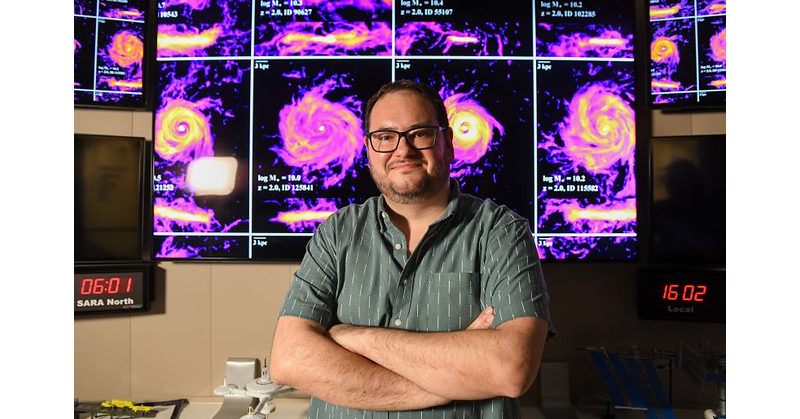
A Florida International University study finds galaxy mergers are neither necessary nor sufficient to stop star formation (“quenching”). In simulations of 11,000 galaxies, only ~3% of major mergers were followed by quenching within 1 billion years, and including all mergers raises this to ~12%. The research suggests slower internal galaxy processes—not dramatic collisions—drive quenching.
This is not a cash-flow event for the market. The only plausible transmission channel is indirect: more emphasis on long-horizon simulations and computational astrophysics could marginally support high-performance compute, storage, and networking budgets at universities and national labs, but that demand is far too small to move fundamentals for NVDA, AMD, ANET, or HPE. The provided names have no identifiable linkage, so there is no clean winner/loser setup here.
The important second-order point is that this is a reminder about how scientific consensus shifts: not via a single dramatic result, but via repeated model refinements and better compute. If that broader pattern accelerates, the beneficiaries are research-cloud providers and HPC vendors on budget-cycle timelines of 12-24 months, not on a headline basis. Falsifiers are simple: if follow-up observations reinforce merger-driven quenching, or if the simulation result is not replicated outside IllustrisTNG-like frameworks, the narrative fades quickly.
Contrarian read: investors should not confuse intellectual novelty with monetizable innovation. The market often overprices "breakthrough" language in sectors with no procurement or revenue bridge; in this case, the right reaction is restraint, not a thematic trade. If anything, the article is mildly supportive of the view that durable compute intensity matters more than flashy one-off scientific events, but that is too diffuse to express with conviction today.
AI-powered research, real-time alerts, and portfolio analytics for institutional investors.
Request TrialOverall Sentiment
neutral
Sentiment Score
0.05
Ticker Sentiment
