
Expanding Nanopositioning Options with Bi-Phase Piezo Motors
Source: PR Newswire
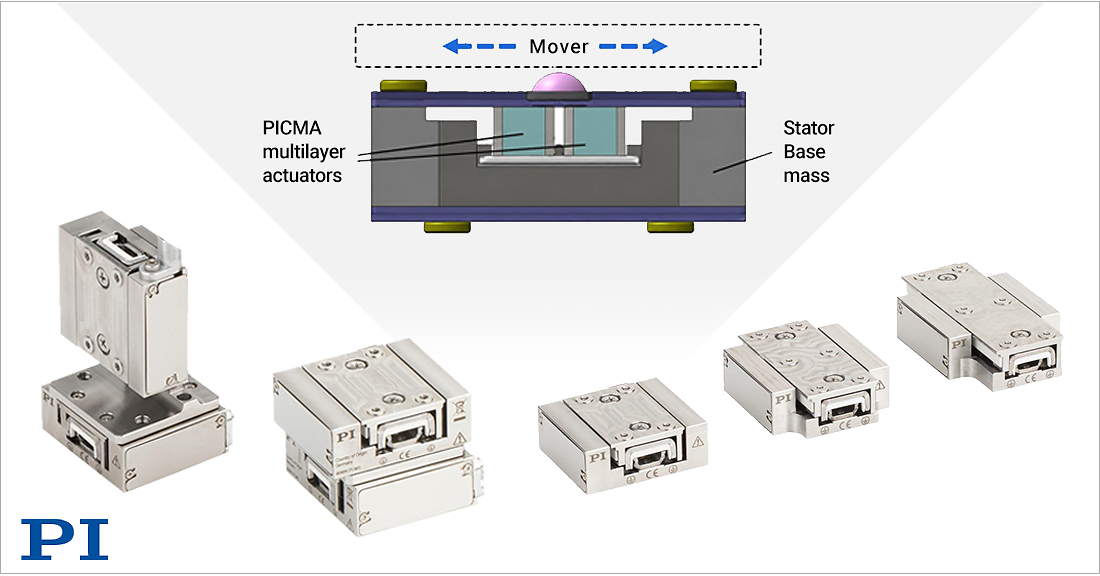
Physik Instrumente expanded its Bi-Phase Inertia Drive (BIX) nanopositioning technology into higher-force linear, rotary, micrometer screw-drive, two-axis tip/tilt, and cryogenic-motion designs. The high-force configuration is designed to approximately double drive force versus the standard one-sided architecture, while the platform targets compact OEM applications in photonics, metrology, microscopy, and semiconductor instrumentation. The announcement demonstrates broader product applicability but provides no revenue, order, or financial guidance metrics.
Analysis
This is technically credible but not yet investable public-equity information: no customer qualification, production ramp, pricing, backlog, or design-win disclosure establishes a near-term revenue catalyst. The relevant mechanism is component substitution in precision-motion assemblies: if the architecture lowers system-level footprint and eliminates external holding hardware, OEMs may accept higher actuator cost in semiconductor inspection, photonics alignment, and cryogenic research tools where downtime and spatial constraints dominate bill-of-materials decisions.
The most plausible second-order beneficiaries are precision-optics and semiconductor-metrology ecosystems rather than broad robotics. Key watch-list exposures include MKS Instruments (MKSI), Coherent (COHR), and FormFactor (FORM), whose customers face demand for tighter alignment and higher-throughput optical/electrical test; however, PI is private and the degree of direct sourcing overlap is unverified. Established motion-control vendors—Novanta (NOVT), Aerotech (private), and Hexagon’s precision-measurement businesses (HEXA-B)—could face selective competitive pressure only if the platform demonstrates reliability at scale and wins OEM qualification cycles.
Near term, the release should not alter estimates or valuation. Over 6-18 months, the investable signal would be disclosed adoption in semiconductor inspection, quantum/cryogenic instrumentation, or laser-processing OEMs, where a compact self-locking stage can improve tool density and reduce calibration/service burden; qualification generally precedes meaningful revenue by 12-24 months. The contrarian view is that piezo-motion innovation often remains a niche premium feature: wear at friction interfaces, controller complexity, and cryogenic-cycle reliability can erase claimed system advantages outside low-volume instruments.
AllMind Terminal
AI-powered research, real-time alerts, and portfolio analytics for institutional investors.
Request TrialMarket Sentiment
Overall Sentiment
mildly positive
Sentiment Score
0.35
Key Decisions for Investors
- No immediate directional trade. Treat this as a technology watch item rather than a catalyst for MKSI, COHR, FORM, NOVT, or HEXA-B; the disclosed information lacks revenue, customer, and volume data.
- Monitor the next 2-4 quarterly calls for semiconductor/optical-tool OEM commentary on compact precision-motion content, design wins, or service-cost reductions. A verified adoption signal at a major inspection or photonics OEM would support a 6-12 month long bias in the relevant supplier, not a broad sector basket.
- Do not short NOVT or related motion-control peers on this development alone. Falsification of the competitive-risk thesis is absence of announced OEM qualifications after 12-18 months, or evidence that conventional servo/stick-slip architectures retain superior lifecycle reliability at comparable force.
- For a broader semiconductor-capex expression, retain focus on independently measurable order trends in metrology and photonics rather than this announcement; use MKSI/FORM relative performance only after management quantifies incremental precision-positioning demand.
More News
- Wall Street’s Nasdaq hits all-time high as AI frenzy gathers pace
- Data-Center Bet Makes ESDS One of India’s Best New Listings
- Asia stocks ride tech wave higher, oil stays subdued
- South Korean solar stocks jump as curbs on Chinese sector expected to remain in place
- Trump Says US Team Met With Iranians at UNGA
- U.S. regulators rush to write crypto rulebook after Clarity Act stalls in Senate