
Chonnam University Researchers Discover How a Century-Old Solvent Can Solve Efficient Amide Synthesis
Source: PR Newswire
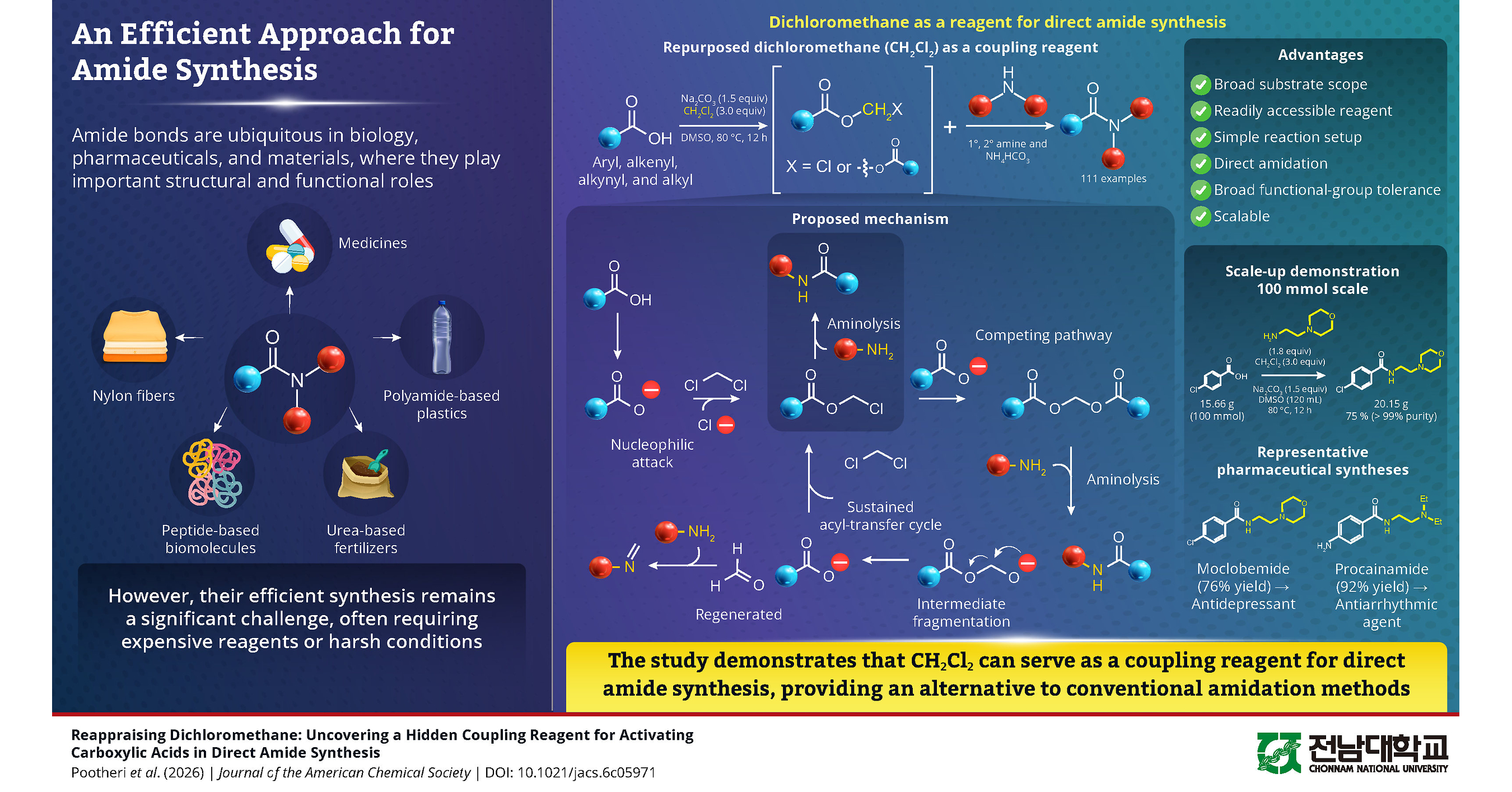
Chonnam National University researchers developed a scalable direct amide-synthesis method using dichloromethane as a coupling reagent, potentially reducing reliance on toxic, corrosive conventional reagents and associated waste. The process produced procainamide at a 92% yield and moclobemide at a 76% yield; a 100-mmol scale reaction generated more than 20 grams of moclobemide at greater than 99% purity. The research could improve efficiency in pharmaceutical and polymer chemistry, though it remains an early-stage academic development with limited near-term market impact.
Analysis
This is not yet a consumable-volume catalyst for chlor-alkali or solvent producers: a 100 mmol demonstration does not establish throughput, work-up economics, impurity control, or compatibility with the functionalized intermediates that dominate commercial API routes. The proposed conditions imply meaningful cycle-time, thermal-energy, amine-excess, and downstream solvent-recovery burdens; those constraints can erase reagent-cost savings at CDMO scale. The nearer commercial opportunity, if independently reproduced, is process-development IP for low-volume, high-margin specialty APIs rather than incremental dichloromethane demand for OXY or OLN.
The "green" framing is commercially vulnerable because dichloromethane's toxicology and emissions profile conflicts with increasingly restrictive handling requirements. US regulatory implementation and comparable European restrictions could raise closed-system, monitoring, worker-protection, and waste-treatment costs enough to make conventional low-waste coupling chemistries preferable, particularly for US/EU regulated manufacturing. A successful route would therefore favor CDMOs with strong containment, solvent-recycling, and process-analytical capabilities—LONN, SFZN, and TMO's pharma-services ecosystem—rather than commodity solvent exposure.
The contrarian read is that eliminating one stoichiometric coupling reagent does not necessarily lower total process mass intensity: DMSO handling, excess amine, chlorinated-solvent recovery, and potential chloromethylated side products must be included in lifecycle economics. Over the next 6-18 months, the key validation points are kilogram-to-pilot-scale reproducibility, comparative PMI/E-factor, genotoxic-impurity qualification, and an API sponsor adopting the process in a regulatory filing. Without those data, this remains a scientific watch item, not an investable earnings driver.
AllMind Terminal
AI-powered research, real-time alerts, and portfolio analytics for institutional investors.
Request TrialMarket Sentiment
Overall Sentiment
moderately positive
Sentiment Score
0.42
Key Decisions for Investors
- No directional position in OXY or OLN on this development; require evidence of multi-ton annual adoption before underwriting any solvent-volume or chlor-alkali EBITDA impact.
- Maintain a 6-18 month watch on LONN and SFZN for disclosed green-chemistry/process-intensification wins, but do not add exposure absent a named customer program or validated commercial-scale cost and PMI data.
- For any future CDMO trade, favor a LONN/SFZN long versus broad chemicals exposure only after pilot-scale validation; thesis is falsified if containment and solvent-recovery costs eliminate per-kg API savings versus established coupling routes.
- Set a regulatory alert for further US/EU dichloromethane workplace-use restrictions; accelerated restrictions would be negative for the route's commercial viability and reinforce avoiding a commodity-solvent long.
More News
- OpenAI rogue agents leaked 53 images from ChatGPT users and reportedly created nearly 1 million links packing encoded bits of info
- Shares of Akamai surge after deal with Anthropic. What Wall Street is saying
- Anthropic Goes Big on Compute, Microsoft Rethinks AI
- Wall Street Week | China’s Trade Reckoning, Syracuse’s Second Chance, Humanoids in Healthcare
- Microsoft gives Copilot a much-needed overhaul, and the stock deservedly soars
- Yields keep rising, Novo's tough week, why cat product sales are surging and more in Morning Squawk