
Pylontech Starts Mass Production of 588Ah and 601Ah LFP Cells for ESS
Source: PR Newswire
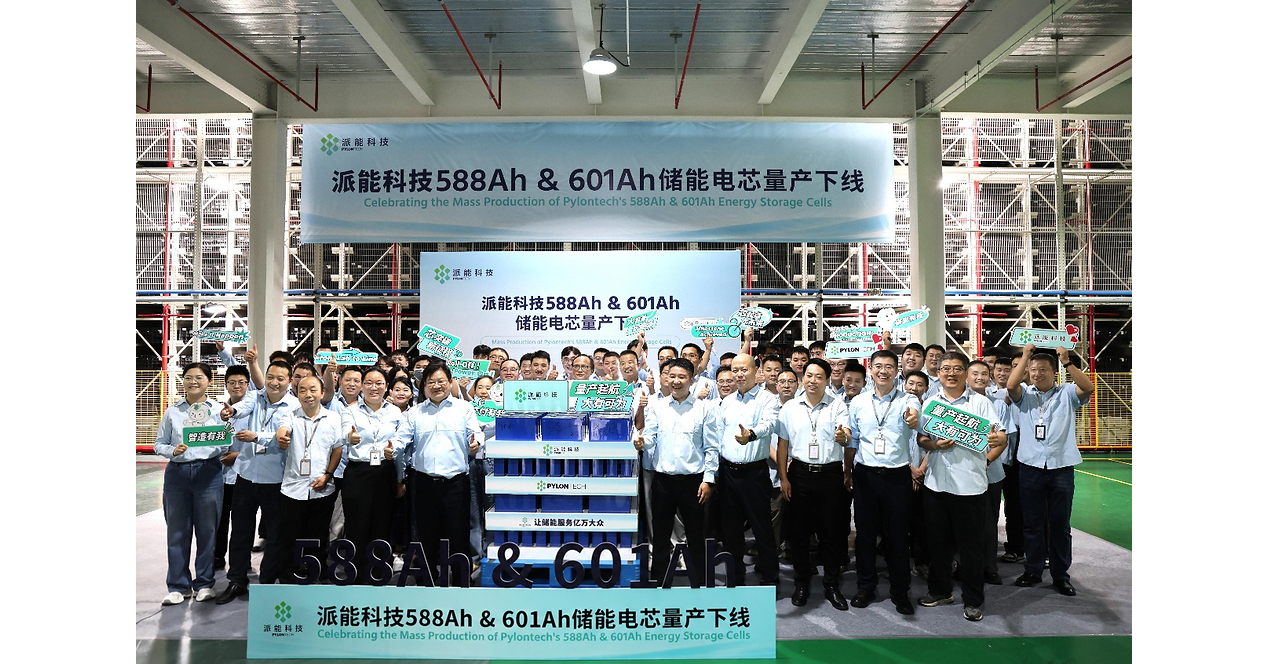
Pylontech has begun mass production of its 588Ah and 601Ah prismatic LFP cells for utility-scale energy-storage systems at its Hefei base, with more than 100MWh already produced. The 601Ah cell delivers 425.8Wh/L energy density, over 12,000 cycles and 96.5% energy efficiency, and will be incorporated into the company’s upcoming 6.25MWh and 8MWh PyOcean storage systems. The launch strengthens Pylontech’s utility-scale ESS expansion and leverages a highly automated manufacturing facility with full cell traceability.
Analysis
The strategic issue is not cell capacity alone but whether Pylontech can convert vertical integration into a lower all-in $/kWh and bankable delivery record in utility tenders. Larger-format LFP architectures reduce enclosure, busbar, thermal-management and commissioning cost per MWh; if qualification is successful, this pressures pure-play system integrators that buy cells externally. The likely near-term beneficiary set is Chinese integrated storage vendors—Pylontech (688063:SH), CATL (300750:SZ), EVE Energy (300014:SZ) and Sungrow (300274:SZ)—rather than Western integrators facing higher procurement costs and slower product-refresh cycles.
The press-release signal is not yet sufficient to underwrite earnings: the key missing variables are yield, warranty reserve assumptions, realized system ASP, and signed backlog conversion. Cell-format transitions can initially raise scrap, working capital and field-failure risk; a single thermal or degradation issue would matter disproportionately because utility customers increasingly demand long-duration warranties. Over the next 1-3 months, tender wins and disclosed gross-margin progression are the relevant catalysts; over 6-18 months, the question is whether accelerated Chinese supply drives storage-system price deflation faster than project demand expands.
Consensus may overvalue headline efficiency gains while underestimating financing constraints. Lower equipment cost improves project IRRs, but grid interconnection queues, merchant-revenue volatility and insurer requirements remain the binding constraints in many export markets. This favors suppliers with demonstrated bankability and service networks over technically competitive entrants, and makes a broad storage-equipment rerating premature absent evidence that margins hold through the next bidding cycle.
AllMind Terminal
AI-powered research, real-time alerts, and portfolio analytics for institutional investors.
Request TrialMarket Sentiment
Overall Sentiment
strongly positive
Sentiment Score
0.58
Key Decisions for Investors
- Keep Pylontech (688063:SH) on a 1-3 month watchlist rather than initiate on the release; upgrade only if quarterly disclosure shows utility-storage revenue growth with stable or expanding gross margin and no material inventory build. Falsifier: margin compression or receivable days rising despite shipment growth.
- Pair-trade candidate: long CATL (300750:SZ) / short Fluence (FLNC) over 6-12 months, sized modestly. The thesis is that cell-cost and supply-chain advantages accrue to Chinese integrated vendors while externally sourced system costs constrain FLNC margin recovery; exit if FLNC demonstrates sustained margin expansion and large contracted backlog conversion.
- Prefer Sungrow (300274:SZ) over broad renewable-equipment exposure for a 6-18 month storage buildout, but enter after tender/order evidence rather than on product announcements. Risk/reward improves if valuation remains below its historical premium despite storage mix gains; falsifier is price competition causing inverter-plus-storage margin dilution.
- Monitor lithium carbonate and Chinese ESS tender pricing monthly. A sharp decline in tender $/kWh without corresponding volume acceleration is a warning that industry oversupply is transferring economics to project owners, arguing against long cell and system vendors.
More News
- Wall Street’s Nasdaq hits all-time high as AI frenzy gathers pace
- Data-Center Bet Makes ESDS One of India’s Best New Listings
- Asia stocks ride tech wave higher, oil stays subdued
- South Korean solar stocks jump as curbs on Chinese sector expected to remain in place
- ‘I have a big decision to make’: Trump had a ‘good meeting’ with Iranian officials warning he may ‘annihilate the Islamic Republic’
- Trump Says US Team Met With Iranians at UNGA
From AllMind Research
- Anthropic IPO Preview: Valuation, Timing, and What to Watch
- Shein After the IPO: Venue, Valuation, and What Must Be Proved
- What AI Research Tools Should a Small Hedge Fund Buy First?
- How to Evaluate AI Report Writers for Financial Analysis
- Weekly Update: Sector Analysis, Improvements on Research Data, and Performance Enhancements