
Virtus Solis Signs Landmark 20-Year Space Solar PPA with Brae Systems to Deliver 250 MW of Orbital Baseload Clean Power
Source: PR Newswire
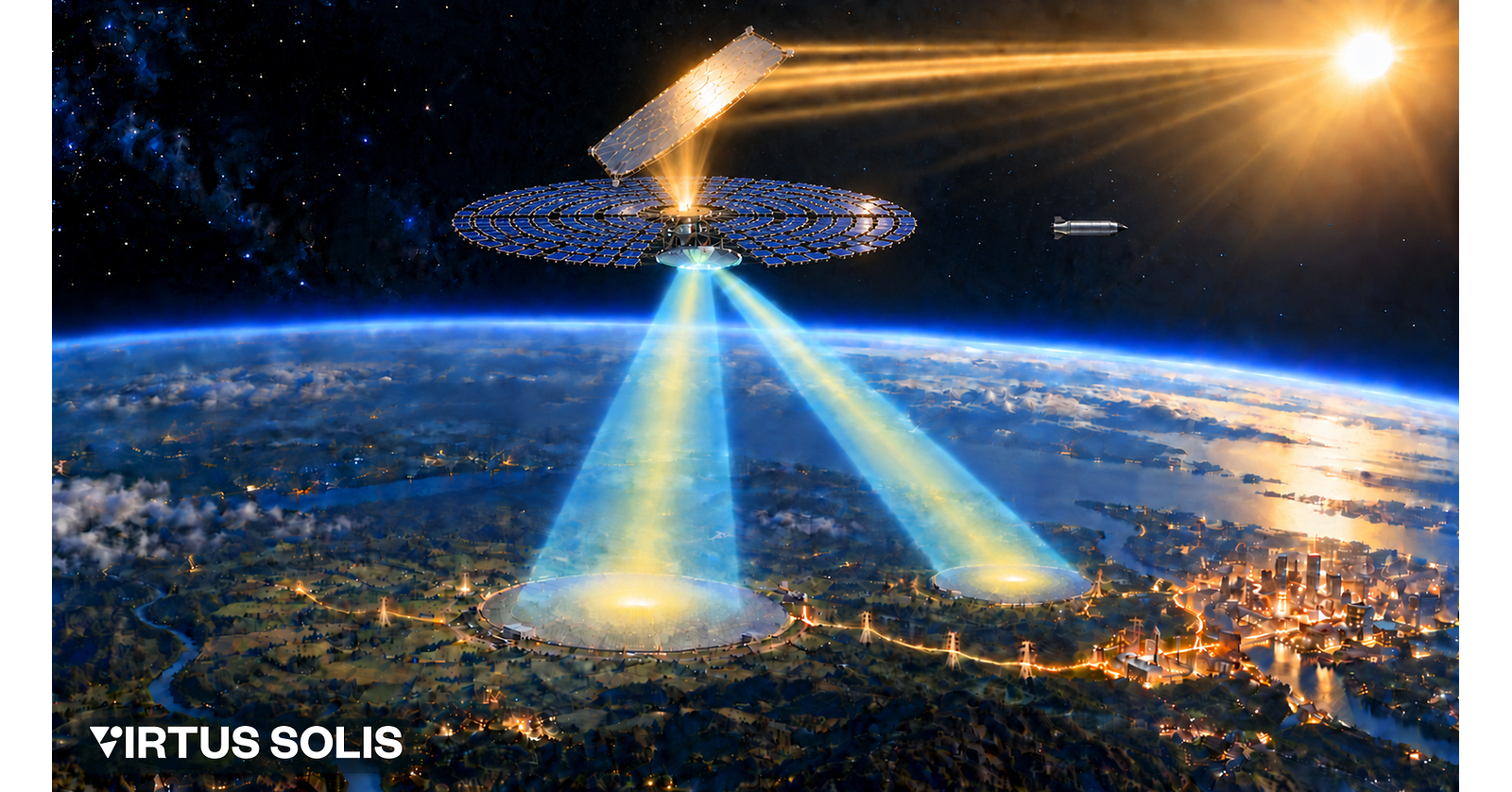
Virtus Solis and Brae Systems signed a 20-year, multi-billion-dollar power purchase agreement for 100 MW of continuous space-based solar power, equivalent to 876,000 MWh annually, with an option to expand to 250 MW within three years of commercial operations. The power would support Brae's subsea GPU data centers, targeting AI infrastructure constraints around grid availability and cooling. Commercial execution remains contingent on development milestones, including Virtus Solis's planned March 2027 public wireless-power-transfer demonstration and construction of an Illinois receiving station.
Analysis
This is not yet a public-equity earnings event: the counterparties appear privately held, contract pricing, financing commitments, launch cadence, delivered-power losses, and commissioning date are undisclosed. The key market implication is therefore optionality rather than a near-term revenue read-through. Until the March 2027 demonstration independently validates end-to-end wireless-power efficiency and receiver safety, the announced offtake should be treated as a non-bankable commercial signal rather than evidence of utility-scale economics.
The more investable second-order issue is the premium AI infrastructure buyers may pay for firm power versus intermittent renewable supply. If hyperscale demand continues to outstrip interconnection capacity, owners of dispatchable generation and grid-connected data-center capacity—CEG, VST, NRG, EQIX and DLR—retain the near-term scarcity value; speculative orbital supply does not relieve that constraint inside the next 12-24 months. Conversely, a credible demonstration could modestly compress the long-duration scarcity multiple embedded in nuclear and gas-powered data-center theses, but only after permitting, spectrum coordination, insurance, launch economics and receiver-site approvals are addressed.
The contrarian view is that the claimed avoidance of terrestrial bottlenecks shifts rather than eliminates them: a dedicated receiving station remains a single-point regulatory, land-use, grid-interconnection and physical-security exposure. At commercial scale, satellite replacement capital, launch failure risk, RF power-density limits and weather/atmospheric transmission losses could make delivered electricity materially more expensive than firm terrestrial alternatives. The relevant catalyst path is March 2027 technical validation, followed by disclosed delivered $/MWh and project-finance terms over the subsequent 6-18 months; absent those disclosures, the news is unlikely to support durable valuation changes in listed AI-power beneficiaries.
AllMind Terminal
AI-powered research, real-time alerts, and portfolio analytics for institutional investors.
Request TrialMarket Sentiment
Overall Sentiment
moderately positive
Sentiment Score
0.52
Key Decisions for Investors
- No directional trade in RENT or GPUS based on this release: verify whether these symbols have any legal or economic connection to the private counterparties before assigning exposure; current per-ticker signal is appropriately neutral.
- Maintain a 3-12 month overweight bias toward CEG and VST versus long-duration speculative clean-energy exposure: near-term AI power scarcity benefits contracted, dispatchable capacity, while orbital power has no demonstrated commercial delivery timeline. Reassess if either company materially de-risks a large data-center power contract at returns below management targets.
- Use the March 2027 demonstration as an event-driven watch item, not an options recommendation. Upgrade the space-power theme only if independently measured end-to-end efficiency, receiver power density, uptime assumptions, delivered $/MWh, and financing sources support competitiveness with firm nuclear/gas power; failure on any of these metrics should reinforce the CEG/VST scarcity thesis.
- For data-center exposure, prefer EQIX or DLR only on evidence that their secured power capacity can be monetized at rising lease spreads; avoid extrapolating subsea-compute claims into public REIT valuations until customer contracts, deployment capex and operating reliability are disclosed.
More News
- Asian stocks dip, bonds in focus after torrid September
- Greer urges G20 to back Trump tariff agenda, takes aim at China
- Tencent leases 100,000 chips from Oracle for $7 bln- FT
- California Gov. Gavin Newsom bans AI 'robo bosses' in landmark state law, reversing his earlier veto
- RAM supply set to worsen, says Micron, as CEO celebrates ‘much higher’ prices
- Why is Kioxia stock rallying today?
From AllMind Research
- Anthropic IPO Preview: Valuation, Timing, and What to Watch
- Shein After the IPO: Venue, Valuation, and What Must Be Proved
- What AI Research Tools Should a Small Hedge Fund Buy First?
- Can ChatGPT or Claude Replace a Research Platform?
- How the 2026 Milan-Cortina Winter Olympics Will Reshape Company Revenues and Stock Performance