
Alif Semiconductor Introduces New Low-Cost StartKit platform for its Edge AI Enabled Ensemble and Balletto Microcontrollers
Source: PR Newswire
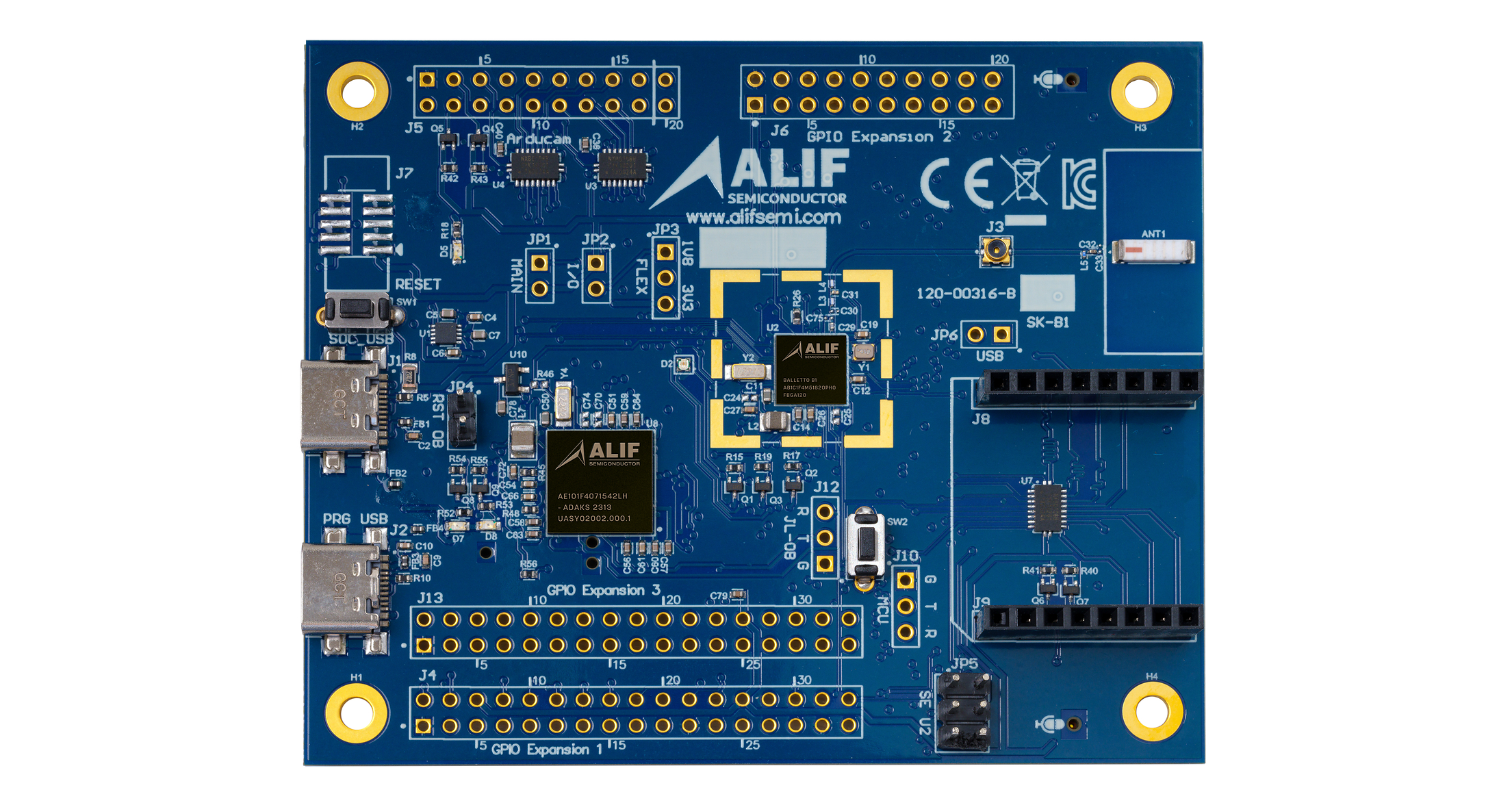
Alif Semiconductor launched $49 StartKit evaluation boards for its Ensemble (SK-E1C) and BLE-enabled Balletto (SK-B1) edge-AI microcontroller families, lowering the cost of entry for battery-powered on-device AI/ML inference. The boards pair a 160MHz Arm Cortex-M55 processor with Helium vector processing, an Ethos-U55 NPU claimed to provide up to 100x faster inference than a traditional MCU core, and 2MB of SRAM/MRAM. The launch broadens developer access to Alif's edge-AI hardware but is unlikely to have a material near-term market impact.
Analysis
This is a developer-acquisition event rather than a near-term semiconductor revenue event. Lower-friction evaluation can expand Alif’s design-in funnel in wearables, sensors, industrial endpoints and battery-powered consumer devices, but conversion from prototyping to production typically requires 12-24 months and depends on software tools, model deployment support, reference designs and supply assurance. The public-market read-through is therefore modestly constructive for edge-AI MCU adoption, not material for any listed semiconductor vendor today.
The more relevant competitive pressure falls on conventional MCU vendors whose installed base lacks integrated inference acceleration: Microchip (MCHP), Renesas (RNECY), NXP (NXPI) and STMicroelectronics (STM) face a potential feature-gap at the low-power intelligent-endpoint tier. However, incumbents retain major advantages in channel reach, application software, functional-safety qualification and long-lived customer support; a low-cost board alone does not alter procurement behavior. ARM (ARM) is the cleaner indirect beneficiary if broader edge deployment increases royalty-bearing CPU/NPU content, though the financial contribution would be immaterial relative to its current valuation.
Consensus risk is treating every edge-AI product announcement as incremental AI semiconductor demand. Many endpoint workloads remain too small, intermittent or accuracy-sensitive to justify a dedicated accelerator, while cloud-connected architectures can remain cheaper at scale. The thesis strengthens only if Alif or peers disclose production wins, materially higher unit volumes, or pricing that shows NPU-equipped MCUs are displacing rather than merely supplementing conventional MCUs over the next 2-4 quarters.
AllMind Terminal
AI-powered research, real-time alerts, and portfolio analytics for institutional investors.
Request TrialMarket Sentiment
Overall Sentiment
mildly positive
Sentiment Score
0.38
Key Decisions for Investors
- No standalone trade from this release; Alif is private and the announcement lacks independently verifiable design-win, unit-volume, ASP or backlog data.
- Maintain a 6-18 month watch on STM and NXPI for edge-AI MCU design-win disclosures and embedded-processing content growth; positive evidence would favor long STM/NXPI versus short MCHP, whose recovery remains more tied to legacy MCU and industrial inventory normalization.
- For ARM, avoid chasing any immediate edge-AI narrative reaction. Reassess only if upcoming results show royalty growth or licensing commentary tied to Cortex-M/Ethos adoption exceeding broader embedded-market growth; absent that, valuation sensitivity dominates the small endpoint-AI upside.
- Falsification for the competitive-displacement thesis: incumbent MCU vendors demonstrate stable-to-rising low-power MCU pricing, no loss of strategic sockets, and continued customer preference for software-compatible conventional architectures through the next two earnings cycles.
More News
- Next week brings major risks for the stock market, just as the AI trade keeps faltering
- AI Doubts Spread Cracks in Equities, Credit Markets: Evening Briefing Americas
- Kinder Morgan, Energy Transfer and Williams could benefit from cheap natural gas
- CrowdStrike CEO's alarming prediction — plus, the sell-off spreads beyond tech
- Vertex reports positive IgAN trial data, FDA decision due Nov. 30
- Elon Musk’s dangerous grip on outer space
From AllMind Research
- Anthropic IPO Preview: Valuation, Timing, and What to Watch
- Shein After the IPO: Venue, Valuation, and What Must Be Proved
- What AI Research Tools Should a Small Hedge Fund Buy First?
- Bitcoin's 52% Crash Proves It's a Tech Stock: Here's What That Means for Portfolio Construction
- What Is an AI Investment Research Platform?