
OLIVIA RODRIGO IS FINALLY GETTING THE MOUNTAIN DEW® BAJA BLAST® OF HER DREAMS WITH THE ALL-NEW YOU SEEM PRETTY PINK FOR A BAJA BLAST®
Source: PR Newswire
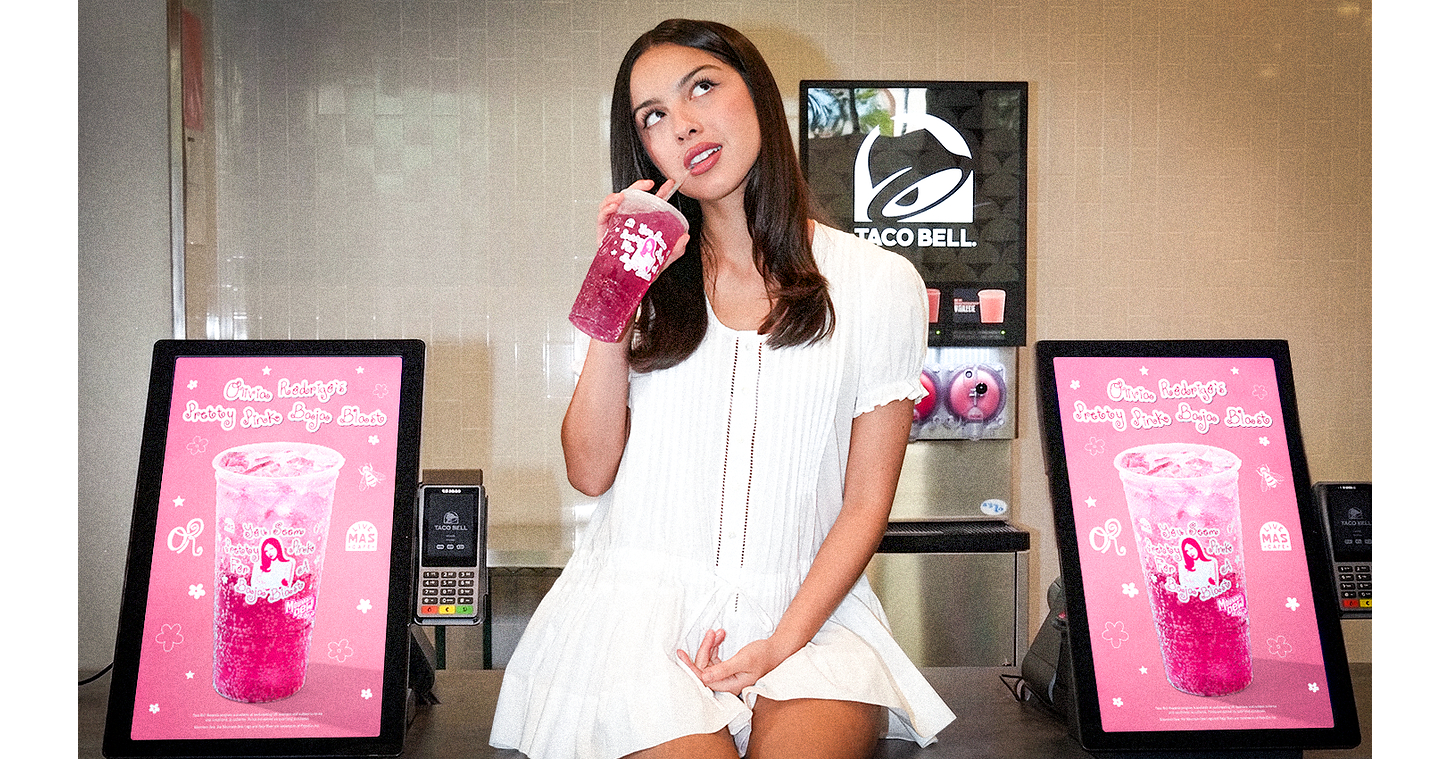
Taco Bell and PepsiCo’s Mountain Dew are launching “You Seem Pretty Pink for a Baja Blast,” a pink lemonade–twist Baja Blast, with pricing of $2.99 (small), $3.19 (medium), and $3.39 (large). The drink debuts exclusively at Live Más Cafés on Aug. 29, expands to Taco Bell nationwide for a limited time on Sep. 24, and includes a Live Más Café frozen variant (Freeze) plus a Taco Bell Rewards “Pretty Pink Picnic Kit” Sept. 29 promotion and Canada rollout starting Oct. 1. The news is promotional/brand-focused with limited immediate financial market impact, but is likely supportive for in-store traffic and engagement around beverage innovation.
Analysis
This is a brand-equity event more than a near-term earnings event. The incremental P&L impact to PEP is likely de minimis, but the mechanism that matters is beverage mix: if the limited-time drink drives higher ticket size and repeated fountain visits, the real beneficiary is the away-from-home franchise, not the soda category broadly. The bigger second-order effect is that Taco Bell keeps proving it can turn beverage innovation into traffic without heavy discounting, which raises the bar for restaurant peers that rely on food-led LTOs.
The immediate tradeable window is sentiment and app engagement over the next 2-6 weeks, not fundamentals. If the launch creates measurable lift in rewards sign-ups, frequency, or attach rates, it modestly supports PEP’s narrative around distribution and brand activation; if not, it fades quickly and becomes another low-cost marketing expense. For restaurant comps, the risk is cannibalization: some of the “newness” likely substitutes for existing high-margin beverage sales rather than creating incremental occasions.
The contrarian view is that the market may be overpricing celebrity-driven virality. Most collab drinks spike on social media but flatten after the first week unless supported by operational simplicity and app-driven reorders; a complex limited-time menu can also hurt throughput and franchisee labor efficiency. The key falsifier is not launch buzz but whether Taco Bell’s same-store sales, beverage mix, and rewards activity improve into the next earnings print; absent that, this should not justify multiple expansion in PEP or any durable read-through to QSR names.
Longer term, the structural winner may be the brand that owns first-party customer data and can repeatedly monetize fandom at low acquisition cost. If Taco Bell can convert these activations into persistent loyalty behavior, that is a modest margin-positive flywheel over 6-18 months. If it remains a one-off cultural stunt, the trade is mostly noise.
AllMind Terminal
AI-powered research, real-time alerts, and portfolio analytics for institutional investors.
Request TrialMarket Sentiment
Overall Sentiment
mildly positive
Sentiment Score
0.15
Ticker Sentiment
Key Decisions for Investors
- No immediate standalone long in PEP on this headline; treat as a low-conviction marketing catalyst unless next-quarter away-from-home beverage mix or guidance commentary shows measurable uplift. Falsifier: no improvement in beverage attach or rewards activity by the next earnings call.
- Use the launch window as a monitor for Taco Bell traffic data: if app downloads, rewards enrollments, or transaction frequency tick up in the 2-6 weeks after September 24, reconsider a tactical long PEP for a 1-3 month horizon. Upside is modest; the thesis is about durable activation, not EPS beats.
- Consider a small relative-value short in QSR versus long PEP only if fast-food promo intensity accelerates and investors start paying up for beverage-led traffic resilience. Risk/reward is skewed toward PEP because the event is low-cost and optionality-rich, but the pair is only justified if restaurant comps remain soft.
- Watch for any franchisee commentary on throughput or complexity at Taco Bell stores. If limited-time beverage innovation starts hurting service times or margins, that would reverse the bullish read-through and argue against extrapolating this model to other QSR operators.
More News
- PepsiCo: Why A 4.6% Yield At 15 Times Earnings Still Wins Against A 5% Treasury
- Pepsi: Near 5% Yield And 15x P/E Compelling, But North America Concerns Me
- I'd Put $500 Into Each of These 5 Dividend Stocks and Throw Away the Statement
- Musk says Terrafab chip factory could outperform rivals despite challenges
- Nvidia GPUs are everywhere. Here are the ways companies are accessing them
- Stocks saw new highs and big declines: How the volatile AI trade moved last week's market