
TCL präsentiert das 5G-AI-CPE X5 auf der Network X 2026 und bietet damit eine umfassende, KI-gestützte Optimierung für Breitbandanschlüsse zu Hause
Source: PR Newswire
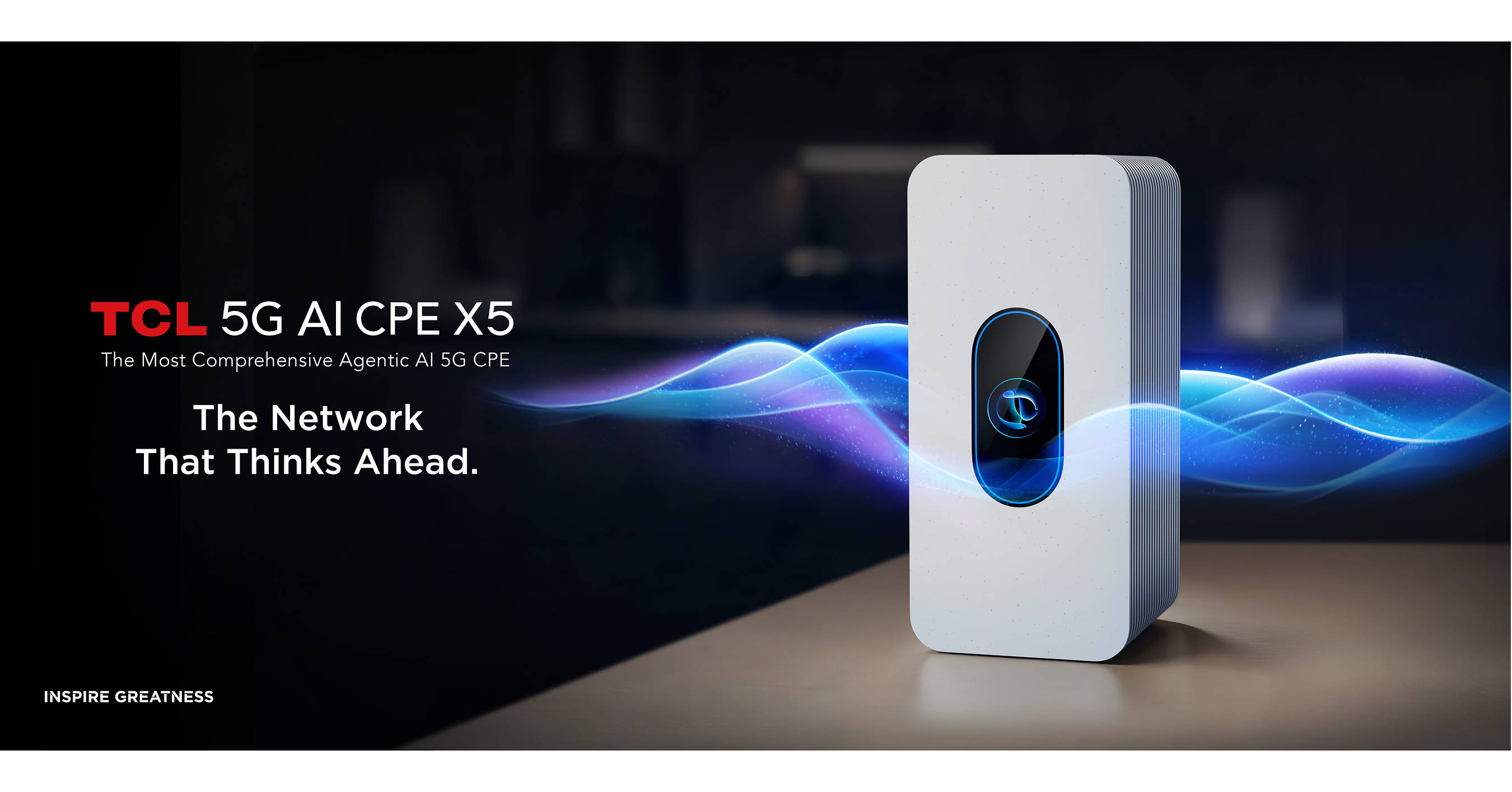
TCL unveiled its 5G-AI-CPE X5 at Network X 2026, featuring an AI agent for network optimization, diagnostics and supported recovery, alongside adaptive QoS and energy management. TCL says its 8Rx antenna design achieved up to 51% higher downlink throughput than a 4Rx design in lab tests; the device supports 3GPP Release 18 and a theoretical peak downlink rate of 7.01 Gbit/s. The announcement is a product showcase, with no sales outlook or financial impact disclosed.
Analysis
This is a product-positioning signal, not yet an earnings signal for TCL: the claimed operator savings and AI services require independent evidence of commercial deployments, support-cost reductions, and paid attach rates. Near term, the main market risk is overcapitalizing lab performance and roadmap language; the reported throughput advantage is a controlled comparison, not proof of better customer experience across live networks. Over 1–3 months, watch for named operator trials, procurement wins, and disclosed integration or service economics. Without those, the launch is unlikely to change near-term revenue expectations materially.
If the self-diagnosis loop works at scale, operators could reduce truck rolls and call-center workload, while 5G fixed-wireless providers gain a tool to improve home-service reliability without extending fiber. That benefit is conditional on integration with operator systems and on measured reductions in support cost. Over 6–18 months, an extensible software layer could help TCL differentiate CPE from increasingly comparable hardware; conversely, operator control of customer relationships and price competition may limit TCL’s ability to capture software value. Competing CPE vendors, including Nokia, ZTE, and Sercomm, may respond with similar features, eroding differentiation.
Contrarian view: the launch’s strongest commercial claim may be reduced operator servicing costs, not consumer-facing AI. But the release provides no deployment data, independently verified performance, pricing, or cost savings. Treat the announcement as optionality, not a basis for a valuation rerating. The thesis weakens if operator trials do not convert to orders, or if subsequent evidence shows no reduction in fault rates or support costs.
AllMind Terminal
AI-powered research, real-time alerts, and portfolio analytics for institutional investors.
Request TrialMarket Sentiment
Overall Sentiment
mildly positive
Sentiment Score
0.25
Key Decisions for Investors
- No immediate directional trade: the release supplies no verifiable sales, margin, or deployment evidence, and the supplied identity data does not provide a ticker mapping for TCL.
- Set a 1–3 month alert for named operator contracts or trials and verify whether they include meaningful volumes, paid software, and cloud-management integration; a demo or certification alone is not a commercial catalyst.
- For any future TCL exposure, require evidence of lower operator support costs or paid service attach, alongside shipment and pricing data. Failure to show these would falsify the software-differentiation thesis and leave hardware competition as the dominant driver.
- Monitor competing CPE announcements and operator procurement commentary: rapid feature matching would likely compress differentiation before TCL establishes recurring software economics.
More News
- South Korean carmaker Hyundai plans 'strategic' investment of $15.5 billion in India by 2032
- Namibia battles cattle disease outbreak as EU suspends several meat imports
- Applied Materials’ $5 billion AI lab aims to cut chip development time in half—and restore Silicon Valley’s edge
- China's exports likely grew by double-digits in September
- Airport attacks put aviation in crosshairs of geopolitical conflicts
- Meta’s Muse models reach the AI frontier—and kill any hopes to ‘pace’ it