
Living Security Launches HRM Framework 2.0 to Help Teams Preempt Workforce Cyber Risk
Source: Newswire
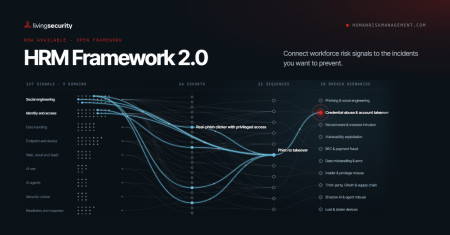
Living Security launched HRM Framework 2.0, an open framework organizing human and AI-agent workforce risk around 10 breach scenarios. The resource links risk signals to targeted interventions, includes a maturity self-assessment, and is being incorporated into Living Security’s platform; it is published under a Creative Commons Attribution 4.0 license and maps to NIST Cybersecurity Framework and MITRE ATT&CK practices.
Analysis
The framework’s strategic value is standardization, not an immediately monetizable product feature. If buyers adopt the scenario-based language, Living Security could lower the cost of explaining HRM internally and create a wedge for its platform—but the open license also lets competitors adopt the taxonomy without buying from Living Security. Durable differentiation therefore depends on whether the platform can prove better detection-to-intervention workflows, integrations, and measurable risk reduction, not on the framework itself.
For the broader market, the approach reinforces demand for joining identity, endpoint, email, and workforce-behavior signals. That could favor vendors already embedded in those control points, including Microsoft, CrowdStrike, and Okta, if customers prefer consolidating response in existing security stacks. It could also intensify pressure on standalone awareness tools if budgets migrate toward measurable incident prevention. These are conditional adoption effects, not evidence of near-term revenue shifts.
Near term (days), the announcement is unlikely to support a meaningful public-market trade: no customer commitments, pricing, adoption data, or independently verified efficacy are provided. Over 1–3 months, watch for platform availability, integrations, and named customer deployments. Over 6–18 months, the key question is whether AI-agent access expands the addressable risk problem or remains a feature absorbed by identity and security platforms. The thesis weakens if the framework gains attention but platform conversion, retention, or measurable customer outcomes do not follow; it strengthens with disclosed adoption and demonstrated reduction in incidents or exposure.
AllMind Terminal
AI-powered research, real-time alerts, and portfolio analytics for institutional investors.
Request TrialMarket Sentiment
Overall Sentiment
mildly positive
Sentiment Score
0.20
Key Decisions for Investors
- No direct position on this announcement alone; Living Security is not mapped to a ticker here, and the release provides no commercial or financial evidence sufficient to underwrite a public-equity trade.
- Treat this as a watch item for Microsoft, CrowdStrike, and Okta rather than a buy signal: assess whether HRM workflows increase demand for their identity, endpoint, and security-data capabilities or are absorbed into existing bundles.
- Over the next 1–3 months, verify platform rollout, integrations, customer adoption, and whether the company reports measurable outcomes such as reduced risky access or incident exposure. Without those indicators, assume the framework is primarily a marketing and category-education asset.
- Contrarian risk: an open framework may expand category awareness while commoditizing the conceptual layer, leaving value with established control-point vendors. Reassess only if Living Security demonstrates proprietary execution or customers explicitly pay for the integrated platform.
More News
- Analysts react as Binance freezes assets after $6.3 billion security breach
- Stocks slump, bonds leap as AI giants’ spending spooks investors
- Alphabet Erases $500 Billion as ChatGPT, Google AI Cut into Search
- Alphabet just had its worst day as a public company. BofA now values Google search at a lower multiple than fossil fuel stocks
- Alphabet’s stock has worst day in over 20 years, dragging the S&P 500 to first loss in four days
- Taiwan Stocks Heads for Correction as Global AI Selloff Deepens