
Global Vitiligo Treatment Market to Reach USD 2.97 Billion by 2034 at 5.8% CAGR as Rising Disease Prevalence, Growing Aesthetic Awareness, and Advances in Targeted Therapies Accelerate Market Growth, Reports Maximize Market Research
Source: PR Newswire
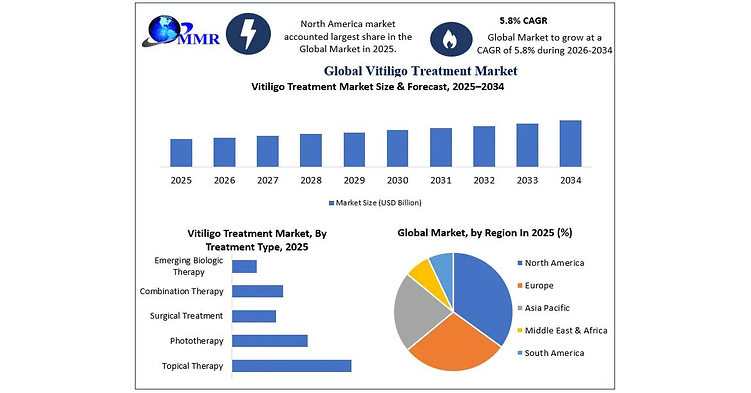
The global vitiligo treatment market is projected to grow from $1.79 billion in 2025 to $2.97 billion by 2034, a 5.8% CAGR. Growth is expected to be supported by rising disease awareness, demand for repigmentation therapies, and innovation in topical JAK inhibitors, phototherapy, immunomodulators, and targeted biologic treatments. North America led the market in 2025, while Asia-Pacific is expected to be a higher-growth region; limited specialist access, variable treatment responses, and disease recurrence remain constraints.
Analysis
This is not a near-term earnings catalyst for large pharma: the addressable category is too small relative to ABBV, PFE, NVS and LLY revenue bases, and the report's long-duration forecast is promotional rather than a demand or prescription-data read. The investable signal is instead that durable repigmentation and convenient topical delivery command disproportionate value versus legacy generic steroids, calcineurin inhibitors and office-based phototherapy. INCY has the cleanest pure-play exposure through Opzelura, but market-share durability depends on persistence, body-area efficacy, payer access and adherence—not category growth alone.
Over the next 1-3 months, watch US prescription trends, gross-to-net commentary and formulary outcomes for topical JAK products. A favorable signal would support INCY multiple expansion because dermatology growth can improve the market's view of its post-Jakafi earnings bridge; weak refill persistence or higher rebates would expose a category whose clinical value proposition may not translate into sustained net sales. ARQT is a higher-beta read-through only if its dermatology pipeline produces differentiated efficacy or access; it lacks direct commercial leverage to vitiligo today.
The consensus risk is treating JAK inhibition as a winner-take-all mechanism. Vitiligo's heterogeneous response and recurrence create room for combination regimens, which can preserve demand for phototherapy and clinic infrastructure while limiting single-agent duration. That makes STRATA Skin Sciences a potential second-order beneficiary if reimbursed combination care expands, but its small-cap liquidity and execution risk make it unsuitable as a core expression. No broad healthcare trade is warranted from this release alone.
Over 6-18 months, the key structural issue is whether lower-cost international topical and oral alternatives compress branded net pricing before penetration offsets it. Generic manufacturers such as TEVA and RDY benefit only after meaningful patent/formulary substitution, while branded innovators retain the advantage if payers require documented response and dermatologist supervision. A material safety-label change, failure to sustain repigmentation after discontinuation, or a competitor with superior facial/acral efficacy would falsify the INCY-led thesis.
AllMind Terminal
AI-powered research, real-time alerts, and portfolio analytics for institutional investors.
Request TrialMarket Sentiment
Overall Sentiment
mildly positive
Sentiment Score
0.32
Ticker Sentiment
Key Decisions for Investors
- Maintain/watch-list long INCY rather than chase on this release; add only on independently verified US prescription acceleration and stable net-price commentary at the next earnings update. Thesis target is dermatology-driven estimate/multiple upside over 6-12 months; exit if Opzelura growth decelerates materially for two consecutive reported periods or management flags worsening rebates.
- Use a defined-risk INCY bullish call spread dated 6-9 months out only if shares pull back on non-fundamental biotech risk and prescription data remain intact. This expresses asymmetric dermatology upside while capping losses; do not initiate from the market-report headline alone.
- Avoid treating PFE, ABBV, NVS or LLY as actionable vitiligo longs: any category revenue impact is immaterial to consolidated estimates. Prefer them only when their own dermatology pipeline, launch, or reimbursement disclosures create a company-specific catalyst.
- Set an alert on STRATA Skin Sciences for payer coverage expansion or evidence that dermatologists are increasing combination phototherapy use; consider a small tactical long only with improving revenue growth and adequate trading liquidity. Falsifier: continued procedure-volume weakness despite category awareness growth.
More News
- Could Retatrutide Be Worth $10 Billion to Eli Lilly?
- China’s Xi to visit Washington without CEO delegation, sources say
- Why Viking Therapeutics Stock Skyrocketed on Tuesday
- Equillium at Stifel 2026 Virtual Immunology and Inflammation Forum: pipeline advances
- OpenAI’s agent hacked Australia’s Medicare website—the latest rogue AI incident that the company didn’t know about for months
- Chinese authorities reportedly in possession of F-35 components in Hong Kong