
Connected Retail Is Widening the Cyber Attack Surface While Security Ownership Remains Fragmented, Info-Tech Research Group Warns
Source: PR Newswire
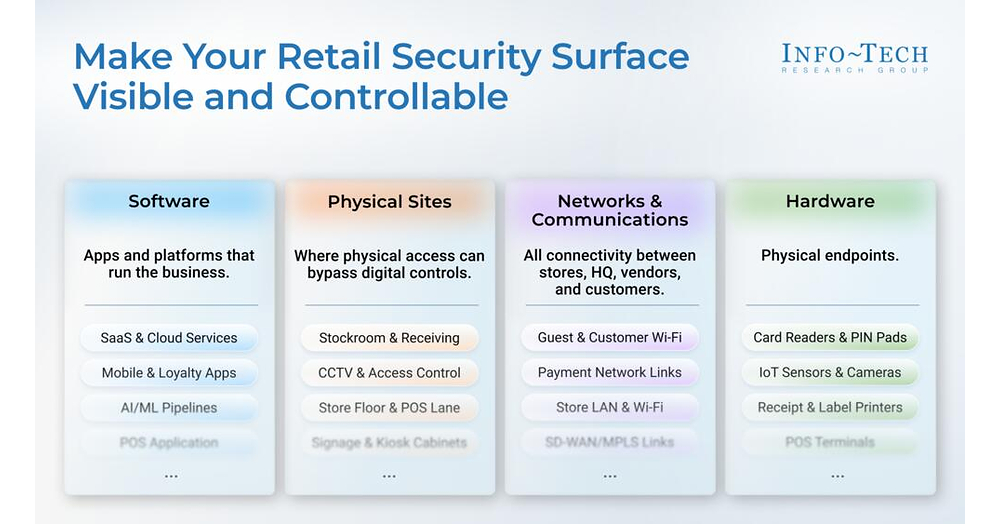
Info-Tech Research Group warns that connected retail expands the cyber attack surface across legacy POS, cloud platforms, IoT devices, vendor links, and customer apps, while security accountability remains fragmented across teams. The firm’s Build Cyber Resilience in Connected Retail blueprint proposes a three-phase framework to map threats to systems/owners and produce a prioritized risk register, emphasizing that faster attack paths (e.g., identity compromise and lateral movement) can outpace traditional governance. Net takeaway: organizations should tighten visibility, control boundaries, decision ownership, risk prioritization, and response coordination to better contain incident spread and protect customer trust.
Analysis
The investable angle is not a one-off cyber headline; it is a procurement filter shift. Retailers with fragmented store/cloud/vendor stacks will increasingly buy platforms that reduce integration friction and centralize policy enforcement, which favors large suites and identity-led controls over narrow point products. That is a modest positive for PANW, CRWD, ZS, OKTA, and FTNT, but the bigger second-order winner is managed security/consulting capacity because the bottleneck is operational ownership, not just tooling.
The near-term risk is that this stays a board-level discussion without immediate budget conversion, so the first response is likely assessment spend rather than large license commitments. That means the revenue impact on cyber vendors should show up with a 1-3 quarter lag, while the real structural effect is 6-18 months of higher attach rates for segmentation, IAM, and third-party access controls in retail and adjacent omni-channel verticals. For retailers, the cost is hidden in downtime, chargebacks, insurance premiums, and inventory/shipping disruption; the biggest margin pressure comes from incident response and lost sales, not the ransom itself.
The consensus may be underestimating how often this drives vendor consolidation. When accountability is fragmented, buyers tend to prefer fewer vendors and clearer SLAs, which compresses budgets for standalone niche tools and raises win-rates for incumbents with unified control planes. The contrarian risk is that many retailers will treat this as a governance exercise rather than a spending cycle, delaying monetization for public cyber names; the thesis is falsified if retail CIO surveys show no increase in 2027 security budget allocations or if deal cycles in cyber remain flat through the next two earnings seasons.
AllMind Terminal
AI-powered research, real-time alerts, and portfolio analytics for institutional investors.
Request TrialMarket Sentiment
Overall Sentiment
mildly negative
Sentiment Score
-0.25
Key Decisions for Investors
- No direct trade in FCD.UN.TO or TCHC from this note; treat the signal as indirect and wait for company-specific retail cyber exposure before acting.
- Add a small basket long in PANW/CRWD/OKTA on pullbacks over the next 1-3 months; thesis is higher identity, segmentation, and control-plane demand as retailers standardize ownership. Falsify if retail pipeline commentary stays flat into the next two quarters.
- Prefer a pairs trade: long PANW or CRWD vs. short a basket of narrower security point-solution names that depend on incremental, not platform, spend. This captures likely vendor consolidation over 6-18 months.
- Watch IT services/managed security providers as second-order beneficiaries; buy dips in DXC/ACN-type cyber consulting exposure only if they can show retail-specific bookings growth, otherwise no trade.
- Set an alert for major retail breach disclosures or cyber insurance repricings over the next 1-6 months; those are the catalysts that would convert this from a governance theme into a spending cycle.
More News
- AI stocks plunge. Inflation heats up. Where we're still finding opportunities
- AI rapidly improving, could vastly boost U.S. GDP, Anthropic's Clark tells policymakers
- Semiconductor market to remain solid ‘at least through next year,’ South Korea finance minister says
- Nasdaq Index: AI Selloff Deepens as Chips and CoreWeave Break
- Tunisia’s economic crisis deepens as the promise of a better life fades
- States sue OpenAI, saying it gives life to ‘cyberhacking agents’ while ChatGPT hurts children and deceives adults
From AllMind Research
- Anthropic IPO Preview: Valuation, Timing, and What to Watch
- Shein After the IPO: Venue, Valuation, and What Must Be Proved
- What AI Research Tools Should a Small Hedge Fund Buy First?
- AllMind's Data Standardization Methodology: Our Approach to Fundamentals
- What Makes Financial Data Ready for AI Research?