
Petrobras Expands Africa Footprint With 8 New Offshore Blocks
Source: zacks.com
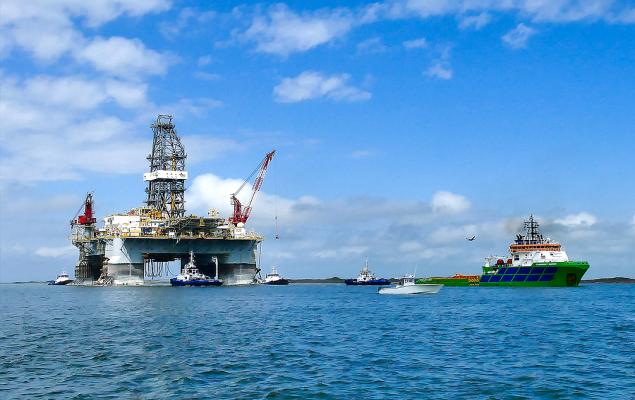
Petrobras signed production-sharing contracts for eight offshore exploration blocks in Ivory Coast, taking a 90% working interest and operatorship, with state-owned PETROCI retaining 10%. The acreage expands Petrobras' African exploration strategy and could support long-term reserve replacement beyond Brazil, following its February 2026 acquisition of a 42.5% stake in Namibia's Block 2613. Financial and production benefits remain uncertain and are unlikely to be immediate, as seismic work, drilling, commercial discoveries and development decisions are still required.
Analysis
This is not an NAV-moving event in the next 12-24 months; the market should treat the acreage as a low-cost real option until Petrobras discloses work commitments, seismic budgets, and an initial drilling schedule. The near-term equity issue is capital-allocation signaling: incremental frontier spending can modestly raise PBR's perceived upstream reinvestment intensity while its valuation remains more sensitive to Brazilian fuel-pricing policy, dividends, and pre-salt execution. A positive reaction is therefore likely to fade absent a defined exploration budget that is immaterial relative to operating cash flow.
The underappreciated risk is portfolio correlation rather than geology. A larger African footprint introduces above-Brazil political, fiscal, security, and partner-country execution risk at the same time PBR retains substantial sovereign exposure at home; this can preserve the company's conglomerate/state-control discount even if exploration succeeds. TTE is better positioned to benefit from regional exploration momentum because its broader African operating base, LNG chain, and balance sheet can absorb dry-hole risk, whereas PBR has more concentrated exposure to any escalation in international E&P spend.
Over 1-3 months, monitor management's capex guidance, exploration expense, and dividend framework rather than seismic headlines. Over 6-18 months, the relevant catalyst is a farm-down, prospect-resource estimate, or first well decision; a discovery alone will not create value if water depth, development cost, or fiscal terms imply sub-hurdle returns. The contrarian view is that investors may be over-crediting reserve-replacement optionality while underpricing the probability that higher frontier capex competes with shareholder distributions.
AllMind Terminal
AI-powered research, real-time alerts, and portfolio analytics for institutional investors.
Request TrialMarket Sentiment
Overall Sentiment
mildly positive
Sentiment Score
0.18
Ticker Sentiment
Key Decisions for Investors
- No directional PBR.A trade on the announcement alone; wait for the next capex update. Initiate an underweight only if international exploration spending rises without an offsetting reduction elsewhere or management lowers its dividend/FCF distribution framework.
- For a 6-12 month relative-value expression, prefer long TTE / short PBR.A in equal oil-beta-adjusted notional. The thesis is superior diversification and regional execution capacity at TTE versus PBR's added frontier-capex and sovereign-risk exposure; exit if PBR reaffirms distributions and holds upstream capex flat.
- Set an alert for disclosed minimum work commitments, first-well timing, and any farm-down. A material multi-year commitment funded from incremental debt or accompanied by lower shareholder returns would be a negative catalyst for PBR.A; a partner sell-down at an attractive valuation would reverse that view.
- Do not use MGY or DK as read-through trades. Their earnings are driven primarily by U.S. shale economics and refining/logistics margins, respectively, with no meaningful sensitivity to West African exploration activity.
More News
- AMD joins the $1 trillion club as chip rally surges - our AI Strategy saw it early
- Perpetual underdog AMD nips at Nvidia's heels as it joins the $1T club
- Intel surges 12% as CPU stocks rally. Here's what's driving the move
- Why Intel, Arm, and Other AI Chip Stocks Soared Today
- AMD joins $1 trillion market cap club on AI computing bets
- Can the US win the AI cold war with China?