
State Networks, Community-based Organizations, and Healthcare Organizations Critical to Community Health Worker Sustainability, says new research from National Association of CHWs (NACHW)
Source: PR Newswire
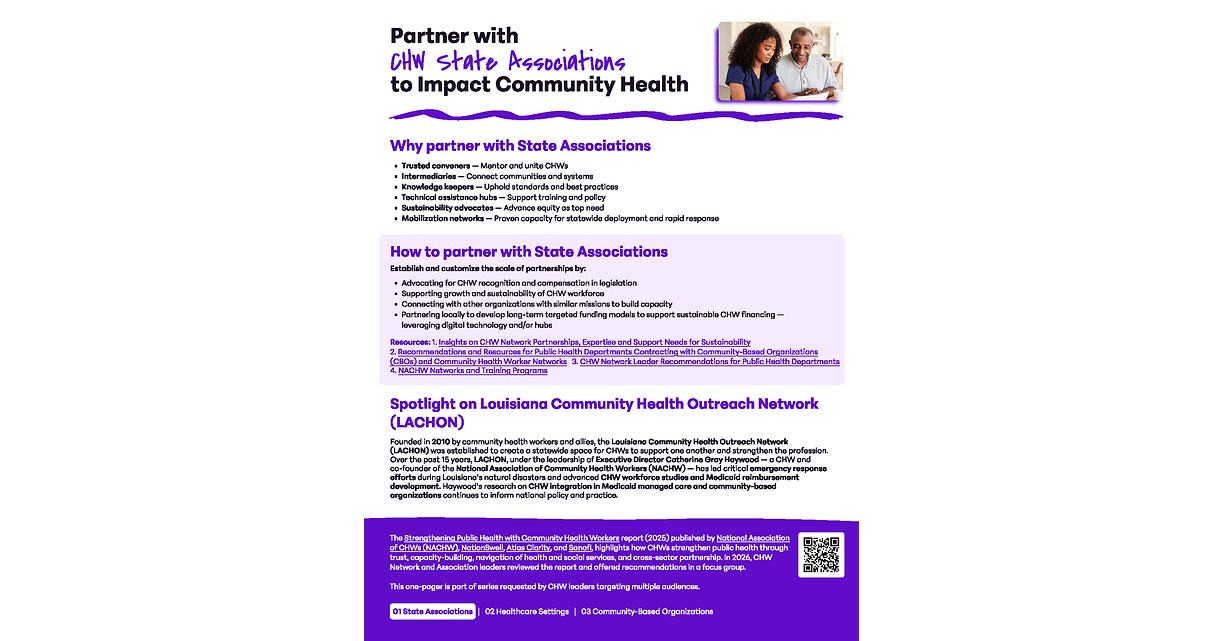
NACHW marked National Community Health Worker Awareness Week (#NCHWAW) by publishing an expanded report, “Strengthening Public Health with Community Health Workers,” aimed at cross-sector education on CHW integration and sustainable financing. The article highlights CHWs’ role bridging health and social services, especially for 76 million Americans in health professional shortage areas. It includes new evidence-based one-pagers based on interviews with CHW leaders, positioning the initiative as an informational tool rather than a market-moving corporate or policy event.
Analysis
This is a policy-signaling item, not a hard earnings catalyst. The monetization path for CHWs runs through reimbursement architecture: Medicaid state plans, 1115 waivers, ACO/shared-savings programs, and MA quality initiatives. Until that financing is codified, the economic benefit is mostly “soft” — better adherence, fewer missed appointments, and lower avoidable utilization — which accrues slowly and is hard to isolate in quarterly numbers.
For providers, the biggest second-order winner is not necessarily the hospital system but the low-acuity, high-churn population manager: organizations that can convert improved navigation into fewer ED visits and lower readmissions. That could help integrated operators with value-based exposure more than fee-for-service hospitals; CYH only benefits if it can demonstrate measurable reduction in uncompensated care or readmission penalties, otherwise the implementation cost lands before the savings. For Sanofi, the upside is more indirect: CHWs can improve persistence in chronic disease and public-health programs, but this is a multi-year patient-access tailwind, not a near-term revenue step-up.
The contrarian point is that the market may be overestimating how quickly “community health” becomes reimbursable cash flow. State budgets are tight, and payers may prefer cheaper digital navigation, call-center, or AI care-management tools over labor-intensive CHW programs unless there is strong evidence of ROI. The thesis is falsified if CMS/state Medicaid plans do not expand payment pathways over the next 6-18 months, or if providers report no measurable delta in readmissions, adherence, or cost-of-care metrics.
AllMind Terminal
AI-powered research, real-time alerts, and portfolio analytics for institutional investors.
Request TrialMarket Sentiment
Overall Sentiment
neutral
Sentiment Score
0.00
Ticker Sentiment
Key Decisions for Investors
- No immediate trade on CYH or SNY from this release; treat as a watch item until there is explicit Medicaid/ACO reimbursement language or measurable care-utilization data.
- For SNY, only consider a long on a confirmed policy catalyst: state-level CHW reimbursement expansion or CMS guidance that improves patient-support economics over the next 3-6 months; upside is modest but durable, downside is low if the catalyst fails.
- Avoid expressing a structural bullish view in CYH until management quantifies readmission or uncompensated-care benefit from CHW integration in earnings calls; otherwise the implementation cost can swamp the benefit.
- Set an alert on Medicaid/1115 waiver announcements and managed-care contract renewals in the next 1-2 quarters; that is the point where CHW policy can convert from narrative to revenue/margin impact.
- If a trade is needed, prefer a small relative-value long SNY vs. broader healthcare ETF only after reimbursement evidence appears; current information does not justify an options premium.
More News
- How Supreme Court justices are leaning in major 401(k) case over private funds and underperformance
- AI's Supercharging a Scam Economy Bigger Than the Cocaine Trade
- Microsoft's Nadella says AI needs an ‘emergency brake’ that humans control
- Merck’s remigromig meets non-inferiority goal in DME trial
- Bank of America is bullish on these top stocks ahead of earnings
- Big Tech is betting $700 billion on AI. Healthcare will decide whether the bet pays off
From AllMind Research
- Anthropic IPO Preview: Valuation, Timing, and What to Watch
- Shein After the IPO: Venue, Valuation, and What Must Be Proved
- What AI Research Tools Should a Small Hedge Fund Buy First?
- Capital Intensity as Gravity: The AI Trade Enters Its Industrial Era (Looking at Q3 2025 Earnings in Tech)
- AI Portfolio Monitoring: Build an Alert Policy Analysts Can Audit