
ThreatLocker takes on AI doomsday fears with global Terminator 2 campaign
Source: PR Newswire
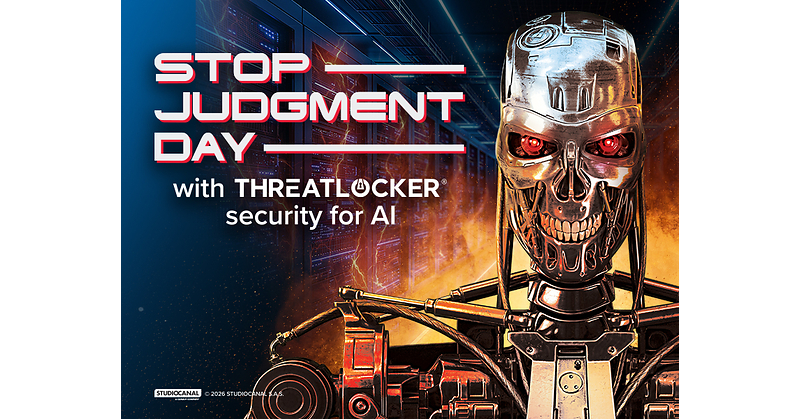
ThreatLocker launched a global “Stop Judgment Day” advertising campaign promoting security controls that let organizations define and enforce boundaries on AI access and actions. The campaign follows this week’s launch of Zero Trust AI Control, which applies Zero Trust principles to agentic AI; the article cites a Quinnipiac poll finding 73% of Americans concerned that future AI systems could threaten human survival. The campaign will run across the U.S., U.K. and Australia, with additional creative content and commercials planned.
Analysis
This is a category-positioning signal, not evidence of product-market fit. If agentic AI adoption raises demand for controls enforced outside the model, the durable value may accrue to the security layer that governs identity, permissions, and runtime actions—not necessarily to the model vendor or a standalone AI-safety brand. That creates an opening for ThreatLocker, but also gives incumbents such as Microsoft, Palo Alto Networks, CrowdStrike, and CyberArk a bundling advantage through existing endpoint, identity, and security workflows. The second-order risk is that customers treat agent controls as a feature of current security contracts, limiting incremental pricing and standalone margins.
Near term, the advertising campaign is unlikely to change public-company earnings estimates; it may increase awareness but is not proof of enterprise conversion. Over 1–3 months, watch for independently verifiable customer deployments, paid adoption, renewal or expansion data, and integrations with major AI-agent platforms. Over 6–18 months, the key question is whether controls remain effective as agents invoke tools and pass work between systems—and whether buyers standardize on a dedicated control plane or accept bundled products.
The contrarian angle: heightened AI anxiety can support demand, but fear-based messaging may not convert if buyers prioritize measurable breach reduction, low deployment friction, and compatibility over broad safety claims. The thesis weakens if agentic AI deployments stall, buyers rely on native platform controls, or ThreatLocker cannot demonstrate policy enforcement across real workflows. No direct public-equity exposure is established by the supplied data.
AllMind Terminal
AI-powered research, real-time alerts, and portfolio analytics for institutional investors.
Request TrialMarket Sentiment
Overall Sentiment
mildly positive
Sentiment Score
0.20
Key Decisions for Investors
- No immediate trade: the campaign and launch do not establish revenue contribution, customer uptake, or a public-market security. Avoid treating the announcement itself as an earnings catalyst.
- Set a 1–3 month watch item for paid customer wins, expansion/renewal evidence, integration coverage, and independent demonstrations of controls persisting across agent-invoked applications; upgrade only if these validate recurring demand.
- For public cybersecurity holdings, assess whether Microsoft, Palo Alto Networks, CrowdStrike, or CyberArk can bundle comparable agent permissions into existing products. Relative performance or guidance showing AI-security monetization would be a stronger signal than campaign reach.
- Falsification triggers: agent deployments remain limited, platform-native controls satisfy buyers, or customer evidence shows the product is primarily a marketing feature without measurable security outcomes or incremental willingness to pay.
More News
- US tech stocks tumble as investors fret over AI spending
- Asian shares wobble as tech rout boosts bonds, dents rate hike bets
- Asia stocks fall as AI rout batters S.Korea; Japan spooked by strong CPI
- AI debt and French bonds face a stress test — why it may not be over
- Nasdaq 100 Drops as Oil Rise Fuels Risk-Off Mood
- SK Hynix shares slide after chipmaker scraps Solidigm IPO plans