
Citigroup Q3 Preview: Earnings Should Be Alright Despite Macro Risks (Upgrade)
Source: seekingalpha.com
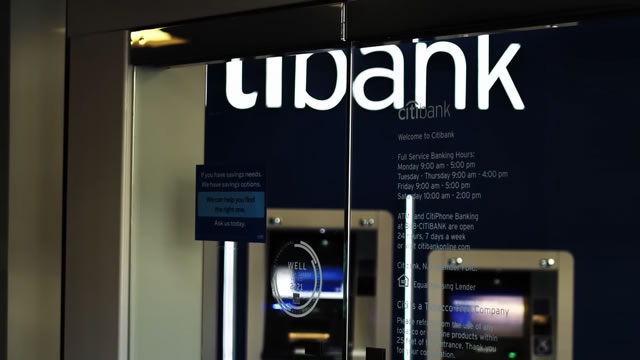
Citigroup was upgraded following strong Q2 operating results and a more attractive starting valuation. The bank increased its dividend by 12% and authorized a $30B share buyback, signaling substantial capital return capacity. Rising interest rates and a flat yield curve remain sector-wide risks that could pressure bank valuations despite Citi's solid fundamentals.
Analysis
The investable question is whether Citi can convert operational improvement into a durable lower cost of equity, not whether one quarter was strong. C’s discount to large-bank peers is principally a credibility discount around expenses, returns in Services/Markets versus capital intensity, and the residual drag from international consumer exits; sustained positive operating leverage over the next 2-3 quarters is needed for multiple expansion. Capital-return announcements should be discounted until reconciled with the Fed’s stress-capital buffer, CET1 target, and the pace of risk-weighted-asset reduction.
A flatter curve is more damaging to domestically funded, deposit-rich banks than to Citi’s diversified fee, transaction-services and markets franchise, making relative positioning more attractive than a broad bank-beta trade. The second-order risk is that persistent high front-end rates raise card delinquencies and credit costs with a lag of 6-12 months, while dollar strength and weaker cross-border activity can dilute the revenue benefit of higher rates. A material reserve build or failure to deliver expense saves would quickly reassert the historical valuation discount.
Consensus may be underweight the optionality from simplification: if management demonstrates that exited businesses release capital without impairing franchise revenue, C can rerate even in an uninspiring banking macro. Conversely, a large repurchase program at a depressed valuation is only accretive if it does not force retrenchment during a credit downturn. The near-term catalyst path is subsequent quarterly evidence on expenses, Services growth, net charge-offs and CET1—not the announced return of capital itself.
AllMind Terminal
AI-powered research, real-time alerts, and portfolio analytics for institutional investors.
Request TrialMarket Sentiment
Overall Sentiment
moderately positive
Sentiment Score
0.58
Ticker Sentiment
Key Decisions for Investors
- Initiate a 3-6 month long C / short BAC pair, sized beta-neutral: Citi has more idiosyncratic restructuring and capital-release upside, while BAC is more directly exposed to deposit pricing and curve-driven NII compression. Target a 10-15% relative move; exit if C’s expense guidance deteriorates or card-credit trends require a meaningful reserve build.
- Do not underwrite the stated repurchase capacity until the next capital-plan disclosure confirms the post-buyback CET1 trajectory and stress-capital-buffer headroom; treat any shortfall versus implied capital return as a negative catalyst.
- For directional exposure, buy C 6-9 month call spreads rather than stock if implied volatility is reasonable: this captures a rerating from credible operating leverage while capping downside from a macro credit shock. A practical invalidation signal is rising net charge-offs and reserve additions that outpace management’s guidance for two consecutive quarters.
- Avoid broad long KRE or XLF as a proxy for this thesis. If the curve bear-flattens further or unemployment rises, reduce bank gross exposure; the 6-12 month credit-cost risk can overwhelm near-term capital-return support.
More News
- Fed could be in pause mode and make next move a cut, says Citi's Chronert
- Citigroup raises one year Bitcoin forecast to $113,000
- Moore: Why I’m Still Betting On Stocks
- Markets Face Rising Yields, AI Risks
- Portfolio adviser to the super-rich wanted a bigger stock market correction. Here's why
- UBS downgrades Ormat Technologies stock rating on limited upside
From AllMind Research
- Anthropic IPO Preview: Valuation, Timing, and What to Watch
- Shein After the IPO: Venue, Valuation, and What Must Be Proved
- What AI Research Tools Should a Small Hedge Fund Buy First?
- How to Write an Investment Memo with AI: A Decision-Record Template
- Best AI to Write Earnings Notes for Sell-Side Analysts