
SDMC predstavuje na IBC 2026 služby AI Home pre domácnosti
Source: PR Newswire
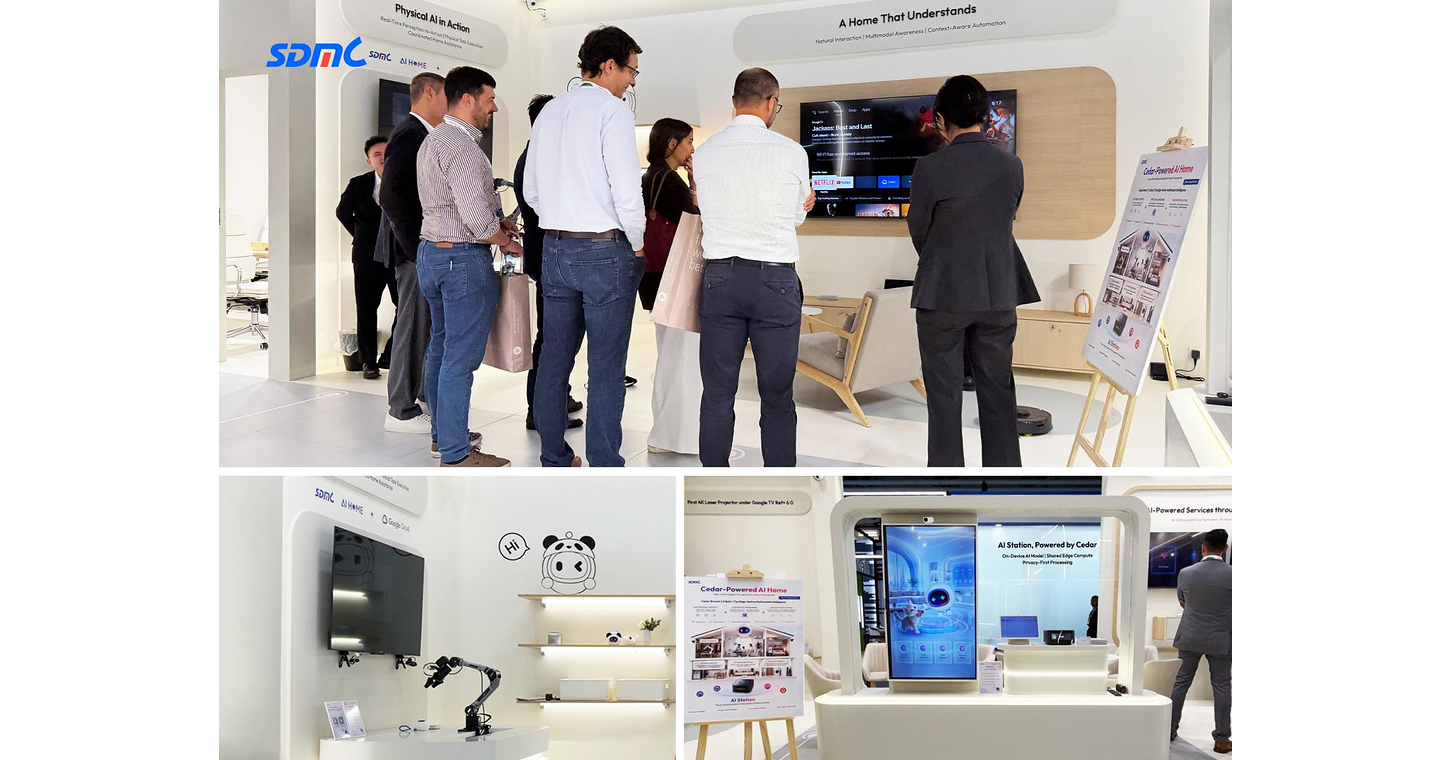
SDMC unveiled its AI Home architecture at IBC 2026, combining Google Cloud intelligence, Edge AI and physical-AI capabilities for household services. The company highlighted its selection for Google Cloud's Proactive Physical AI Acceleration Program and demonstrated Cedar, AI Station and AI-enabled home devices built with partners including NVIDIA, Amlogic and Google. The platform aims to reduce dedicated endpoint-hardware requirements while supporting lower-latency, more private AI services; commercialization remains at the customer-validation and pilot-project stage.
Analysis
This is not yet a revenue catalyst for GOOG or NVDA; it is a channel-validation datapoint for extending AI inference into operator-managed homes. Google’s economic upside depends on whether Gemini is selected for recurring cloud orchestration rather than merely used as an optional escalation layer, while NVDA’s upside depends on AI Station moving from showcase units to standardized operator CPE. Neither condition is independently evidenced, so the near-term equity impact should be negligible.
The more relevant competitive dynamic is architectural: shared in-home compute can reduce per-device silicon content while increasing the value captured by the gateway/platform owner. That is favorable to NVDA only if Jetson-class modules become the local inference standard; otherwise Qualcomm (QCOM), MediaTek (2454.TW), Amlogic and custom ASIC vendors can win the larger-volume endpoint attach. For Google, local Gemma-based models potentially lower cloud-token consumption and could constrain direct cloud monetization even as they strengthen Android/Google TV ecosystem lock-in.
Over 6-18 months, operator adoption is constrained less by model capability than by procurement cycles, privacy liability, installation/support costs and a still-unclear willingness of households to pay for proactive automation. A security or privacy failure would slow deployments disproportionately because operators bear customer-service and regulatory exposure. The thesis improves only with disclosed carrier pilots, unit volumes, attach-rate pricing, or evidence that AI network operations reduce truck rolls and support costs.
AllMind Terminal
AI-powered research, real-time alerts, and portfolio analytics for institutional investors.
Request TrialMarket Sentiment
Overall Sentiment
moderately positive
Sentiment Score
0.42
Ticker Sentiment
Key Decisions for Investors
- No directional trade in GOOG or NVDA on this announcement; treat it as a watch item rather than a fundamental estimate revision over the next 1-3 months.
- Maintain NVDA exposure only if broader edge-inference demand remains intact; do not underwrite material Jetson revenue until SDMC or an operator discloses commercial volumes. Falsifier: Nvidia commentary indicating embedded/edge design wins are not converting to production revenue.
- Monitor Alphabet disclosures and Google Cloud partner announcements for named telecom/operator pilots and recurring Gemini consumption. A multi-operator rollout would support a modest incremental GOOG cloud/services upside over 6-18 months; absent that, local-model deployment is ecosystem-positive but financially immaterial.
- For a liquid competitive hedge if edge AI enthusiasm accelerates without orders, prefer long NVDA versus short QCOM only after confirmed Jetson design wins; QCOM has more handset/endpoint exposure, while the claimed shared-compute architecture favors centralized edge modules. Exit if QCOM wins the gateway reference design or NVDA fails to disclose conversion.
More News
- Jensen Huang says Nvidia will sell twice as many chips next year
- Warsh says AI’s hyperscalers are part of why your borrowing costs are rising: ‘The competition for capital is real’
- Crusoe raises $3.9B to build massive data centers and small modular “AI factories”
- What an Oscar-winning movie can teach us about investing through the AI slowdown debate
- AI coding agents' 0-click RCE flaw could hand attackers keys to the kingdom
- Goldman’s top strategist just added hard numbers to his earnings-bubble warning