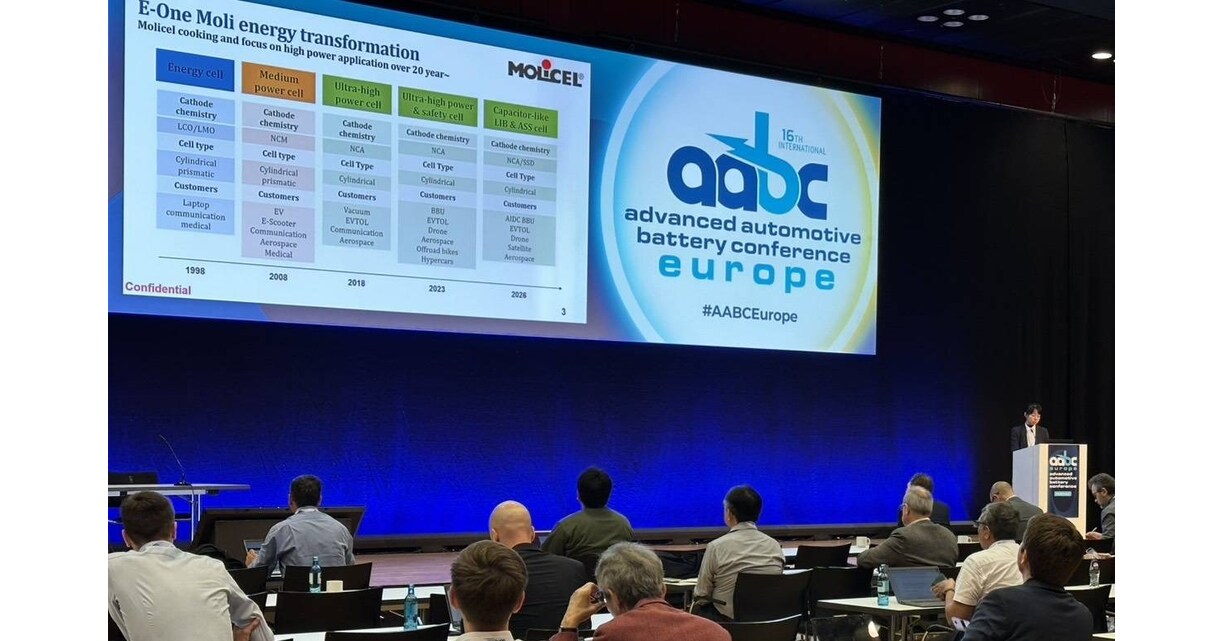
Molicel unveiled the INR-21700-P70X (PX series) next-gen hybrid cell, targeting 7000 mAh capacity and 340 Wh/kg energy density, with 30C continuous discharge and <200 microseconds power switching. The company claims UL9540A thermal runaway compliance and ~50% lower exothermal heat vs poly-crystal materials, plus 96% capacity retention after 1,000,000 cycles under rapid shallow fluctuation testing. The release is positioned against a reported hybrid rebound—hybrids near ~20% of US new sales by late 2025 and ~24% share in Europe—supporting a growing battery demand profile for hybrids.
The key market mechanism is not "more batteries" but a re-tilt in battery economics: hybrids reward power density, thermal robustness, and cycle life, while reducing the kWh-per-vehicle intensity that has driven the last leg of the battery value chain. That favors specialized, qualification-heavy cell vendors and automotive suppliers with proven safety records, while making it harder for commodity cell makers to monetize unit growth at the same revenue per car. In other words, the winner is the supplier that can charge for performance and reliability, not the one that simply ships the most capacity.
For automakers, the hybrid mix is a margin bridge: lower platform risk, faster time-to-market, and less dependence on charging infrastructure buildout. That is structurally helpful for legacy OEMs with strong hybrid franchises, while pure-BEV names face a slower share-gain path and potentially more multiple compression if investors start discounting a longer hybrid transition. The second-order effect is on raw materials: hybrids still consume lithium and graphite, but the intensity per vehicle is lower, so volume growth in vehicle sales can coexist with weaker-than-modeled battery material demand.
The contrarian issue is that this is likely a design-win story, not an immediate earnings story. Press-release technology claims only matter if they translate into OEM qualification, pricing power, and line-of-sight to volume; that usually takes 2-4 quarters at minimum. If BEV costs fall again or charging coverage improves faster than expected, the hybrid premium can fade quickly. Conversely, if hybrid penetration keeps rising, the market may be underestimating how durable the shift is for Toyota/Honda-style ecosystems versus pure EV manufacturers.
AI-powered research, real-time alerts, and portfolio analytics for institutional investors.
Request TrialOverall Sentiment
mildly positive
Sentiment Score
0.35
Ticker Sentiment
