
Prismatic Launches New Executions Experience to Help Teams Diagnose Integration Issues Faster
Source: PRWeb
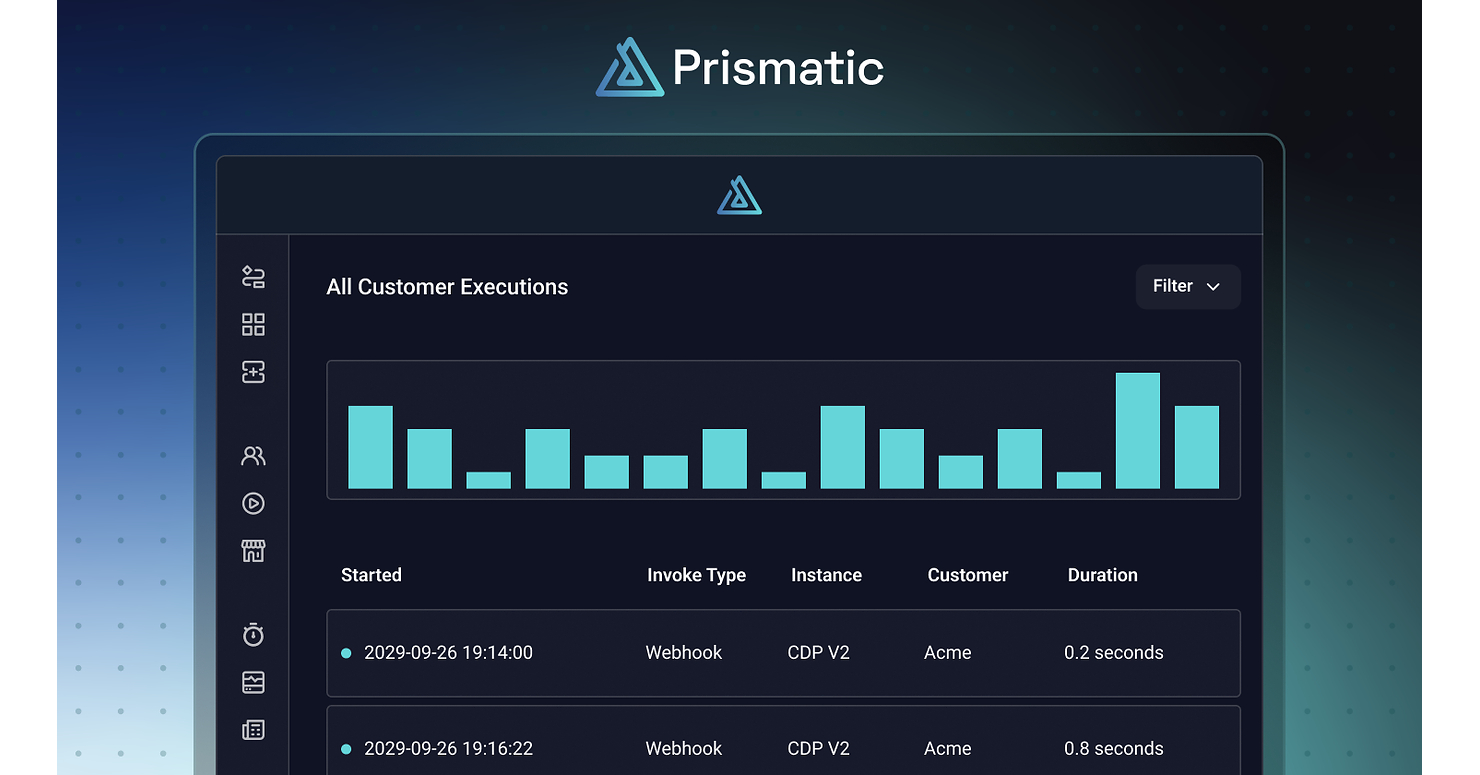
Prismatic launched execution sections for code-native integrations and rebuilt execution list and detail views, giving support and operations teams step-level status, timing and logs for failed integration runs. The release adds filtering by trigger payload, flow, status and date, bulk replay of affected executions, and plain-language errors; the features are available at no additional cost. Prismatic positions the new execution structure as a foundation for AI-assisted debugging, while extending visibility tools released earlier in 2026, including health charts and search across a 14-day log-retention window.
Analysis
This is a product-parity and retention enhancement, not yet a valuation-relevant event. The economic value is lower support labor per deployed integration and potentially faster code-native adoption among customers that previously preferred low-code for operational visibility; the benefit will show up first in net revenue retention and gross-margin efficiency over the next 2-4 quarters, not in a near-term revenue step-up. Offering the functionality without incremental pricing limits direct ARPU upside and suggests the primary intent is reducing churn and competitive displacement.
Second-order pressure falls on adjacent integration-platform vendors whose differentiation rests on citizen-developer usability rather than developer tooling plus observability. Public proxies include Salesforce (MULE), Workday (WDAY; Workato exposure is indirect through ecosystem competition), Boomi's private parent Dell (DELL), and ServiceNow (NOW) workflow tooling, but none has sufficient revenue exposure for a single-stock reaction. The more relevant structural signal is that embedded-iPaaS vendors are converging on AI-readable execution telemetry; this lowers the barrier for automated incident diagnosis and could ultimately compress premium pricing for standalone observability layers in integration-heavy SaaS stacks.
The contrarian view is that telemetry alone does not establish an AI monetization moat. Customers will require demonstrated reductions in mean time to resolution, failed-run rates, and support tickets before paying more or expanding deployments. Watch for adoption of the updated SDK, code-native workflow mix, retention disclosures, and evidence that replay functionality reduces customer-impacting outages; absent those metrics over 6-12 months, the release remains feature maintenance rather than a competitive inflection.
AllMind Terminal
AI-powered research, real-time alerts, and portfolio analytics for institutional investors.
Request TrialMarket Sentiment
Overall Sentiment
mildly positive
Sentiment Score
0.38
Key Decisions for Investors
- No standalone trade: Prismatic is private and the named public workflow/integration proxies lack disclosed revenue sensitivity sufficient to justify a position on this release.
- Set a 1-3 quarter watch on NOW and DELL: look for enterprise integration-platform pricing pressure or win-rate commentary tied to embedded, code-first alternatives. Treat a guidance cut or material workflow-software multiple compression as confirmation, not this announcement.
- For private-market diligence, require cohort evidence that code-native adoption raises NRR by at least 3-5 points or cuts support cost per integration before assigning any revenue or margin uplift to AI-assisted debugging.
More News
- Trump launches midterms campaign blitz amid record low approval ratings
- Nvidia Faces Questions Over China AI Chip Smuggling Cases
- Fed’s Cook sees AI buildup as top inflation risk for 2027
- The September jobs report will be released Friday. Here's what to expect
- U.S. stock futures drift higher with nonfarm payrolls in focus
- $8.2B acquisition validates AI-picked chip stock: +20% since June