
McDonald's: Investor Day Selloff Makes NEXT A Buy
Source: seekingalpha.com
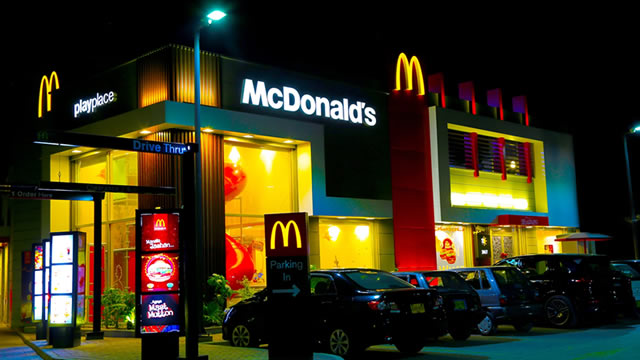
McDonald's is rated Buy following a post-Investor Day share pullback, which has made its valuation and 3.24% dividend yield more attractive. Its NEXT strategy targets low-to-mid-50% operating margins and mid-to-high-80% free-cash-flow conversion by 2030, supported by $8.5 billion for franchisees. Q2 2026 featured modest U.S. traffic but resilient global comparable sales and strong loyalty revenue; the company also raised its dividend 4%.
Analysis
The pullback creates a potential quality-defensive entry, but the key underwriting question is whether franchisee investment support preserves unit-level returns rather than merely subsidizing a mature store base. If digital, delivery and loyalty raise transaction frequency without proportional labor or discounting expense, MCD can compound royalty revenue faster than systemwide sales; that would support both margin durability and a premium multiple versus QSR and YUM. Conversely, support commitments that translate into higher corporate capex or franchisee affordability stress would dilute the asset-light narrative and cap multiple expansion.
Near term, the market will likely focus less on aggregate comparable sales than on U.S. guest-count recovery, loyalty-member purchase frequency, and franchisee cash-on-cash returns. A traffic-led improvement over the next 1-3 months would be materially higher quality than check growth driven by price, particularly if lower-income consumers remain pressured. The main downside catalyst is renewed value competition from QSR, YUM and WEN: sustained discounting could force MCD to trade margin for traffic and expose consensus estimates that implicitly assume stable restaurant-level economics.
The contrarian view is that a modestly higher dividend yield alone is not sufficient reason to own MCD if long-dated margin targets are already embedded in estimates. The more actionable positive setup is evidence that digital mix lowers marketing and service costs while franchisee reinvestment accelerates openings or remodel-led sales; absent those KPIs, this is a watchlist-quality defensive rather than an aggressive catalyst trade. Falsify a long thesis on two consecutive quarters of negative U.S. traffic, franchisee-margin commentary deteriorating, or a guidance reset on corporate investment intensity.
AllMind Terminal
AI-powered research, real-time alerts, and portfolio analytics for institutional investors.
Request TrialMarket Sentiment
Overall Sentiment
moderately positive
Sentiment Score
0.42
Ticker Sentiment
Key Decisions for Investors
- Accumulate MCD on further post-event weakness for a 6-18 month defensive compounder position, sized modestly until the next earnings release validates traffic and franchisee-return trends. Target a 10-15% total-return profile from earnings growth plus dividend; exit or reduce if U.S. traffic remains negative for two quarters.
- Implement a 3-6 month pair trade: long MCD / short QSR, provided the relative valuation spread is not already at an extreme. The thesis is that MCD's scale, digital ecosystem and franchisee economics should better absorb value-menu competition; risk is Burger King/Tim Hortons executing a stronger-than-expected traffic recovery or MCD funding promotions more heavily.
- Do not buy upside calls solely on the long-term margin framework. Reassess after the next quarterly print for independently measurable evidence: loyalty sales growth translating into higher transactions, stable restaurant margins, and no increase in corporate capex burden; if all three are confirmed, add equity exposure rather than paying elevated event volatility.
More News
- McDonald’s bets $8.5 billion on a productivity makeover across more than 46,000 restaurants
- Oracle Japan shares surge 7% after record fiscal first quarter, bucking selloff of U.S. parent
- Here’s the Tesla Semi… again
- Costco makes progress on a key membership metric. Here's our new price target on the stock
- Goldman’s Moe Says He’s in ‘Stronger-for-Longer Camp’ on AI
- Akamai secures $11.6B cloud deal with Anthropic for AI workloads