
New Zywave Research Finds AI Set to Unlock More Than $100 Billion in Annual Value Through Transformed Insurance Distribution
Source: PR Newswire
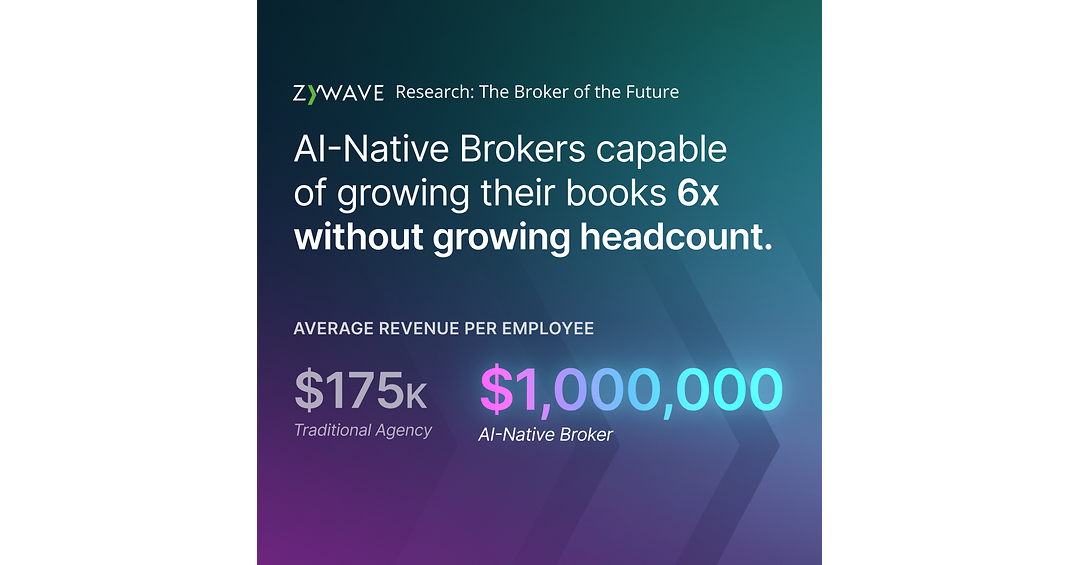
Zywave's study estimates AI could unlock more than $100 billion in annual value for U.S. insurance carriers and brokers over the next five to seven years, while the U.S. Bureau of Labor Statistics projects roughly 400,000 insurance professionals will have retired since 2021 by year-end. It says traditional agencies generate about $175,000 in revenue per employee versus nearly $1 million at AI-native brokerages, attributing the gap to productivity rather than staff reductions. The report argues AI will automate clerical work while human brokers retain judgment and review responsibilities, and warns firms that fail to modernize risk falling behind.
Analysis
The investable implication is not broker displacement but widening operating leverage: firms that automate routine servicing may handle more business without matching headcount growth, while experienced producers remain a scarce input for complex placement and client judgment. That favors scaled brokers with data, compliance, and implementation capacity and increases pressure on smaller agencies to modernize or sell. Potential public-market beneficiaries include Marsh McLennan (MMC), Aon (AON), Arthur J. Gallagher (AJG), and Brown & Brown (BRO), but the study does not establish that any has captured the claimed productivity gap.
Treat the sixfold revenue-per-employee comparison and $100B opportunity as vendor-sponsored claims, not underwriting evidence. Revenue per employee can reflect book mix, commission economics, geography, or acquisition history as well as technology; it does not by itself demonstrate incremental margins or returns on AI investment. Automation may also shift, rather than remove, cost: human review remains a binding control point, and errors, privacy incidents, or poor data could raise E&O and remediation costs. The long-run winners may be firms that improve risk selection and retention without compromising placement quality—not simply those that cut administrative labor.
Near term, this release is too weak to justify a directional trade. Over 1–3 months, look for earnings disclosures on organic growth, expense leverage, producer retention, and technology spending. Over 6–18 months, consolidation and talent scarcity could reinforce scale advantages. The thesis weakens if productivity claims fail to appear in margins or service metrics, or if AI-related errors and client attrition offset labor savings.
AllMind Terminal
AI-powered research, real-time alerts, and portfolio analytics for institutional investors.
Request TrialMarket Sentiment
Overall Sentiment
mildly positive
Sentiment Score
0.35
Key Decisions for Investors
- No trade on the release alone. Track MMC, AON, AJG, and BRO for verifiable expense leverage and organic growth; do not infer company-level adoption from an industry-wide study.
- Set an earnings-season alert for quantified changes in servicing costs, revenue per employee, producer retention, and organic growth. Favor evidence of sustainable margin improvement over management AI-use counts or broad addressable-market estimates.
- Monitor acquisition activity and producer retention at smaller agencies as a potential second-order beneficiary signal for scaled brokers; the thesis is falsified if acquired-book retention or organic growth deteriorates enough to erase productivity gains.
- Watch for AI-related E&O claims, regulatory guidance, or carrier requirements for human review. Rising remediation costs or slower placement would challenge the assumption that clerical automation translates into net operating leverage.
More News
- SK Hynix Posts Record Profit Amid AI Rush
- SK Hynix third-quarter profit sharply beats estimates on AI memory boost
- Anthropic's IPO could be 'speculative fiction' or a 'generational moment' — investors are split
- Iran’s calculations as US escalation looms: Trust, midterms, Hormuz
- Anthropic IPO Seeks Investors, With Risks of Catastrophe, Rogue AI
- Tech's relief rally extends as attention turns to tough decisions for the Fed