
Nearly 72% of Americans expect their next vehicle to function like a smartphone, Verra Mobility survey finds
Source: PR Newswire
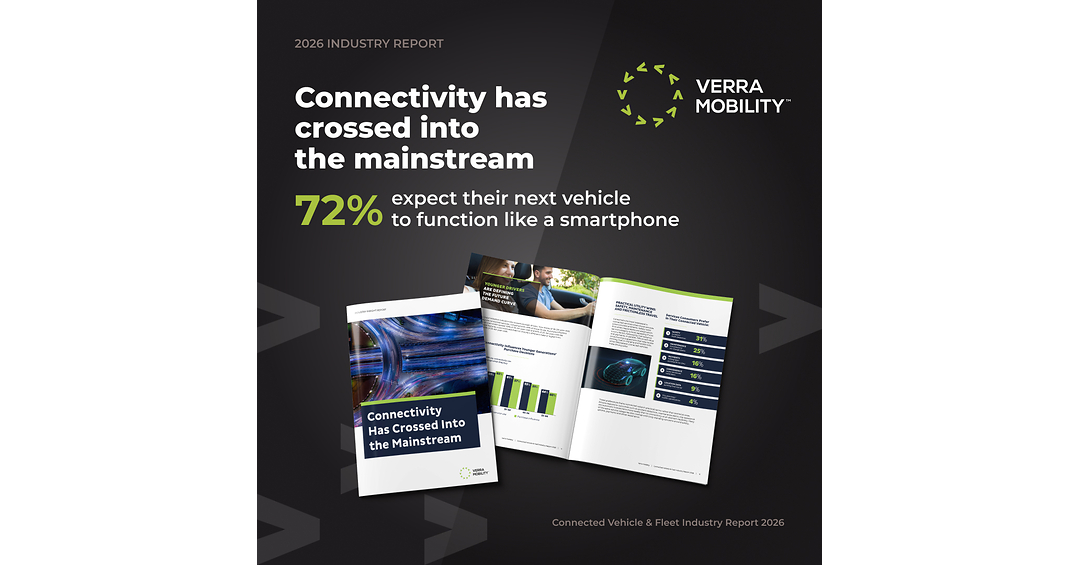
Verra Mobility’s survey of 2,000 U.S. drivers found connected-vehicle services are gaining mainstream adoption: 54% use at least one manufacturer-provided service, up from 49% in 2024, and 72% expect their next vehicle to function like a smartphone. Connected features would influence 51% of respondents’ vehicle purchases, while 66% would share driving or location data for benefits; data understanding remains limited, with only 14% saying they fully understand what their vehicle collects, down from 22% in 2024.
Analysis
The survey is better read as evidence that automakers face growing pressure to make connected features standard—not as proof that those features yet generate material incremental revenue for Verra Mobility. The key economic question is who controls the customer interface and captures transaction economics: OEMs can bundle tolling, parking and other services, but may also keep the payment relationship in-house or route users through Apple CarPlay and Android Auto. That creates a real opportunity for mobility-payment providers, alongside a risk that adoption accrues mainly to OEM software platforms rather than third-party vendors.
Near term, the release is a weak standalone earnings catalyst: it is company-commissioned consumer research, and stated appeal or willingness to share data does not establish paid usage, conversion, or unit economics. Over 1–3 months, look for corroboration in VRRM’s filings and calls—connected-payment transaction volumes, partner wins, monetization per active vehicle, and evidence of repeat use. Over 6–18 months, privacy regulation, cybersecurity incidents, or consumer backlash could raise compliance costs and slow data-dependent services even if feature adoption continues. The reported gap between adoption and understanding makes trust a potential constraint, not just a messaging issue.
Contrarian view: the adoption trend may be real, but investors could over-attribute its value to VRRM. The upside case requires the company to secure a durable role in OEM workflows and convert usage into monetized transactions; survey intent alone cannot establish either. No trade is warranted on this release alone.
AllMind Terminal
AI-powered research, real-time alerts, and portfolio analytics for institutional investors.
Request TrialMarket Sentiment
Overall Sentiment
mildly positive
Sentiment Score
0.20
Ticker Sentiment
Key Decisions for Investors
- Keep VRRM on watch rather than adding on the survey. Reassess after the next earnings update or filing for transaction growth, partner disclosures, and monetization evidence tied to embedded vehicle services.
- Treat OEM control of the interface as the key competitive variable. Track whether automakers integrate third-party tolling and parking providers or steer payments into proprietary services; the latter would weaken the revenue-capture thesis for outside providers.
- Use privacy and cybersecurity developments as downside alerts over the next 6–18 months. A material regulatory restriction, breach, or OEM pullback from location-data use would challenge the assumption that consumer interest converts into scalable services.
- Falsify the cautious view only if VRRM demonstrates sustained growth in connected transactions or recurring service revenue without deterioration in relevant guidance; absent that, consider the survey sentiment rather than an earnings revision.
More News
- US fines Bank of America $1.2bn for money laundering, sanctions violations
- South Korean carmaker Hyundai plans 'strategic' investment of $15.5 billion in India by 2032
- Applied Materials’ $5 billion AI lab aims to cut chip development time in half—and restore Silicon Valley’s edge
- Namibia battles cattle disease outbreak as EU suspends several meat imports
- Meta’s Muse models reach the AI frontier—and kill any hopes to ‘pace’ it
- Mainspring, AEP Strike Deal to Bring Power Online Faster
From AllMind Research
- Anthropic IPO Preview: Valuation, Timing, and What to Watch
- Shein After the IPO: Venue, Valuation, and What Must Be Proved
- What AI Research Tools Should a Small Hedge Fund Buy First?
- 2026 Global Markets Outlook: Asset Allocation After the Great Disconnect
- Fintool Alternatives After the Microsoft Acquisition