
Can Better Store Traffic Support American Eagle's Sales Recovery?
Source: zacks.com
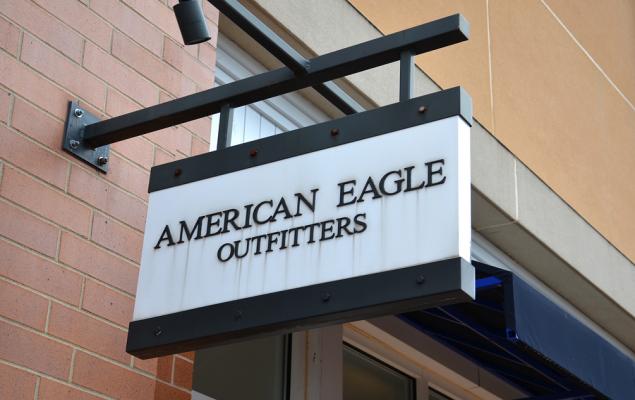
American Eagle Outfitters' fiscal Q2 2026 revenue rose 1% year over year, while comparable sales fell 1%, an improvement from Q1. The men's business delivered its fourth consecutive quarter of positive comparable sales, and improved denim demand and better Q3 store trends suggest an early recovery, though physical stores remain a relative weakness. Management is shifting marketing toward conversion and rebalancing older inventory; AEO trades at 8.85x forward earnings versus the industry's 12.24x, while consensus expects fiscal-year EPS growth of 49.3%.
Analysis
AEO's setup is less a demand-recovery trade than an execution-and-gross-margin trade. Conversion-led marketing can improve sales productivity, but the near-term cost is higher promotional and digital-acquisition intensity while aged seasonal product is cleared; a modest comp improvement may therefore fail to translate into EBIT upside. The key next 1-3 month read-through is whether peak-season traffic converts without renewed markdown pressure, not whether traffic alone rises.
The low earnings multiple is not automatically cheap: the market is discounting a sharp post-recovery earnings normalization, suggesting that a rerating requires evidence of sustainable full-price sell-through and inventory turns rather than a single quarter of improved denim demand. Mall concentration makes AEO more exposed than digitally native apparel peers to a soft discretionary-spending print, but also gives it operating leverage if holiday traffic is stronger than expected. A cleaner AEO recovery would be incrementally negative for similarly positioned teen-apparel competitors such as ANF and URBN, where denim/category share gains are more likely a zero-sum outcome.
Contrarian view: the positive surprise path may be underappreciated if product mix shifts toward better-accepted denim and men's categories while clearance is substantially completed before holiday. That would reduce the markdown drag embedded in forward estimates and could support multiple expansion toward specialty-retail peers over 6-12 months. Conversely, a sales lift purchased through promotions would validate the market's lower terminal-earnings assumption and leave limited downside protection despite the headline valuation discount.
BOOT remains the preferable retail expression: its category demand and earnings-growth profile are less dependent on mall traffic and fashion-fit execution, while AEO's evidence is still management commentary rather than a demonstrated margin inflection. FIGS is not a direct apparel-demand analogue; its stronger estimate trajectory reflects a distinct healthcare-uniform replacement cycle, so using it as confirmation of broad consumer strength would be misleading.
AllMind Terminal
AI-powered research, real-time alerts, and portfolio analytics for institutional investors.
Request TrialMarket Sentiment
Overall Sentiment
mildly positive
Sentiment Score
0.12
Ticker Sentiment
Key Decisions for Investors
- Maintain AEO as a watch-list long rather than initiate before the next sales/earnings update. Enter only if comparable sales turn positive and gross margin is stable-to-up year over year despite inventory clearance; target a 15-25% rerating over 6-12 months if those conditions support a move toward peer valuation, with thesis invalidated by renewed negative comps or markdown-driven margin erosion.
- For the next 1-3 months, express relative quality through long BOOT / short AEO in dollar-neutral size. BOOT offers cleaner earnings momentum; the pair should benefit if mall traffic or promotional intensity disappoints. Cover the short leg if AEO reports positive comparable sales with meaningful gross-margin expansion, indicating the recovery has moved beyond traffic rhetoric.
- Monitor weekly channel checks for AEO denim sell-through, promotional cadence, and store conversion through holiday. A reduction in discounts alongside improving traffic is the actionable confirmation signal; traffic gains accompanied by persistent clearance activity are a no-trade signal.
- Avoid FOSL as a retail-recovery proxy despite potentially optically strong earnings comparisons: declining revenue and a history of large estimate misses create balance-sheet and forecast-risk asymmetry. FIGS can be held independently only if its next results confirm revenue growth and operating leverage; it is not a hedge for AEO-specific execution risk.
More News
- Europe’s winter energy crunch may already be underway. Two U.S. stocks that may benefit
- U.S. stock futures drift higher with nonfarm payrolls in focus
- $8.2B acquisition validates AI-picked chip stock: +20% since June
- Nike Warns Sales Slump Will Worsen This Fiscal Year
- Nuveen CEO on Schroders Deal, Plans for Combined Company
- Broadcom to lend Anthropic up to $42 billion to lease its chips, filing says