
Chicago Skyscraper Battles Office Distress Icon Status
Source: Bloomberg
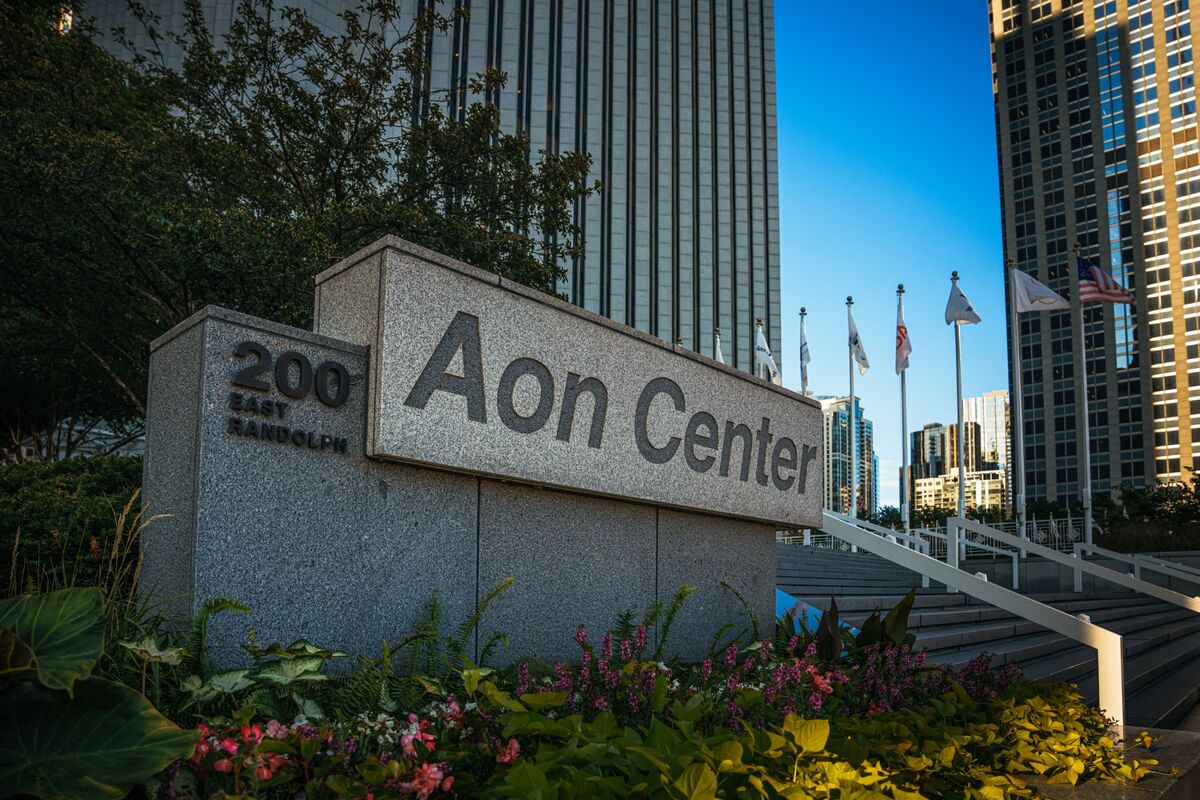
Chicago’s 83-story Aon Center is presented as a focal point for persistent US commercial real estate distress, underscoring that the sector’s rebound is bypassing some of the country’s largest business hubs. The article signals continued weakness in office property markets and related private-market investment risks, although no financial figures or transaction details are provided in the excerpt.
Analysis
Chicago office distress is less a direct equity event than a refinancing and valuation-discovery problem. Assets with near-term debt maturities face a nonlinear outcome: a modest decline in NOI or a higher exit cap rate can eliminate sponsor equity, forcing discounted sales that reset comparable values across lenders' portfolios. The most exposed public-market read-through is regional-bank CRE reserve formation rather than AON, whose financial sensitivity is primarily to workspace cost and employee-location flexibility, not property values.
The 1-3 month catalyst path is bank earnings, CMBS special-servicing transfers, and any large distressed transaction that establishes a lower clearing price for Class A space. A broad rebound requires lending spreads to narrow and net absorption to improve; lower policy rates alone are insufficient if lenders continue requiring materially more equity. Over 6-18 months, the likely winners are well-capitalized alternative lenders and asset managers able to originate senior loans at wide spreads, while legacy owners with 2026-27 maturities remain structurally disadvantaged.
The contrarian point is that headline office weakness can overstate risk for diversified real-estate platforms: public REITs have already marked portfolios more frequently than private owners and often have longer debt duration. Conversely, the underappreciated risk is geographic concentration at regional banks, where a small number of impaired downtown loans can drive reserve increases disproportionate to reported office-loan percentages. BLK's upside is contingent on fee-bearing private-credit deployment and fundraising; it is not a clean directional Chicago-office long.
AllMind Terminal
AI-powered research, real-time alerts, and portfolio analytics for institutional investors.
Request TrialMarket Sentiment
Overall Sentiment
mildly negative
Sentiment Score
-0.35
Ticker Sentiment
Key Decisions for Investors
- Maintain a 3-6 month relative-value position: long BX or ARES versus short KRE. Alternative managers can deploy capital into senior CRE credit at attractive yields, while KRE retains downside from reserve additions and refinancing losses. Reassess if CMBS delinquency/special-servicing trends stabilize for two consecutive monthly reports.
- Avoid treating AON as a proxy short for Chicago office. Use it only as a watch item: a material reduction in its property footprint could pressure local occupancy comparables, but AON's earnings are much more sensitive to organic brokerage growth and commercial-insurance pricing.
- For a direct hedged CRE expression, consider long CMBX BBB- protection only after confirming rising transfers in the relevant vintage; do not initiate solely on a single-asset narrative. The trade has asymmetric payoff if valuation resets broaden, but carry and vintage-specific collateral selection are critical.
- Watch quarterly disclosures from CMA, FITB, HBAN and other Midwest lenders for criticized-office-loan migration, reserve builds, and maturity extensions. A guidance increase in CRE charge-offs or criticized-loan balances is the trigger to add regional-bank downside; absent that evidence, broad bank shorts are premature.
- Do not chase BLK on this signal alone. Upgrade only if private-markets net inflows and private-credit fee growth accelerate together; weaker fundraising or fee-rate compression would falsify the thesis despite potential distressed-credit opportunity.
More News
- Stocks, Bonds Slip as Oil Jump Fuels Fed-Hike Bets
- Trump-Xi meeting: Why China's self-sufficiency changes the calculus
- AI drone maker hits $6.4 billion valuation as Ukraine war spurs defense tech
- How brokerage Compass sold its 83,000 real estate agents to use more AI
- Texas turning blue may hinge on Democrats harnessing data center opposition
- The old cybersecurity model is breaking
From AllMind Research
- Anthropic IPO Preview: Valuation, Timing, and What to Watch
- Shein After the IPO: Venue, Valuation, and What Must Be Proved
- What AI Research Tools Should a Small Hedge Fund Buy First?
- 2026 Global Markets Outlook: Asset Allocation After the Great Disconnect
- Fintool Alternatives After the Microsoft Acquisition