
Should You Buy Citigroup Stock as It Jumps 29.3% in 6 Months?
Source: zacks.com
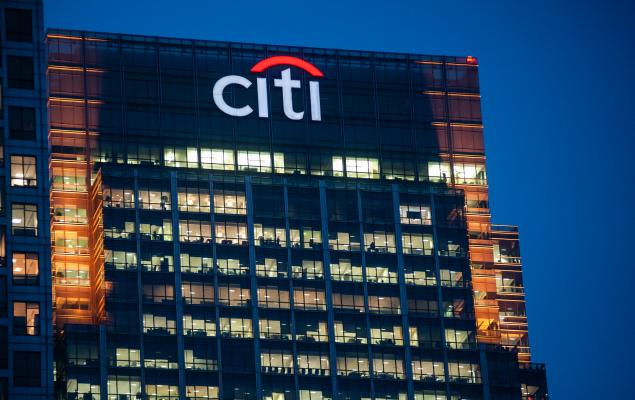
Citigroup shares have risen 29.3% in six months, supported by four consecutive earnings beats and upward 2026-27 estimate revisions; earnings are projected to increase 40.5% in 2026 and 15.6% in 2027. Management expects 5-6% 2026 ex-Markets NII growth, $2.0-$2.5 billion of annualized cost savings and a 10-11% ROTCE by 2026, while the planned Banamex deconsolidation/IPO in early 2027 could release $5 billion of capital. Capital returns remain supportive, including an 11.7% dividend increase to $0.67 per share and a $30 billion buyback authorization, while C trades at 11.17x forward earnings versus the industry's 13.99x.
Analysis
The relevant debate is not whether Citigroup can reduce costs, but whether it can convert released capital into a durable return-on-equity re-rating before reinvestment absorbs the savings. A 60% efficiency ratio and 11-13% ROTCE would still leave C below the best-in-class operating model; the valuation discount should therefore persist unless quarterly revenue growth in Services, Markets and Wealth offsets the loss of legacy earnings. The early-2027 Banamex separation is a discrete catalyst, but its capital benefit is likely anticipated; the market will focus on the valuation achieved and residual stranded costs rather than headline capital release.
Near-term earnings sensitivity is asymmetric to rates and credit. Further front-end rate declines would challenge NII expectations, while expanded card acquisition and marketing spending can elevate provision expense before revenues mature. BAC has greater upside to a benign yield curve and domestic deposit repricing; WFC has a cleaner expense-removal path if its regulatory constraints continue to ease. C's relative advantage is its global transaction-services franchise, which should benefit from cross-border volumes and corporate liquidity activity, but that same exposure makes it more vulnerable to a global trade slowdown or emerging-market stress.
Consensus may be over-crediting the buyback as an incremental catalyst: repurchases only create material per-share accretion if the stock remains meaningfully below tangible book and capital requirements do not rise. The more differentiated upside case is a credible path to a sustainably higher ROTCE, which requires evidence over the next two earnings reports that technology investment is reducing operational intensity rather than merely shifting costs from headcount to vendors and depreciation. A miss on expenses, card losses, or Services revenue would quickly reframe C as a low-multiple, low-return bank rather than a turnaround.
AllMind Terminal
AI-powered research, real-time alerts, and portfolio analytics for institutional investors.
Request TrialMarket Sentiment
Overall Sentiment
moderately positive
Sentiment Score
0.66
Ticker Sentiment
Key Decisions for Investors
- Initiate a 6-12 month long C / short WFC pair at equal dollar exposure. C has the larger execution-driven re-rating opportunity into the Banamex catalyst, while WFC already embeds more of the efficiency and regulatory-normalization narrative; target 10-15% relative return. Exit if C fails to demonstrate sequential operating leverage or guides ROTCE below 10%.
- Add C only on post-earnings weakness if results preserve full-year revenue and expense objectives; avoid chasing momentum ahead of the print. A sustained ROTCE trajectory toward 11-13% could support a 12-13x forward P/E versus the current discount, while a cost or credit miss can compress the multiple toward sub-10x.
- Use BAC as the preferred long for a steeper-curve/macroeconomic-acceleration view rather than treating C as a pure rate trade. Pair long BAC versus C if 2s10s steepens materially and domestic loan growth accelerates; reverse the relative stance if global transaction volumes improve faster than U.S. consumer credit.
- Monitor quarterly Services fee growth, card net charge-offs, efficiency ratio, and capital return pace. Treat any upward revision to investment spending without commensurate revenue acceleration as thesis-negative; a widening in card losses or a regulatory capital increase would warrant reducing C exposure.
More News
- Tencent, Visa deepen payments push in China after regulatory green light
- Wells Fargo cuts Hubbell stock price target on margin pressures
- Wells Fargo raises Nucor stock price target on market share gains
- StoneX reiterates Buy on Instacart stock, cites acquisition potential
- Wells Fargo raises Herc Holdings price target on tight supply
- TPG faces earnings test as analyst estimates cool ahead of report