
Sophont Launches Holon-S1 to Reveal Tumor Biology from Routine Pathology Slides
Source: PR Newswire
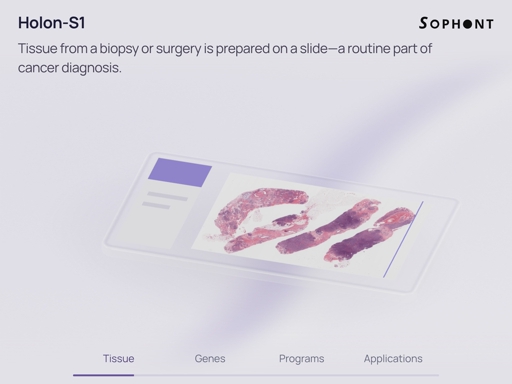
Sophont launched Holon-S1, a pan-cancer AI model that predicts spatial gene and pathway activity from routine pathology slides; it is currently available for research use only. In retrospective case studies, it recovered findings from an osteosarcoma case and identified a spatial EREG biomarker associated with chemotherapy response in triple-negative breast cancer, while outperforming two recent models in controlled comparisons. Prospective studies are still needed to evaluate potential diagnostic use.
Analysis
Investment read-through: this is a research-stage capability signal, not yet evidence of a clinical product or a near-term threat to diagnostic revenue. If H&E-derived biology generalizes, the first economic value is likely faster, cheaper cohort screening for biopharma: archived slides could expand retrospective biomarker work and help prioritize patients for trials. That may increase demand for confirmatory molecular testing rather than eliminate it; the displacement risk is greatest for lower-complexity assays, while comprehensive profiling remains the validation benchmark.
The key bottleneck is not model inference but transportability and clinical utility. Company-reported retrospective results and internal model comparisons do not establish reproducibility across institutions, treatment regimens, or real-world slide workflows. Any eventual workflow also depends on digitized-slide availability, pathology-system integration, and prospective evidence that predictions change decisions or outcomes. Thus, near-term impact on listed diagnostics and AI names is negligible; a credible 6–18 month validation path could matter more to biomarker-discovery economics than to routine testing volumes.
Contrarian angle: interpretability may help researchers generate hypotheses, but an interpretable prediction is not necessarily a clinically actionable biomarker. The market could overvalue the “molecular testing from images” framing and underweight the risk that signatures are cohort-specific or require costly confirmatory assays. No direct public-equity exposure is identified in the supplied company mapping.
AllMind Terminal
AI-powered research, real-time alerts, and portfolio analytics for institutional investors.
Request TrialMarket Sentiment
Overall Sentiment
mildly positive
Sentiment Score
0.30
Key Decisions for Investors
- No trade on the announcement alone. Sophont is private, research-use-only, and the release does not establish commercial adoption or clinical validity.
- Treat computational pathology as a watch item for diagnostics and life-sciences research workflows, not as a short thesis against molecular-testing providers: image-based screening could expand the pool of samples sent for confirmatory testing.
- Reassess over the next 1–3 months only if independent groups publish head-to-head results on external cohorts, scanner/site shifts, and clinically relevant endpoints; company-run benchmarks are insufficient.
- For a 6–18 month thesis, look for prospective evidence that the model changes treatment selection or trial-enrollment efficiency, plus named pharma collaborations or repeatable paid use. Failure to reproduce the biomarker signal outside discovery cohorts would falsify the adoption case.
More News
- Elon Musk says SpaceX and Tesla exploring largest merger in history
- Asia stocks rebound as SpaceX, Super Micro results lift chipmakers
- Neoclouds Lose Silver Lining as Elice, CoreWeave Dive: Evening Briefing Americas
- Anthropic May Spend $750 Billion on Computing Costs, WSJ Reports
- This Janus Henderson fund manager owns CoreWeave debt — here's why he's sticking with it
- ‘I don’t care how it’s done’: Trump pressures Ukraine to cut peace deal