
Solid Demand in Commercial Aerospace Drives Howmet: Can It Sustain?
Source: zacks.com
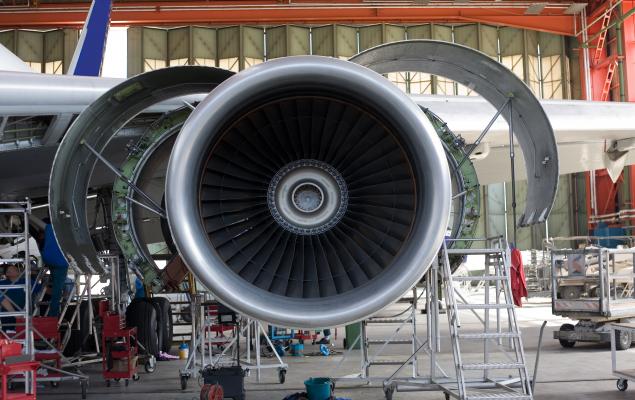
Howmet's commercial-aerospace revenue rose 28% year over year in Q2 2026, representing 53% of company business, while Engine Products revenue climbed 32% to $1.37B and Fastening Systems increased 37% to $589M. Demand for commercial and defense engine spares, gas turbines, Boeing 737 MAX production recovery and Airbus build rates support continued momentum. Howmet also acquired Stanley Black & Decker's CAM aerospace-fastening business for $1.8B, expanding its product and engineering capabilities; shares are up 22.7% over the past year despite a 9.9% industry decline, though its 38.44x forward P/E exceeds the 29.82x industry average.
Analysis
HWM’s premium multiple leaves the equity increasingly dependent on continued margin conversion rather than revenue growth alone. The key underwriting issue is whether aerospace supply-chain tightness lets HWM retain pricing and mix benefits as OEM production rates rise; if so, fasteners and rotating-engine components can deliver operating leverage disproportionate to airframe build-rate growth. CAM should improve content-per-aircraft and cross-selling, but the market will require evidence of accretion and leverage reduction rather than crediting the purchase price upfront.
The more differentiated exposure is the aftermarket: fleet age, deferred maintenance and constrained new-aircraft deliveries support spare-part demand even if Boeing’s production cadence remains uneven. RBC is a credible alternative beneficiary because bearings are a lower-visibility bottleneck category with both OEM and replacement demand, while BA is the critical near-term read-through: production stabilization helps suppliers, but any renewed delivery disruption can postpone revenue recognition and create working-capital drag across the chain.
Consensus appears to treat aerospace as a uniform volume recovery. The risk is that OEM rate increases shift the mix toward lower-margin original equipment while high-margin spares normalize, producing earnings misses despite healthy top-line growth; this is most damaging to HWM given its valuation. Over the next 1-3 months, watch HWM’s incremental segment margins, CAM integration costs, BA monthly deliveries and supplier inventory commentary; over 6-18 months, engine shop-visit intensity and aircraft utilization matter more than headline build rates.
AllMind Terminal
AI-powered research, real-time alerts, and portfolio analytics for institutional investors.
Request TrialMarket Sentiment
Overall Sentiment
moderately positive
Sentiment Score
0.62
Ticker Sentiment
Key Decisions for Investors
- Do not chase HWM on a positive-demand narrative; maintain only a tactical long on a 8-12% pullback or after results demonstrate CAM-related margin/earnings accretion. Target 15-20% upside over 6-12 months if execution holds; exit or hedge if incremental margins fall materially for two consecutive quarters or net-debt reduction misses management’s post-deal path.
- Initiate a 3-6 month relative-value position: long RBC / short HWM in equal dollar amounts for investors seeking aerospace exposure with reduced cycle beta. The thesis is that HWM’s valuation embeds more flawless execution; risk is a faster-than-expected CAM synergy realization or sustained HWM pricing power, which would warrant closing if HWM outperforms RBC by 15% without a corresponding deterioration in HWM margins.
- Use BA monthly production and delivery data as a catalyst filter rather than a standalone supplier trade: add HWM/RBC exposure only after two consecutive months of stable or improving 737 delivery cadence. A renewed regulatory or quality disruption at BA would likely compress aerospace-supplier multiples within days, even if aftermarket fundamentals remain intact.
- Avoid using TXT as the primary commercial-aerospace proxy in this cycle; its aviation exposure has different end-market sensitivity and weaker operating leverage to large-commercial-aircraft production. Prefer HWM or RBC for aftermarket/supplier exposure, and AIR only as a liquid hedge against a broad Airbus-led build-rate slowdown.
More News
- USTR Greer tells EU that loan to Airbus threatens trade truce on aircraft financing
- J&J's potential 'game-changer' drug — plus, what Microsoft's mass buyouts mean
- Boeing forecast to post small quarterly loss despite recent wins, analysts say
- Boeing Losses Expected To Narrow. Defense Awards, 737 Certification, Deliveries In Focus.
- Jim Cramer's top 10 things to watch in the stock market Monday
- Stock futures are little changed after Wall Street starts the week on a winning note: Live updates